
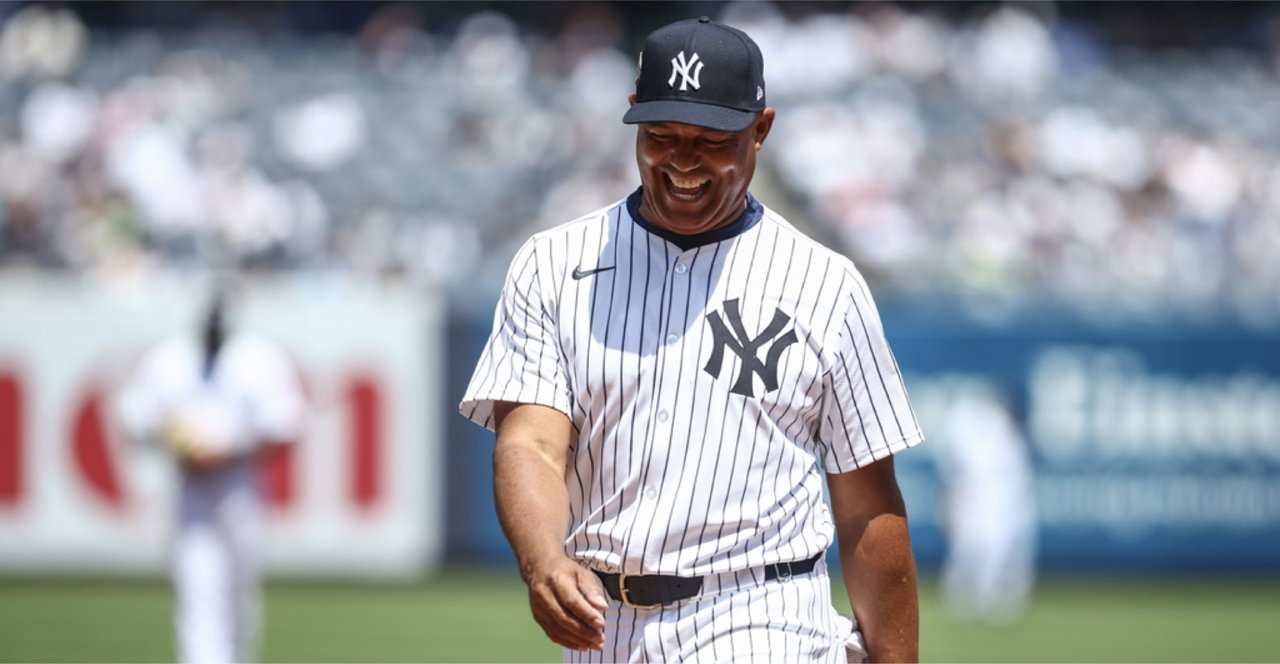
After the Yankees were swept by the Tampa Bay Rays in the 2026 ALDS, former players questioned the team’s clubhouse standards. CC Sabathia said nobody was keeping those standards anymore, pointing toward the absence of former leaders. Mariano Rivera was one of the players who helped establish that culture during his 19 years in pinstripes. And he just shared why playing for the Yankees meant more than just playing on the field.
Watch What’s Trending Now!
“When you’re playing with the New York Yankees, there’s nothing better than that,” said Rivera on the pregame show.
During his appearance on the pregame show with FOX alongside David Ortiz, Derek Jeter, and Alex Rodriguez, Rivera talked about why he never treated playing for the Yankees as just another job, calling it a privilege.
At his 2019 Hall of Fame induction, Rivera said, “I tried to carry the pinstripes the best that I could.” He followed that with, “I think I did all right with that.” His words reflected the pride he carried throughout his career.
Rivera’s value to the Yankees went beyond his numbers, although those numbers were remarkable. He finished his career with 652 saves, a 2.21 ERA, and 5 World Series rings. In 96 postseason appearances, Rivera recorded 42 saves with a 0.70 ERA. Those performances gave teammates confidence whenever he entered a game with a lead.
Bernie Williams explained that Rivera set the example through his demeanor on and off the field. Williams said Rivera was always willing to help teammates and teach younger players how to be Yankees. That leadership helped establish a culture where preparation and responsibility mattered every day.
Rivera also believed accountability applied to everyone, including the Yankees’ biggest stars. Alex Rodriguez recalled Rivera asking what he expected to accomplish at the plate that day. Rodriguez sometimes predicted 2 home runs or 5 RBIs, only to hear Rivera question him after failing to do the same in the game. If Rodriguez failed to deliver, Rivera would call him “pathetic.”
A-Rod later explained, “What people don’t know is what an incredible leader you were in that clubhouse, and the impact you made on someone like me.”
Rivera’s approach showed that being a superstar did not excuse anyone from performing.
That attitude also helped Rivera support Derek Jeter, the Yankees’ captain and the face of the franchise. Rivera praised Jeter as “the perfect captain,” explaining that teammates helped him carry the responsibility. He said Jeter handled the media, while the rest of the clubhouse worked together. Rivera added, “We were all doing the job,” describing leadership as a collective effort. Jeter set the tone through preparation and consistency, while Rivera reinforced those standards through his own actions.
Rivera’s final Yankee Stadium appearance in September 2013 showed how deeply those relationships mattered. After his last home appearance, Jeter and Pettitte walked to the mound to remove him from the game. Rivera had spent years helping teammates win, and now they stood beside him during his farewell.
He later called it “the perfect moment” and said, “It was something I would have never expected.”
The emotional scene became one of the most memorable moments in Yankees history. It showed that Rivera’s legacy involved more than saves, championships, and records.
The Yankees eventually retired Rivera’s No. 42 in Monument Park, recognizing his place in the franchise’s history.
During the ceremony, he said, “The New York Yankees have been my family. They have been special to me.”
His Hall of Fame speech carried the same message, thanking teammates, fans, and the organization. Rivera said he had played “with dignity, honor and pride,” reflecting how seriously he took representing the pinstripes. His loyalty was not simply about staying with one team for 19 seasons. It was about respecting the people and standards that made the Yankees special.
Now, the Yankees face questions about whether those standards still exist in their clubhouse. Rivera’s example cannot explain every problem, but it shows how leadership once worked alongside talent. Players prepared, challenged each other, and shared responsibility instead of relying on one person. CC Sabathia also recalled learning from Rivera, Jeter, Posada, and Pettitte when he joined the team.
The Yankees still have talented players, but the challenge is rebuilding that shared accountability. Rivera helped create a culture where wearing pinstripes meant something beyond individual performance.