
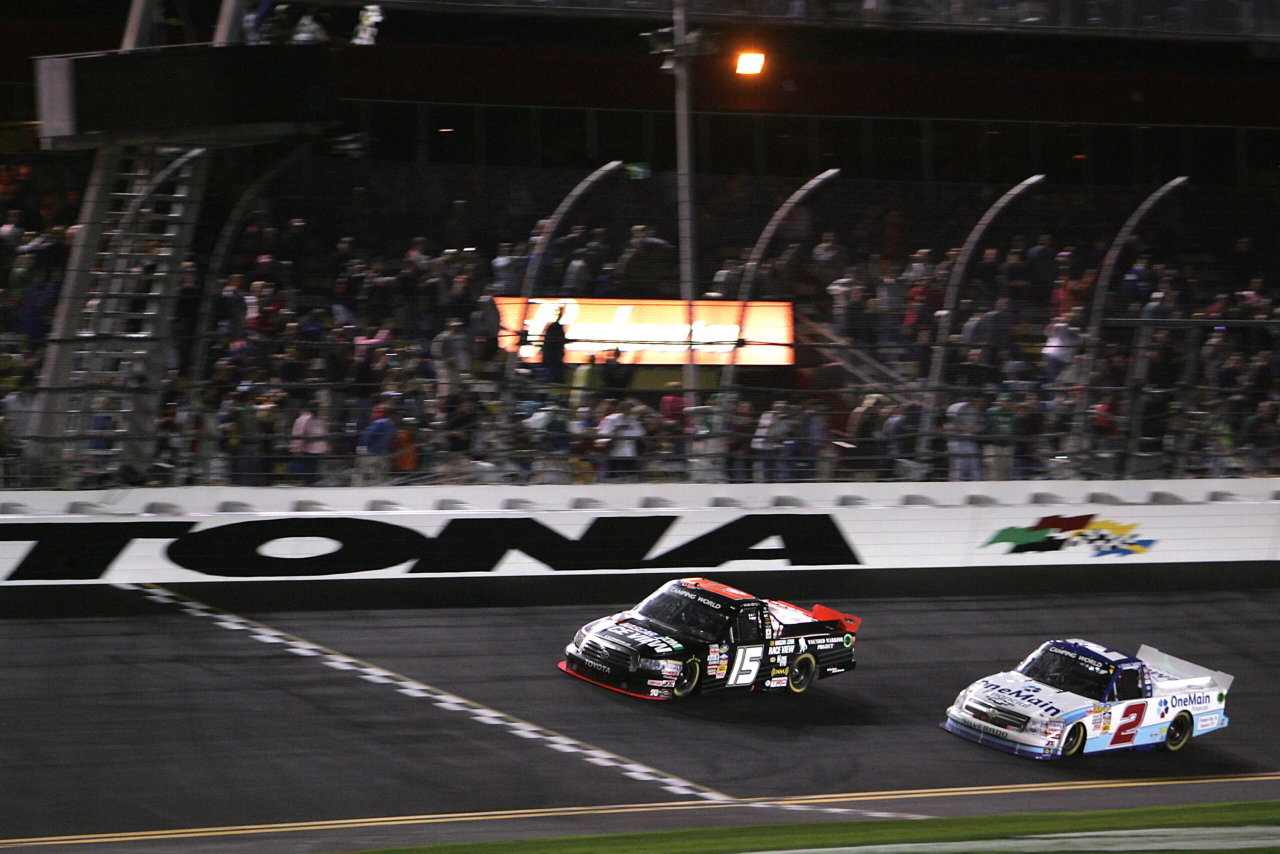
On August 29, at Daytona International Speedway, Ryan Preece won the Coke Zero Sugar 400 in his 249th Cup start. It gave RFK Racing its first Cup win of 2026 and gave NASCAR’s new superspeedway package its first real test. The changes were visible in the numbers. A smaller spoiler, less power, 41 lead changes among 22 different leaders. Ask the drivers what they thought, though, and the picture falls apart almost immediately.
Watch What’s Trending Now!
Chase Briscoe called it “way better.” Denny Hamlin said if you wanted to get to the front, you could. Chase Elliott was trading passes with Zane Smith, and Daniel Suarez felt like runs were easier to build.
Then, Brad Keselowski said he couldn’t tell the package had changed. Christopher Bell said the cars drove “the exact same,” and Carson Hocevar described the overall result as “super similar.”
So that’s objectively the same race, same package, and yet, completely different experiences depending on who was driving. That split is the premise of what we’ll be covering further, because it tells you more about what NASCAR is actually dealing with than any of the race statistics do.
Ryan Blaney had already laid out the core problem four months earlier, after the Talladega Superspeedway spring race. “We’re either fuel saving, or we’re running all over each other because that’s just what this car is, and that’s how you move forward.”
That was April, before NASCAR changed the spoiler, before the horsepower cut, and before the August experiment. A driver had already described exactly what the package change was going to be up against, and he described it without mentioning the car’s specifications at all.
What the package actually changed
The specifics matter here. The rear spoiler went from seven inches to four, engine output dropped from 510 horsepower to 465 through a smaller tapered spacer, and NASCAR also reworked the spoiler-deflection device, added new spoiler braces, and carried over wider splitter stuffers from the intermediate track setup. A solo car would be roughly two to three miles per hour faster, while pack speeds would stay broadly similar.
With a seven-inch spoiler, a driver who pulled out of line could lose almost all of his momentum in the dirty air behind the car ahead. The smaller spoiler was meant to give him enough separation to build a run instead of hitting an aerodynamic wall the second he moved out of the draft. So this was never really about making the cars faster. NASCAR was trying to change what drivers could do once they got into traffic, and, more importantly, what they would choose to do. That distinction got lost in a lot of the debate around the change.
John Probst, NASCAR’s executive vice president of racing development, said they had more aggressive options on the table in August, but decided against using them. It wasn’t because those changes didn’t work. The problem was that something that significant needed a proper multi-car test before NASCAR could put it into a race. The four-inch spoiler and 465 horsepower ended up being the combination they felt showed the most promise without adding another layer of risk.
Inside NASCAR, this wasn’t being treated as a fix. It was a test built around a pretty simple question: would these changes give drivers more freedom to race? The race itself gave them a mixed answer. Some drivers said they genuinely felt they had more freedom. Others barely noticed a difference. And by the end of the race, the exact behavior NASCAR was trying to discourage, fuel saving, was still very much part of the equation.
None of that means the package failed. It means the question they were asking did not get a clean answer yet. Probst was direct about why that last part is so hard to address. “This is a tool now that the teams know.”
Once teams find that fuel conservation produces better outcomes than burning it, they keep using it until the system makes it stop working, and a smaller spoiler does not automatically change that payoff.
The rulebook tried first
Before anyone touched the car, NASCAR had already tried fixing this through sporting rules. At Talladega in April, the stage structure changed from 60/60/68 laps to 98/45/45, with the logic being: shorten the final two stages so drivers can theoretically complete them without stopping for fuel, and you remove the incentive to lift off and preserve what’s in the tank.
The field saved fuel through the opening stage anyway, then the racing intensified, and 26 cars crashed at the start of the final stage. Then everyone reorganized back into a two-by-two formation where passing was difficult again. Blaney’s two behaviors played out in sequence, in one afternoon, after NASCAR had already restructured the competitive environment around the car.
NASCAR changed the rules, and the behavior survived. Then it changed the car, and the behavior survived again. That pattern is not a coincidence, and understanding why it keeps happening requires looking at the incentives rather than the specifications.
NASCAR changed the rules, and yet the behavior was consistent. It then tried changing the car, to no effect in that area. When you notice such a pattern, it cannot be passed off as a coincidence. There’s an incentive-driven answer to this rather than the specifications.
There’s a reason drivers at Daytona and Talladega don’t race flat-out for 500 miles. More often than not, the guys who win are the ones who waited. Saving fuel at a superspeedway gives a driver options late in the race that the guy behind him might not have. He can stay out an extra lap, pit at a different time from the cars around him and, if everything works out, come back onto the track at the front. At these tracks, getting to the lead without actually passing a bunch of cars is nothing unusual. Those options can be worth far more than whatever a driver gains by racing aggressively early and paying for it when the race gets to the closing laps.
The manufacturer piece works the same way. Chevy guys run with Chevy guys; likewise, Ford guys stay with the Fords. Toyota does the same thing. They share fuel numbers, coordinate when they pit, and keep each other in the draft. That structure is what keeps all of them moving.
If the second one of them peels off alone, without a single car willing to go with him, it falls apart fast. That’s because he’ll practically get no aerodynamic cover or momentum, and suddenly he’ll be fighting to stay on the lead lap instead of racing for the win.
The speed ceiling
The most direct technical fix for all of this is making the cars genuinely difficult to drive at superspeedways: strip enough downforce away, and drivers have to manage every corner; create real speed differences across the field, and there is finally a reason to attack rather than wait. Denny Hamlin spent months pushing for exactly this kind of change, pointing to EchoPark Speedway near Atlanta as the model, since at that 1.54-mile track the surface becomes grip-limited as the race goes on, cars slow at different rates, and a faster car can run down a slower one on merit. He wanted Daytona and Talladega to produce something similar, where driver skill creates real separation rather than aerodynamic positioning determining everything.
The problem is physics. Removing downforce at superspeedway speeds produces more speed, and more speed on 31-degree banking with 40 cars in a pack is not a racing problem; it is a safety one. Mike Forde, NASCAR’s senior vice president of racing operations, raised this directly in April when Hamlin was pushing for a more aggressive spoiler reduction, noting that a significant drag cut could push speeds toward 210 miles per hour.
NASCAR already solved this problem once: Bill Elliott qualified at Talladega at 212.809 miles per hour in 1988, and restrictor plates showed up before the race started. The margin between harder to drive and dangerously unpredictable is not wide, and NASCAR cannot pursue the make-the-car-harder-to-drive approach without that ceiling coming into view fairly quickly.
Bubba Wallace made the practical version of the same point before August, expressing concern that nobody had tested the new configuration in heavy pack traffic and that the fear was a Turn 1 crash on the opening lap because the aerodynamic behavior in a group was unknown. That is not a trivial concern when you are deliberately reducing stability at superspeedway speeds.
Atlanta also illustrates why the comparison Hamlin keeps making has limits. EchoPark Speedway is 1.54 miles with progressive banking and a surface that wears in a specific way, while Daytona is 2.5 miles and Talladega is 2.66, meaning the aerodynamic environment 40 cars create at those distances is categorically different from what happens at a shorter intermediate track.
Hamlin acknowledged this himself, noting that the size and speed of both venues produce fewer natural opportunities to separate the field. NASCAR cannot transplant what develops organically at Atlanta and expect it to show up at a drafting oval where everything about the competitive scale changes.
Where this actually goes
The Coke Zero Sugar 400 had real improvement in certain areas. Elliott and Smith were trading the lead by pulling out of line and completing genuine passes, Hamlin felt the race was less gridlocked, and Briscoe felt like drivers had actual options throughout the field. The race gave out 41 lead changes and 22 different leaders, and the field was not simply frozen into one formation for 160 laps. Those observations are not nothing, and calling the experiment a failure would be reading the results wrong.
But Motorsport.com’s post-race assessment found that fuel saving remained a significant part of the race and that the horsepower reduction may have actually made certain fuel-stretching approaches easier in specific circumstances. There was also the late caution that NASCAR later admitted should have been a red flag, after an incident involving Carson Hocevar and Erik Jones left oil against the outside wall on 31-degree banking where NASCAR’s vacuum truck could not reach it. The field sat under yellow for nine laps while the cleanup continued, and in a fuel-sensitive race, nine laps of caution is not a neutral event. It changes every calculation on every pit box in the garage, which is not a car problem or a package problem. It goes on to show how many variables are actually shaping the race at any given moment, most of which no spoiler adjustment touches.
The next real data point comes at Talladega Superspeedway on October 25. That race will be more revealing than Daytona because Talladega takes everything that made the spring race complicated and turns up the volume. The track is 2.66 miles, the packs get bigger, the straights are longer, and manufacturer alliances become more pronounced because there is simply more ground to cover between each critical moment. If the October race has more movement in traffic alongside continuing fuel conservation, NASCAR will have something much clearer than one August result to work with.
After that, the January 2027 Preseason Thunder test at Daytona is where the more controlled work happens. Multiple horsepower levels, multiple spoiler configurations, and potentially other car changes, all tested in an environment where teams can actually compare setups directly rather than drawing conclusions from a single race weekend. Probst confirmed that NASCAR’s preference was always to run a proper test session before making more aggressive changes.
August happened because the problem had become urgent enough that waiting was no longer an option. January is the session NASCAR wanted to have first. January finally gives the sport the conditions it needed in the first place, and the sequence that follows is clear: August was the experiment, October is the second data point, January is the controlled test, and February’s Daytona 500 is where it all has to be applied in a race NASCAR cannot use as a laboratory.
Forty drivers are making rational decisions inside a system that rewards specific behaviors. The spoiler changed one input into those decisions, and the stage lengths changed another.
But the underlying calculation remains the same: fuel conservation, manufacturer cooperation, and track-position protection still give better results than aggressive, independent racing as long as the competitive incentives remain pointed in the same direction. That is a harder problem than spoiler height, and it is the one NASCAR is going to be working on well past January.