
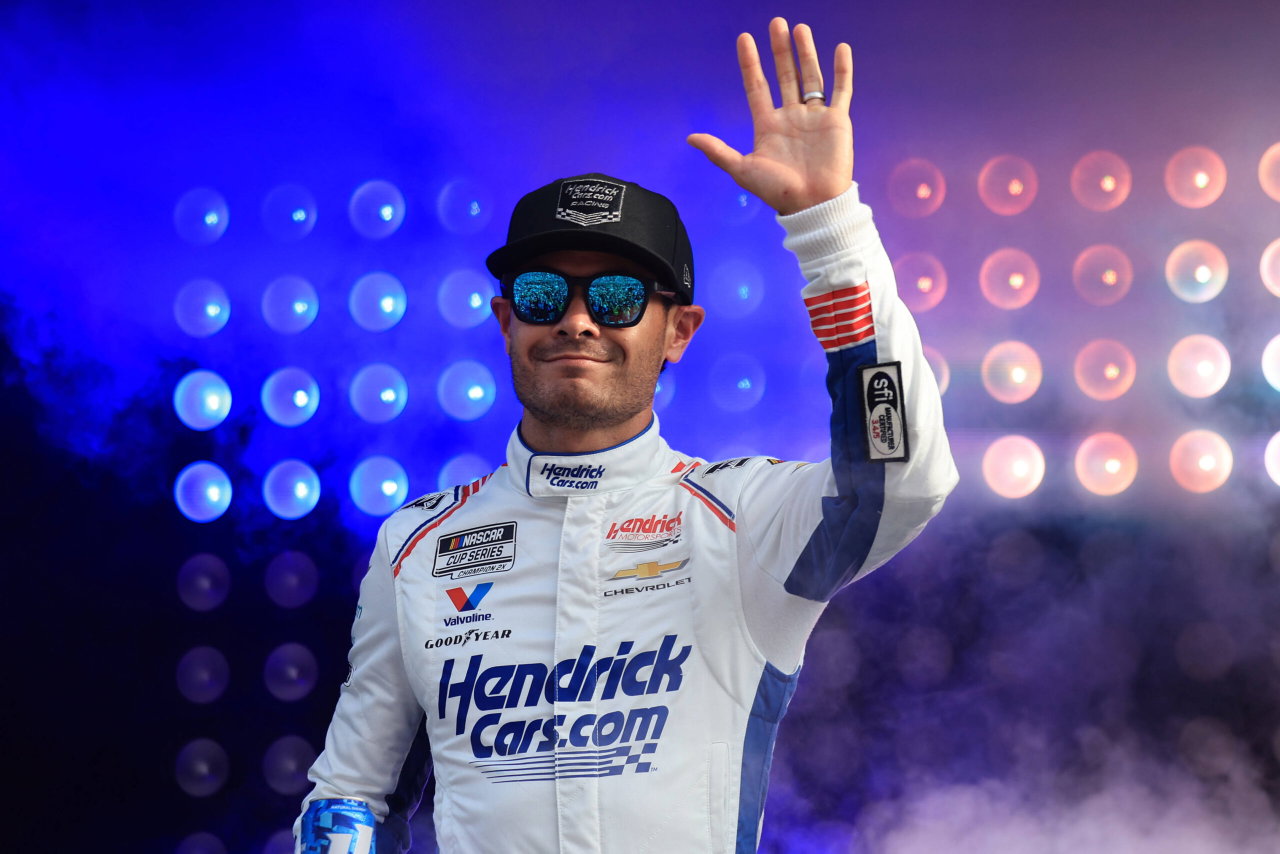
Kyle Larson won. Hendrick Motorsports went 1-2. Joey Logano rounded out the podium. And 35.2% of the race happened under a yellow flag.
Watch What’s Trending Now!
That was the Enjoy Illinois 300 at World Wide Technology Raceway on September 13. Race 2 of NASCAR’s 10-race championship. 18 cautions, a Gateway track record. 87 caution laps out of 247 completed. Two red flags. Five Chase drivers who never saw the finish. Five apparent brake failures. NASCAR’s own race report called it a “cauldron of chaos,” which, if anything, was being polite. Bubba Wallace gave the simplest, most layman version of what happened.
“Everybody hit everything out here today,” he said afterward. “Super frustrating and embarrassing for us as Cup drivers.”
Nobody is saying that the race was boring. The argument here is whether a race like this should be shaping a championship.
What makes Gateway so punishing
World Wide Technology Raceway is 1.25 miles long, but teams do not treat it like a typical intermediate. The banking is 11 degrees in Turns 1 and 2, and drops to 9 degrees in Turns 3 and 4. The straightaways stretch nearly 2,000 feet each. Every lap, cars are decelerating from high speed into brutal braking zones, then those brakes cool rapidly down the straight before the whole cycle repeats.
Logano has described it as something closer to a short track in terms of how his team approaches setup. Crew chief Adam Stevens has previously called the configuration a constant compromise between two very different ends of the racetrack.
In 2026, NASCAR brought the 750-horsepower short-track package to Gateway. More power, less downforce, a three-inch rear spoiler, fewer diffuser strakes. All of that pushed considerably more load onto the brakes. James Small, crew chief for Chase Briscoe’s No. 19 Joe Gibbs Racing Toyota, flagged it before a single lap had been run. He described the brake situation as one of the hardest educated guesses teams would face all year.
That turned out to be an understatement. Then the brakes started going berserk. Zane Smith hit the outside barrier on Lap 131 after a failure entering Turn 1. He was helped toward an ambulance. That was the first of five. Ryan Blaney was running sixth on Lap 155, collecting stage points, closing on Hamlin. His right-front brake rotor exploded through the hood entering Turn 1. He finished 35th.
“I felt like we were in contention,” Blaney said.
He had wanted to see how a three-way fight between himself, Larson and Logano would play out. It never happened. Crew chief Jonathan Hassler confirmed the team had underestimated how much cooling the brakes needed under the higher-horsepower package.
Noah Gragson’s rotor failed on Lap 199. Then Chase Elliott’s went on Lap 214.Elliott was running seventh when his No. 9 Chevrolet began producing black smoke entering Turn 1 and spun directly into Briscoe. Both hit the wall. Both were done for the day.
Elliott finished 31st, Briscoe 32nd. Two championship contenders taken out by one component failure.
Elliott pointed out afterward that Gateway has been “blowing brake rotors” since NASCAR started racing there in the current car, noting there is always some luck involved in whether the system holds together through the intense heat cycles. Chris Buescher’s rotor then failed on Lap 238, three laps from the scheduled finish of the 240-lap regulation distance, which sent the race into overtime in the first place.
Five apparent brake failures. Four of them were Chase drivers. And somewhere along all of that, the drivers started going at each other. That was only one layer of the afternoon. The racing? Another story entirely.
Lap 141, the final stage. The field went four-wide out of Turn 4. Wallace went to the bottom, Briscoe was alongside him, Ryan Preece and Josh Berry were in the mix above them. The track didn’t have enough room to fit all four. Wallace and Briscoe touched and spun. William Byron was collected. Briscoe tagged Preece. Denny Hamlin and Blaney made contact trying to avoid the whole thing.
Seven Chase drivers. One restart.
Lap 223 was more violent to watch. Wallace made contact with Berry exiting Turn 2. Berry slid up into Christopher Bell. Reddick’s Toyota then climbed the left-rear of Berry’s Ford and briefly went airborne. Bell spun with a flat tire. Wallace looped back into traffic. Three more Chase drivers taken out of meaningful contention. Bell had won at Darlington the previous week and came into Gateway second in the standings.
“Just a missed opportunity,” he said.
Ryan Preece identified the pattern driving all of it. Passing at Gateway is hard enough in clean air. Drivers knew restarts were their best shot at gaining ground, so everyone attacked the first two corners as hard as possible. One car moves slightly off line and the whole row behind it pays for it. That cycle played out again and again.
What the carnage actually produced: Here is where this gets more complicated. Logano won the pole, won Stage 1, finished second in Stage 2, and led 96 laps. His team did a lot right. The issue was the tire call. When Logano and Larson both pitted on Lap 201, Logano took right-side tires, and Larson took four. With the race turning into a series of short restart runs in the final stretch, that gap in tire life became a decisive factor.
Larson passed Logano on Lap 227 and then had to hold off Bowman, his own teammate, through multiple restarts before winning by 0.333 seconds. Logano’s assessment was straightforward. Once Larson had fresher rubber and the race kept resetting, there was nothing left to manipulate.
“Lots of cautions today, a lot of restarts,” Logano said. His car was good enough to win. The race just changed shape at the wrong moment.
For Larson, it meant something else entirely. He ended a 51-race winless drought going back to Kansas in May 2025 and moved from seventh to second in the standings, nine points behind Hamlin.
“I haven’t doubted myself,” Larson said. “I haven’t doubted our team. No better time to have a great day than today.”
Carson Hocevar came home eighth and made an interesting point about how the chaos actually helped him. He came from the back twice after being caught in incidents and said every caution gave him a chance to recover track position. His car was quick enough to do the rest.
The NASCAR championship math
Now for the part that matters beyond the race result. Five Chase drivers finished at the bottom of the order. Blaney 35th, Briscoe 32nd, Elliott 31st, Daniel Suarez 29th, Buescher 27th. Three had brake failures. One was collected by a brake failure. One was retired late by a punctured oil cooler.
Hamlin, meanwhile, had a bad pit stop, struggled on restarts, and admitted the day was not particularly good for him. He still finished ninth and still leads the championship.
“We kind of needed others to have issues,” he acknowledged.
That one sentence captures the race as well as anything else said that afternoon. The points leader was not especially competitive. He survived. The people around him did not.
After two Chase races, the top five are separated by 42 points. Hamlin leads at 2,168. Larson second at 2,159, Bell third at 2,150, Blaney fourth at 2,135, Reddick fifth at 2,126. But the bottom five are already more than 100 points behind Hamlin. Darlington played a role in that too. Gateway made it considerably worse.
NASCAR rebuilt the Chase in 2026 specifically to reward the driver who performs most consistently across 10 races. NASCAR president Steve O’Donnell said the goal was a format where the best driver across the full sample wins. When one of those 10 races sees 87 of 247 laps run under caution and five championship contenders fail to finish through brake failures and incidents they could not avoid, it is carrying more championship weight than the format was designed to absorb.
The case for Gateway
This side deserves a proper section, because it is not without merit. Gateway is not like anywhere else on the schedule. The unusual shape, the asymmetric banking and the setup challenge between its two ends create a test that a lot of tracks on the circuit simply do not. A championship schedule that only rewards teams built for 1.5-mile intermediates is not actually testing the sport’s best all-around teams.
Larson’s win also undercuts any argument that the race was purely random. His four-tire call on Lap 201 was a smart strategic decision. Bowman’s restart pushes helped execute it. Byron recovered from the Lap 141 mess and still finished fourth. Chastain spun on Lap 170 and still came home fifth. Teams that made good calls and kept their cars clean were rewarded.
And there is a philosophical point worth sitting with. You cannot spend years complaining that NASCAR’s postseason is too predictable and then demand the sport remove the venue most capable of disrupting expectations.
What is harder to argue away is this. Blaney did not lose because Larson outran him. Elliott did not lose a head-to-head fight with Briscoe. Buescher did not make a bad strategy call. All three lost because brake components failed.
Bell was not beaten by anyone. He was caught in someone else’s incident. That is not the same as saying the race was unfair. Mechanical failures and contact have been part of NASCAR forever. The specific issue here is the weight those events carry inside a 10-race championship. One tenth of the entire Chase was completed on a day where a third of all laps ran under yellow, five championship drivers did not finish, and the points leader admitted he mostly needed others to have problems.
NASCAR already moved on
There is one more piece to all of this that changes the conversation. Gateway is not in the 2027 Chase. NASCAR on its official page announced on August 26, weeks before the September 13 race, that World Wide Technology Raceway would shift to a regular-season date. The 2027 postseason brings in Watkins Glen, New Hampshire, Richmond, Charlotte, Phoenix, Kansas, Las Vegas, Talladega, Martinsville, and Homestead-Miami.
That decision had nothing to do with what happened Sunday. It was made well in advance. But what happened Sunday makes the reasoning behind it very hard to argue with now.
Gateway does not need to disappear from NASCAR. The chaos, the brake demands, the restart battles, the unpredictability, all of that can stay. A driver who has a brake failure at Gateway in August 2027 still has most of the regular season left. A driver who had a brake failure there on September 13 lost one tenth of the championship in an afternoon that had very little to do with how fast their car actually was.
That is the real distinction. And it is why the scheduling move, whatever the original reasoning behind it, looks considerably smarter today than it did before the race started.
Gateway did not have to be a bad race to be the wrong championship race. Sunday proved exactly that. Larson’s win was real. The drama was real. The finish was close. And five Chase drivers went home early through things they largely could not control. How much of that belongs in a championship? Gateway gave NASCAR 247 laps worth of answer.