
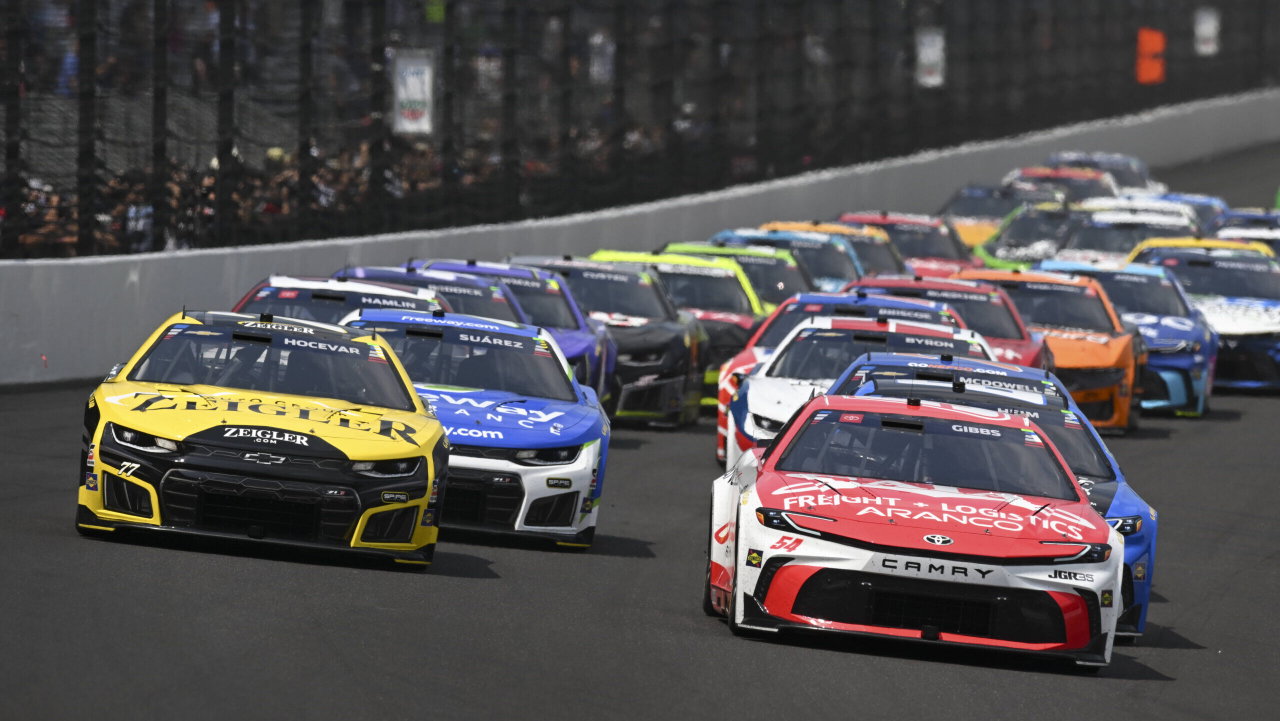
After a one-year hiatus, the NASCAR All-Star Race will return to North Wilkesboro Speedway in 2027. The historic venue hosted the exhibition event from 2023 through 2025 after its revitalization brought racing back in 2022. Its return will mark the fourth All-Star event at the track in five years. Yet, with the 2027 race already confirmed, NASCAR is apparently looking further ahead.
Watch What’s Trending Now!
“I think it’s an opportunity for us to continue to test things and try things that we may implement elsewhere in the future. And, you know, a lot of that will come down to collaboration and conversations that we have with a lot of our partners on what that looks like in 28 and beyond,” NASCAR COO Ben Kennedy’s comments on the SiriusXM podcast suggest NASCAR does not view the All-Star Race simply as another exhibition on the calendar.
Instead, the event could become a testing ground for ideas that the sanctioning body eventually wants to introduce elsewhere. That could mean experimenting with formats, competition rules, race procedures or other elements without immediately committing to changes across the Cup Series.
The All-Star Race has always provided NASCAR with some freedom to experiment. Unlike points-paying events, the exhibition can be built around entertainment, unpredictability and innovation.
That philosophy dates back to 1985, when NASCAR introduced the event at Charlotte Motor Speedway. Over the decades, the race has moved between venues and undergone numerous format changes. Its most famous incentive has remained the massive winner’s prize.
The $1 million top prize has been attached to the event since 2003, creating an additional layer of prestige for drivers competing in the exhibition. However, the payout has also faced criticism in recent years.
The $1 million prize has remained unchanged since 2003, leading some drivers and fans to question whether NASCAR should increase the amount to account for inflation. The sport has also continued experimenting with the actual structure of the race.
The 2026 NASCAR All-Star Race at Dover Motor Speedway, for example, featured a three-segment, 350-lap format. The structure is designed to gradually narrow the field to 26 drivers before the final $1 million showdown.
That willingness to change is precisely what makes Kennedy’s 2028 comments particularly interesting. Rather than simply preserving a familiar exhibition, NASCAR appears interested in using the All-Star platform to test concepts that could have a life beyond the event itself.
With North Wilkesboro returning in 2027, the following year’s race could therefore become another opportunity for NASCAR to push the boundaries.
For now, Kennedy has not revealed what those experiments will look like. But his reference to “28 and beyond” makes one thing clear: NASCAR is already thinking about the All-Star Race beyond its next stop at North Wilkesboro.
Another plan for 2028 revealed
NASCAR’s plans for 2028 are already taking shape in another part of the schedule, with one of its newest venues set to disappear after next season.
The Naval Base Coronado street course will feature on the 2027 calendar after NASCAR confirmed its return following a successful inaugural event in June. However, the 2028 schedule will not include the 19-turn, 3.4-mile Qualcomm Circuit.
That does not necessarily mean fans have seen the last of the Coronado Street Course. NASCAR has indicated that its broader objective is to create a long-term rotation of events held at different military installations.
For 2028, the sanctioning body plans to stage another street race at a different military base. The location, however, has not yet been announced. The approach would allow NASCAR to showcase its national series at multiple military facilities instead of permanently anchoring the event at one location.
That makes the Coronado exit more of a rotation than a permanent farewell. The 2027 event is scheduled for Sunday, August 1. This season, all three national series competed at the venue, giving fans an entire NASCAR weekend on the military installation.
Next year, the lineup will be slightly different. The Cup Series and O’Reilly Auto Parts Series are scheduled to race there, while the Truck national series will not return.
The changing venue also highlights how willing NASCAR has become to rethink its calendar and experiment with unconventional locations. From historic short tracks to temporary street circuits on military bases, the sanctioning body has increasingly used its schedule to introduce something different.
With the Coronado race already facing a 2028 absence, NASCAR has another opportunity to reshape its approach. And if Ben Kennedy’s comments about 2028 are any indication, experimentation could become an even bigger part of the sport’s future.