
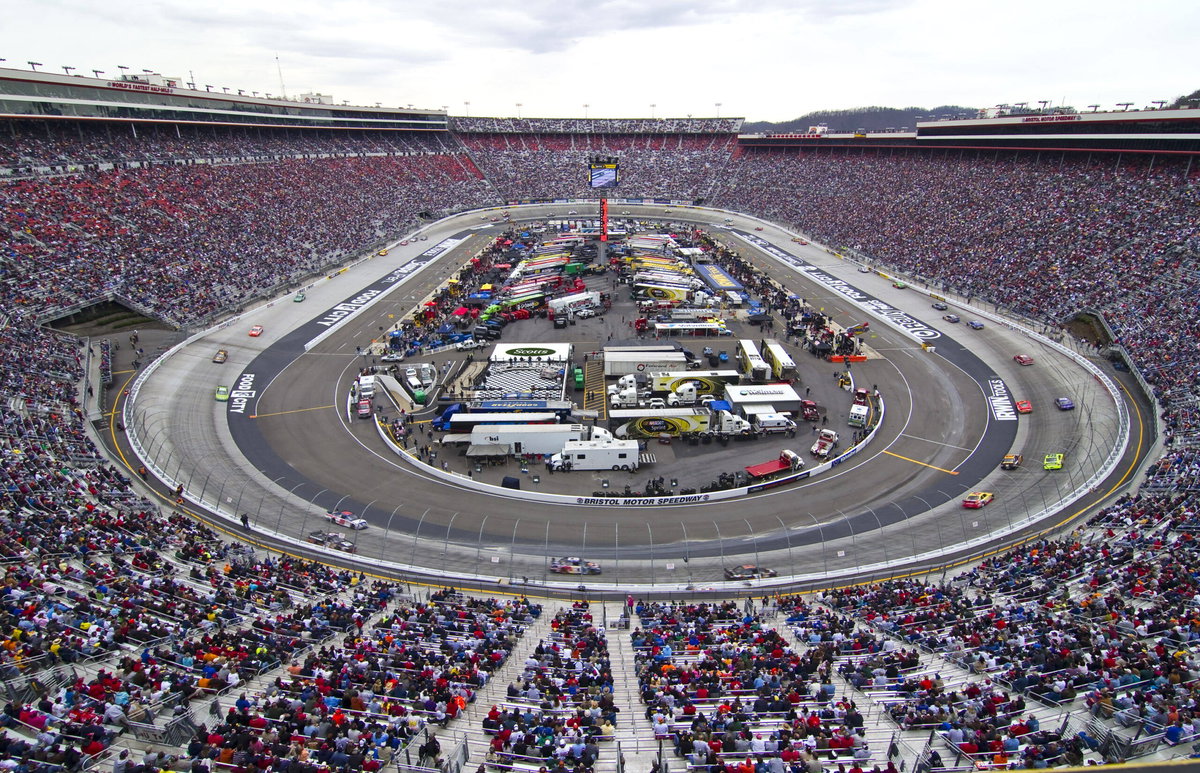
Let’s admit, we all loved the racing at Bristol. NASCAR leaped in with changes for the rubber that made it a better fit for drivers as well as a better feel for viewers. But did it turn out the way NASCAR intended?
Watch What’s Trending Now!
A race that unfolded exactly as expected
NASCAR Cup Series Managing Director Brad Moran seemed delighted with how the race went down at Bristol.
“I think all the teams were excited going in there,” and that optimism, as admitted, wasn’t blind. “From what we saw there on Saturday during practice and qualifying, we were all pretty pumped up about what we thought we were going to have on Sunday.”
Well, this wasn’t a statement that was low on confidence, and it didn’t even need to be, for as the director said, the race “did happen the way we planned.”
The expectation was grounded in a lot of work behind the scenes between NASCAR and Goodyear to build a tire during offseason testing to limit unpredictability due to track conditions, forcing Moran to admit, “We know we’ve all been surprised, and it’s really temperature-sensitive.”
He then noted upon the issues, “So, the rubber laid down, the drivers had to move around, you saw the leaders of the race… almost wreck on their own,” then adding, “With the extra horsepower, the lower downforce, the cars became a handful.”
The race day result, you ask?

👍 "Overall I think it worked out pretty well for the teams and for Goodyear." #NASCAR Cup Series Managing Director Brad Moran was happy with the package and tire direction at @ItsBristolBaby. More → sxm.app.link/NASCARIntervie…
Well, in the director’s own words:
“And then, they had to move around all day long because as the rubber built, it would be a good area for a while,” before quickly becoming unusable, pushing drivers to “stay off of that thick rubber.” He then went on to defend the same, which plenty of fans would agree with: “They were moving around, finding lanes, finding grip all day long, which is precisely what made it pretty exciting.”
This excitement did, in fact, find ground in the result. “It was the closest finish since 1991,” a claim backed by the 0.055-second margin that capped the race, which, mind you, was the tightest at Bristol in over three decades.
But despite the gratification, the race director signaled worthy times ahead, stating, “We’re not done. We’ll go back, we’ll look at all the data with our partners at Goodyear, and we certainly got some great benefits from the tests they did there, and not to say we might not, you know, go back and do another test there, and again, just try to tweak a little more.”
All this verbatim by the director made it seem that Goodyear had a massive role to play in the entire race experience. But why was it so? Why is NASCAR so dependent on Goodyear to make it a great year? And with the new horsepower package, can it assist these heavy machines?
Goodyear’s evolving role under pressure to fix the short-track product
If Bristol has made anything increasingly clear, it’s that Goodyear now works as a performance enhancement agent for NASCAR. The setup at Bristol came after months of testing in November, which was explicitly done to reduce temperature sensitivity in rubber laydown kinetics.
Why does it matter? It is because Bristol’s surface is unique, as the concrete road exhibits rapid thermally driven grip transitions, where rubber deposition rate, marbling formation, and pickup directly alter the effective racing groove.
From the viewpoint of building the tire, Goodyear’s role is complex. What it needs to do is find a balance between carcass stiffness, tread compound hysteresis, and thermal degradation curves simultaneously. This kind of places them in a debatable position where a softer compound does help with mechanical grip and adhesion, but increases wear rate and heat issues. A hard compound, on the other hand, stabilizes degradation but reduces falloff. In 2026, NASCAR attempted to flatten this disparity, creating a more “average” tire.
Through option tires at Richmond and Phoenix, NASCAR has developed this tire choice as a strategy in itself that affects everything from pit stops to track position. This places our beloved Goodyear at the center of the competition.
Even though it means excellent PR for the company and its engineering department, a single mistake could equally prove much more disastrous now. Well, Goodyear wanted the attention, and now they have it, so definitely no complaints there.