
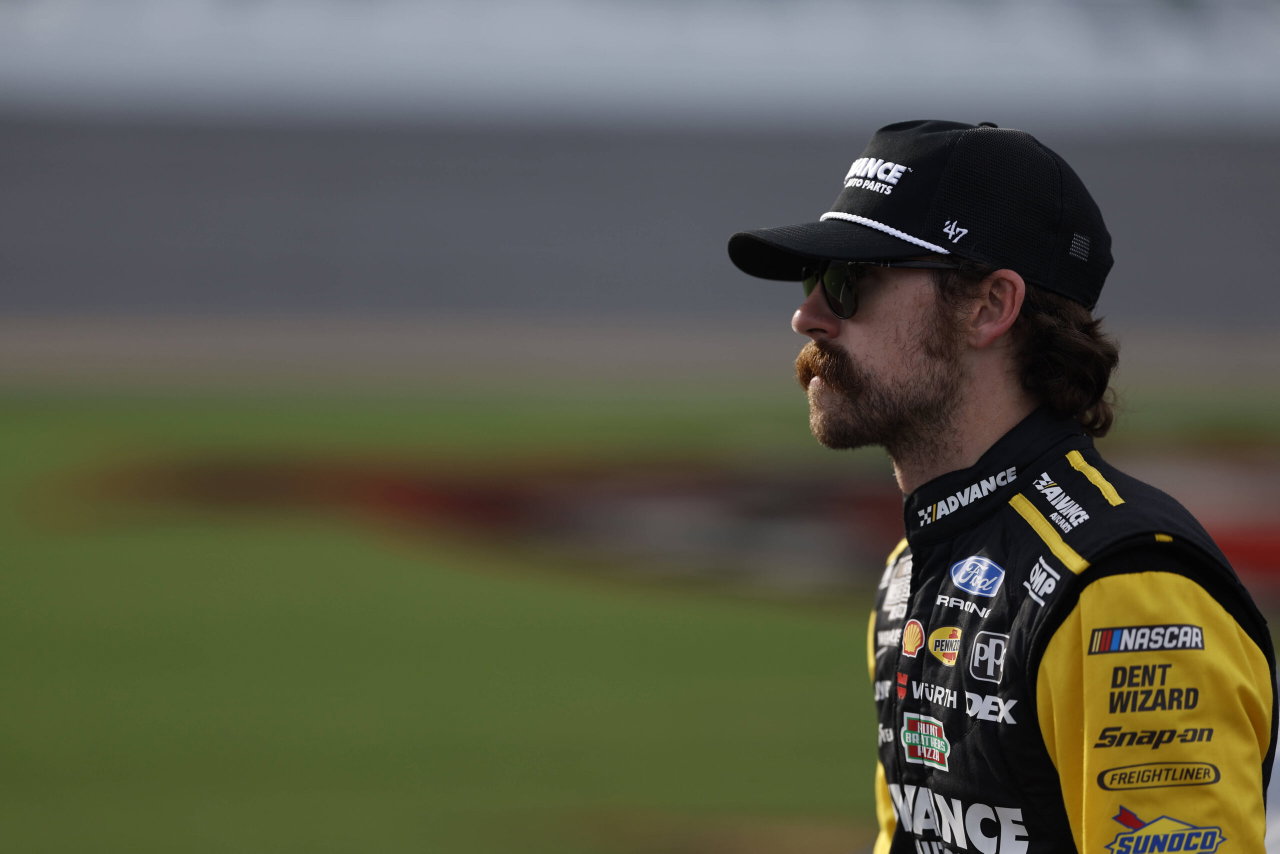
With 43 laps left at Bristol Motor Speedway, Ryan Blaney had just passed Carson Hocevar for second place coming off Turn 4. As they charged down the straightaway, Hocevar immediately tried to cross back underneath on the inside lane. Blaney moved down defensively to close the lane. The two NASCAR cars made violent contact entering Turn 1, sending Blaney’s No. 12 Ford hard into the outside wall. Blaney, who had led a dominant 202 laps that night, finished a disappointing 33rd. Fuming after the race, he went looking for Hocevar on pit road.
Watch What’s Trending Now!
Blaney put a hand on Hocevar’s shoulder. Hocevar threw the first punch, then a second. Blaney fell back, recovered, and landed a left hand before officials stepped in. Within the hour, the fight was on ESPN and spreading across social media. The punches were the part everyone saw first. They were not where this story started.
The wreck was not as clear as it looked. Before the fight took over the weekend, the crash behind it needed a proper look.
NASCAR’s post-race analysis did not produce a clean verdict. Officials described the sequence as Blaney clearing Hocevar, moving back toward the bottom lane, and Hocevar attempting to cross back underneath. NASCAR had one question it could not resolve: Was Blaney late getting to the block, or was Hocevar late getting to the brakes?
The difference between those two answers matters. One means Blaney made a normal defensive move and expected Hocevar to yield. The other means Hocevar was already committed when Blaney moved into his path. They point to very different things.
Blaney was specific about his version. He said he had left Hocevar room on the previous lap. He had not chopped him. He had not run him into the fence.
“I didn’t chop him. I didn’t run him into the fence or nothing like I easily could have,” he said.
His read was that Hocevar chose to stay in the lane when he should have backed off. Hocevar’s version went the other way. He said he was already beside Blaney’s left rear and was on the brakes hard when Blaney continued coming down. In his words:
“I kind of crossed him over, and I felt like I was at least at his left rear, and it looked like he just kept coming down.”
Spire Motorsports co-owner Jeff Dickerson added something important. He said his team was not even discussing the on-track incident after the race. He acknowledged that Hocevar has made his share of mistakes but said of Bristol specifically: “I’m just not sure that was one of them.” His read was that it did not look like Hocevar simply drove into the corner and wrecked Blaney. The crash came with an asterisk. So did the reputation of the driver involved.
Hocevar’s NASCAR history is now part of how everyone reads him
That ambiguity would carry more weight if Hocevar did not arrive at every race weekend carrying as much history as he does.
Racing Insights data cited by NASCAR tracked 63 Cup race weekends from the start of the 2025 season through Bristol. Hocevar had been involved in driver conflicts at 16 of them. That is roughly one in every four weekends. Drivers on that list include Brad Keselowski, Joey Logano, Kyle Busch, Corey Heim, and Blaney himself.
His history with Heim goes back to the 2023 Truck Series championship race at Phoenix Raceway. Hocevar bumped Heim on a lap that briefly affected the title fight. Heim later squeezed Hocevar into the wall in retaliation. The feud carried into Cup racing. At Indianapolis Motor Speedway in 2026, Corey Heim won the race, but the tension peaked during Stage 2 when Carson Hocevar gave Heim the middle finger while they were racing side-by-side at 180 mph just before Heim entered pit road.
Thirteen days before Bristol, Hocevar spun Keselowski at the Cook Out Southern 500 in Darlington, South Carolina. Keselowski finished 23rd and was curt in his response:
“His day is coming and it’s coming hard. Watch out, Carson.” Hocevar’s response was: “I’ll tighten my belts.”
Hocevar tracks what his incidents generate and has not hidden that. He noted after Darlington that a video related to the Keselowski controversy had passed a million views online. On a TNT Sports appearance in July, he said:
“I just want to be the race-car driver I would’ve wanted to be a fan of.”
After Bristol, he called the fight an “old-school Bristol show” and waved to the crowd when fans cheered for him on the stadium screen. His team ran a merchandise discount tied to Blaney’s No. 12 car number.
NASCAR’s own post-Bristol analysis made the point plainly. Hocevar’s accumulated history had removed the benefit of the doubt most drivers get after an ambiguous racing incident. William Byron or Christopher Bell makes the same hard contact and the default read is a racing deal. When Hocevar makes hard contact, everything that came before arrives with it. But Hocevar was not the only driver whose history defined Bristol.
What NASCAR’s Bristol also revealed about Blaney
In February 2025 at EchoPark Speedway in Atlanta, Hocevar had spun Blaney while they raced inside the top five. Before the Bristol confrontation, Blaney told reporters he had not had a real problem with Hocevar for about a year and a half. Then he added:
“It’s getting old.”
So when he told reporters before the fight that something was going to happen, it was not coming from nowhere. He had led 202 laps at Bristol and won Stage 2. He had recovered from a pit-cycle problem and was fighting for second with 43 laps to go. Hocevar took him out.
Ryan Blaney’s championship position dropped from third to sixth, now 52 points behind Kyle Larson. It was also his second straight Chase race finish outside the top 30. At Gateway Motor Speedway the week before, a brake failure had put him 35th. Blaney had specifically said multiple finishes in the 30s would effectively end his championship campaign. Hocevar, who collided with Blaney to cause the Bristol exit, acknowledged the championship dimension after the race:
“That’s probably his championship.”
He said he understood why Blaney was angry and that he would probably feel the same way. When Blaney found Hocevar on pit road, two things happened separately. Blaney put a hand on Hocevar’s shoulder first.
Hocevar threw the first punches. Blaney fell back, got up, and landed his own left hand before officials stepped in. Blaney kept trying to get back toward Hocevar as crew members pushed between them.
Those two facts stand separately: Blaney initiated the physical confrontation, and Hocevar threw the first punches. Neither cancels the other.
Bubba Wallace, one of Blaney’s closest friends in the sport, said the reaction caught him off guard.
“That surprised the f*** out of me,” Wallace said.
He added he was proud to see Blaney show passion, but noted he had not watched the original crash clearly enough to judge the cause. When someone that close to you says they did not see it coming, it says something about what Bristol pushed Blaney past. Both drivers followed a logic the sport has always tolerated.
NASCAR built the culture. Now it has to manage it.
Driver confrontations have never been new here. Cale Yarborough and the Allison brothers fought on pit road at the 1979 Daytona 500 while national cameras were still rolling. Rusty Wallace and Dale Earnhardt had their confrontation at Bristol. Tony Stewart’s list of confrontations spans an entire career. Kevin Harvick went after Greg Biffle at Martinsville Speedway. Physical confrontations have long been part of how the NASCAR garage settles things.
In 2026, NASCAR has also been more deliberately personality-forward than in recent memory. Vice president of race communications Mike Forde said in March that the sport genuinely wants drivers to show emotion. He described the line between passion and punishment as a
“moving line.”
CEO Steve O’Donnell has said he is not opposed to drivers settling personal disputes. His bigger concern, he has said, is when crew members pile in and it becomes a group situation.
Bristol stayed mostly between two people. No serious injuries. No crew escalation. Based on AP reporting from September 21, no punishment was expected for either driver.
That fits how NASCAR has handled comparable incidents in 2026. Ryan Preece was fined $50,000 and docked 25 points at Texas Motor Speedway after NASCAR found he had intentionally wrecked Ty Gibbs. The key was Preece’s radio communication saying he was “done with” Gibbs, followed immediately by the contact. Intent was traceable.
Kyle Busch’s contact with John Hunter Nemechek at that same Texas race produced no penalty because Busch’s steering was badly damaged and the data did not establish intent. A dispute between Brett Moffitt and Shane van Gisbergen at Chicago Street Course followed the same pattern: NASCAR reviewed throttle, braking, and steering data and found insufficient evidence.
For post-race fights specifically, the 2024 All-Star Race offers useful context. Ricky Stenhouse Jr. received a $75,000 fine after confronting Kyle Busch. Part of NASCAR’s reasoning was that Stenhouse had left, changed clothes, and returned before starting the confrontation. That looked deliberate rather than spontaneous. A fight that breaks out in the immediate heat of the moment is treated differently. Bristol fits that category.
The framework is consistent: find traceable evidence of intent and NASCAR acts. Without it, it monitors. Whether or not either driver gets penalized, the racing calendar will not let this rest.
The championship does not allow this to just pass
Bristol was Race 3 of the 10-race Chase. In 2026, the format runs on accumulated points across all 10 races with no driver eliminations at any point, meaning every single Chase finish counts directly in the final standings.
After Bristol: Kyle Larson led at 2,206 points. Denny Hamlin was one point back. Joey Logano moved to third at 16 behind. Christopher Bell was 17 back. Blaney was 52 points back in sixth. Hocevar was 85 points back in eighth.
Logano won the race. It was his 40th career Cup Series victory and his third win of 2026, moving him firmly into championship contention. Larson finished second and became the only driver with a top-five in all three Chase races.
He had gone fifth at Darlington Raceway, first at Gateway Motor Speedway, and second at Bristol. Those are the real developments that should have defined the weekend. The fight buried all of it.
Hocevar left with his best career Bristol finish and a solid points haul. Blaney left in sixth with two consecutive 30s-finishes and the exact scenario he had said he could not recover from. The same on-track incident produced opposite championship results for both of them.
Seven Chase races remain. Kansas Speedway is next on September 27. Then come Charlotte Motor Speedway, Las Vegas Motor Speedway, and others through the finale. Any time Hocevar and Blaney end up close to each other over those seven races, Turn 1 on Lap 458 will already be in the background.
A defensive move will be read differently. A crossover attempt will carry more weight. Their racing together is no longer just racing.
NASCAR’s culture encouraged both of them to show their passion and handle their business personally. Blaney and Hocevar did exactly that, from opposite directions, at the same corner. Seven races left, and the sport is still working out where the line is.