
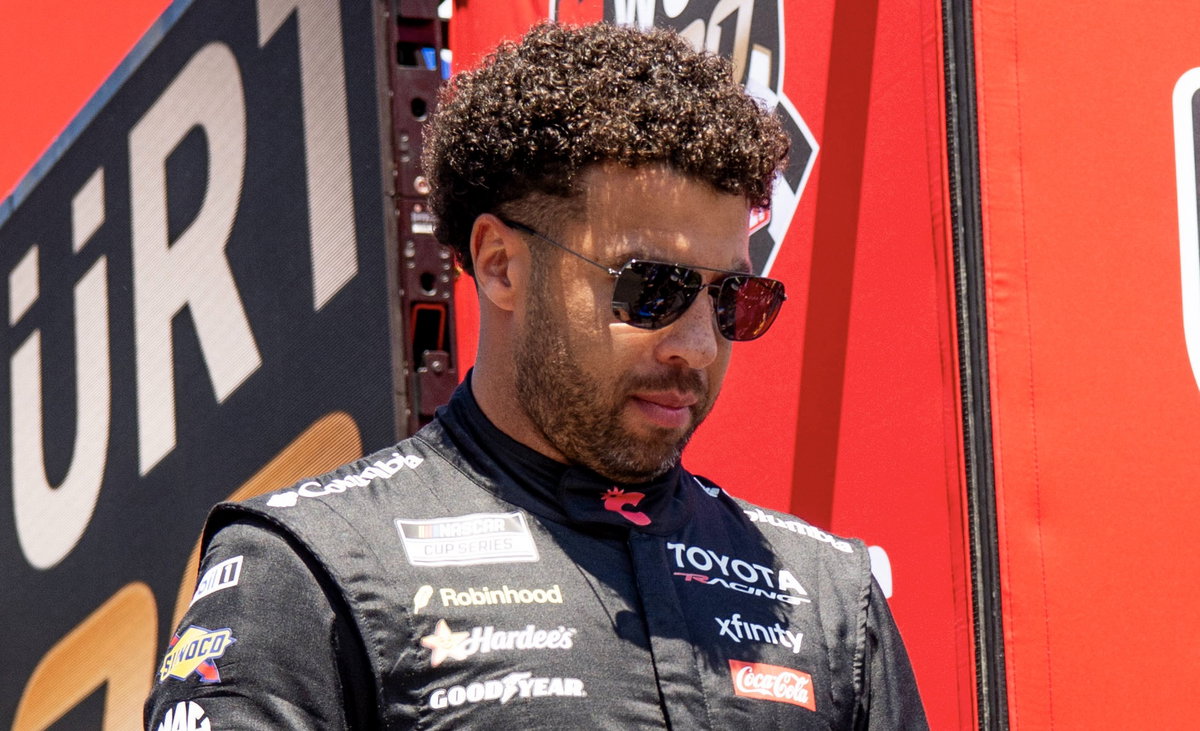
Four-wide racing is nothing unusual at Talladega Superspeedway or Daytona International Speedway that gives race highlight moments. But when four cars squeeze into the same corner at an intermediate oval, it usually results in a wreck taking out multiple cars, as there is often little room for forgiveness if things go wrong. That was exactly the situation at Gateway, where Bubba Wallace found himself at the center of a four-wide crash involving several drivers. The wreck has now sparked a heated debate over who was actually responsible.
Watch What’s Trending Now!
“Does Bubba not know that the 21 is going to come down a little bit to gain his momentum off the corner? Both instances you said that Bubba was on the rumble strips, right? That f***** means that there was no f***** space. End of the story. The 20 was next to him. I mean, I’m sorry. Bubba caused that wreck,” Tommy Baldwin Jr. did not hesitate to put the blame on Bubba Wallace during the Door Bumper Clear podcast.
The former team owner believed Wallace should have understood what was coming next as the four-wide battle entered the corner. Wallace was already committed to the extreme inside of the track, while Chase Briscoe had his own momentum to manage alongside him. With Ryan Preece and Josh Berry also occupying the higher lanes, the available racing room was disappearing quickly.
The incident unfolded on Lap 141 of the Enjoy Illinois 300 at Gateway. Wallace was fighting toward the front when the situation tightened between the four cars. What began as an aggressive attempt to capitalize on a strong run soon left Wallace and Briscoe with almost no room to adjust. Contact followed, sending the two Toyotas around and creating a chain reaction that also involved William Byron and Alex Bowman.
For Baldwin, the presence of the rumble strips was the clearest indication that Wallace had reached the limit of the racing surface. His argument was that Briscoe still needed to move toward the bottom to generate momentum through the corner. If Wallace was already at the rumble strips, there was simply nowhere else for Briscoe to go.
Freddie Kraft offered a completely different interpretation. The 23XI Racing employee argued that Wallace had done what the situation demanded. He had received a major run on the restart and could not afford to simply lift while cars behind him were also moving forward. In Kraft’s view, Wallace had taken his car as low as physically possible and was trying to use the momentum available to him.
Kraft also pushed back against the idea that Wallace should have avoided the move simply because four-wide racing carried a greater risk. If a driver consistently refuses to take an opening during a restart, he can quickly become trapped in the middle of the pack. The aggressive move, therefore, was not necessarily about Wallace recklessly forcing his way into a gap. It was about trying to protect the positions he could gain when the opportunity appeared.
That context becomes even more important when looking at Wallace’s position in the Chase. Wallace entered the Chase in 14th place, meaning he already had ground to make up if he wanted to challenge for the title.
After Darlington, he had climbed to 10th, cutting the deficit to Denny Hamlin to 81 points. With every position carrying value across every stage, Wallace had plenty of incentive to keep pushing forward rather than settling for whatever position was immediately available.
The Gateway race ultimately showed how difficult that calculation can be. Wallace finished 14th and collected 24 points, but the result did not allow him to close the gap to Hamlin.
Instead, he remained 10th and was still 90 points behind his fellow Toyota driver. That made every position he could gain during the race even more significant, especially in a Chase where the points battle can change quickly. Wallace acknowledged that pressure when discussing the incident himself in a post-race media conference.
“We’re all fighting forward, and this package was kind of a handful, but the two instances I had a great run on the restart of the 19, and again, this is with me without seeing it all. I felt like I got crowded. I need to go back and see if I actually had more room to get up or whatnot. So it’s just we’re all fighting for the same real estate.”
Interestingly, Wallace’s crash was not the only Toyota-on-Toyota incident that brought the limits of the racing surface into focus. Ty Gibbs and Erik Jones also became involved in an incident where running close to the bottom brought the rumble strips back into the discussion.
Both situations highlighted the same fundamental problem: once a driver reaches the extreme inside edge, there is virtually no additional room available if another car moves toward them.