
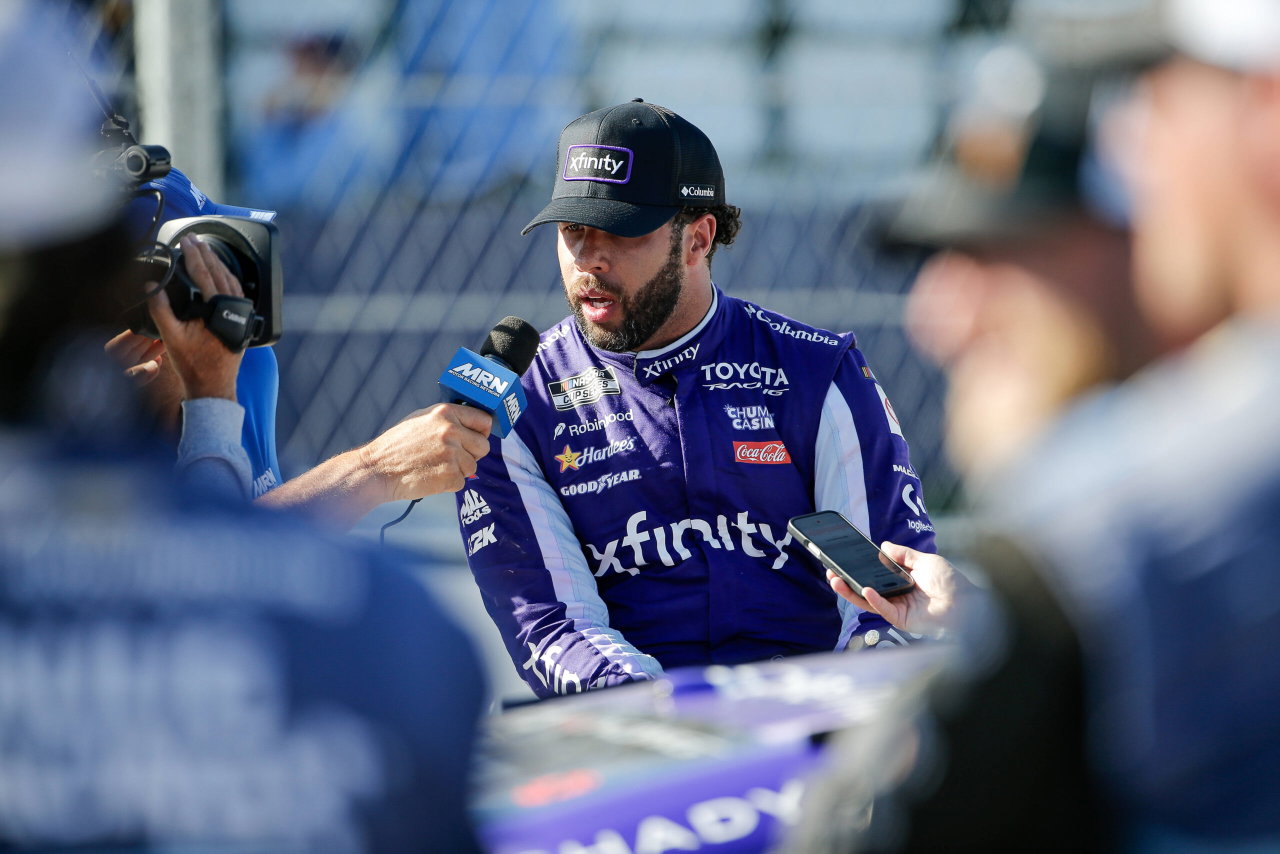
At 33, Bubba Wallace still has plenty of racing ahead of him. But when the conversation turned to Phoenix Raceway’s dogleg, the 23XI Racing driver was already thinking about life at 60. The shortcut has become part of the show at Phoenix, giving drivers another way to attack the track. Wallace sees a problem with that bargain. What looks exciting to fans today could come with a cost drivers have to live with long after retirement. And he has a blunt reason for wanting NASCAR to reconsider it.
Watch What’s Trending Now!
“It’s brutal. It looks cool on TV, and it ain’t going to be cool when we’re 60, right?”
Bubba Wallace made the remark during an interview shared by Peter Stratta on X. He was asked whether NASCAR should change the dogleg, where drivers cut across the paved section inside the frontstretch instead of following the entire bend. The move saves distance and gives drivers another line through the track. It also creates the kind of aggressive racing that makes the section appealing to watch.
Wallace’s concern is what happens inside the car when drivers take that route. He believes the physical demands deserve more attention, particularly because drivers face them repeatedly throughout their careers.
“From a physical standpoint, absolutely. We’re pulling, I don’t know what it is, 30-something Gs. I might be wrong on that number, but it’s high every time we cut the dogleg.”
Bubba Wallace acknowledged that he could be wrong about the exact figure. His estimate should not be treated as a verified measurement of the forces drivers experience. But the concern behind it was clear. The physical demands of racing accumulate over years, and he wants NASCAR to consider whether this particular feature is worth keeping in its current form.
The reference to turning 60 makes his point harder to dismiss. Wallace was not claiming the dogleg would cause a specific future injury. He was questioning a design that rewards drivers for taking a shortcut despite the physical demands he associates with it. The excitement lasts a few seconds on television. A racing career can last decades.
There is also the question of what NASCAR could change. The interviewer suggested grass or turf through the area, but Bubba Wallace was unsure that either would stop drivers from cutting across it. Competitors will naturally look for the quickest route, especially when the alternative costs them ground.
“Just like, I think the original Phoenix had grass through there, right? So…”
Phoenix Raceway’s layout has changed over time. Its 2011 redevelopment altered the dogleg and expanded the paved area, creating the route drivers use today. The shortcut has since become part of the racing there. Changing it would mean rethinking a feature that teams and drivers have spent years learning to use.
Bubba Wallace also suggested that NASCAR could consider restrictions similar to those used in IndyCar. He did not offer a detailed engineering plan, but he made his preference clear.
“Whatever they build, we’ll race. So, I mean, I’m in favor of getting rid of it, for sure.”
That leaves NASCAR with a question beyond whether the dogleg produces entertaining racing. Any change would need to account for how drivers approach the corner, how the cars respond and whether a different surface creates other risks. Wallace’s comments do not establish that the dogleg causes lasting health problems, but they put the physical side of its design under scrutiny.
His frustration at Phoenix gave the discussion another layer. Wallace had led 52 laps in the Freeway Insurance 500 and looked capable of fighting for the win. However, a pit-road speeding penalty following a caution dropped him out of contention. He finished 17th, while his 23XI Racing teammate Tyler Reddick went on to win.
Bubba Wallace then arrived at Talladega Superspeedway looking to put that result behind him. He admitted he would prefer not to face the uncertainty of superspeedway racing, where close packs and small mistakes can quickly change a race. Still, he was encouraged by his team’s speed at those tracks and wanted another opportunity to compete.
He also backed NASCAR’s return to the Chase championship format. The 2026 system puts 16 drivers into a 10-race points battle without the eliminations that defined the previous playoffs. A poor finish can hurt a driver’s position, but it does not automatically end his championship hopes.
“To go through the first three races and still have a shot, that was nice to know.”
Bubba Wallace likes that the format rewards consistency. His Phoenix penalty hurt, but he still had races ahead to recover ground. That flexibility matters when a championship is decided over several weeks rather than through a series of elimination rounds.
Yet a better championship format cannot answer every question about the physical demands of racing. Wallace can accept the uncertainty of Talladega because competing is part of his job. What he wants NASCAR to examine is whether a feature like Phoenix’s dogleg needs to remain part of that job in its current form.
For now, the shortcut remains part of the show. Bubba Wallace’s concern is what that show asks of the people inside the cars. He wants to keep racing, but he also wants the sport to think beyond the next checkered flag. At Phoenix, that means asking whether a few seconds of spectacle are worth a physical cost drivers may carry long after their careers end.