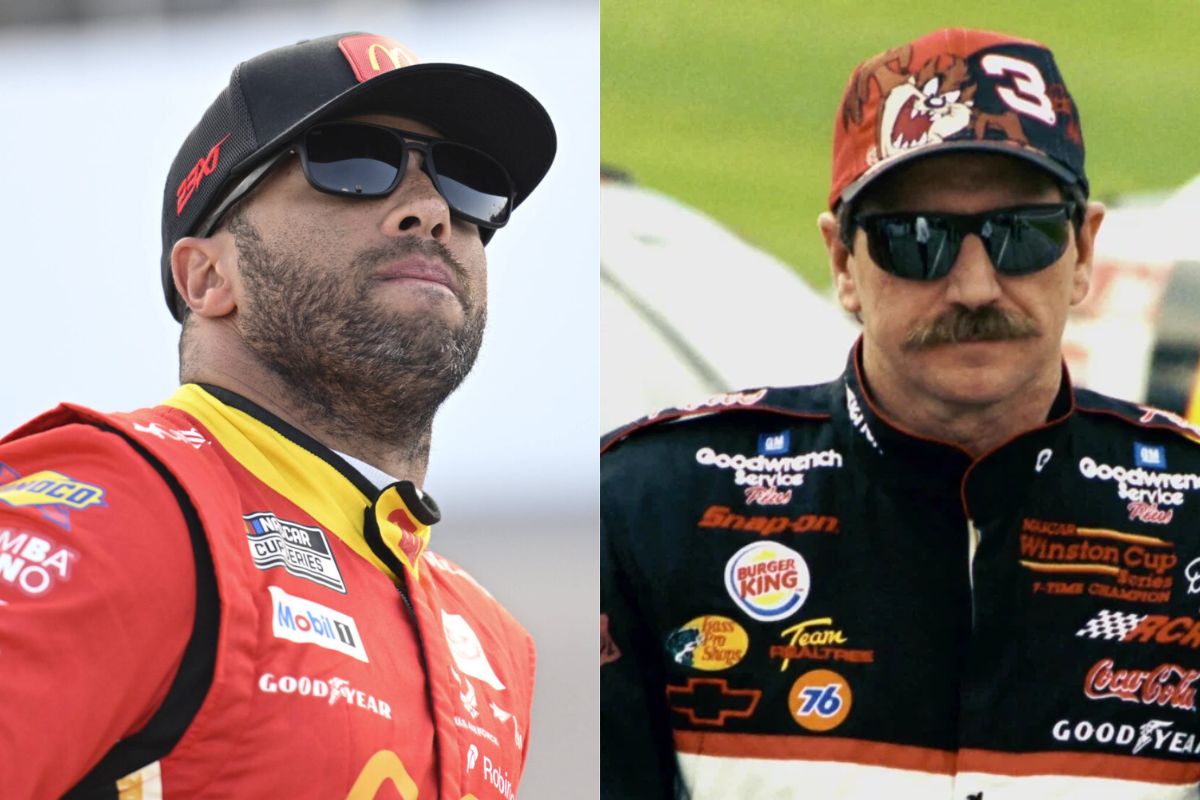
Tempers boiling over on the racetrack is nothing new in NASCAR. Put drivers inches apart at a place like Martinsville Speedway, and it’s almost inevitable that emotions will spill over. But while aggression is part of the sport, knowing when to hold back is what separates the greats from the rest. And after Bubba Wallace’s latest moment, one veteran believes the lesson is clear: Sometimes, it’s about thinking like Dale Earnhardt.
Watch What’s Trending Now!
Bubba Wallace’s Martinsville moment under the lens
“There comes a point in time in that sport where you’ve got to, you know, really mentally take care of stuff. One of the best that was Earnhardt Senior. I mean, he was one of the best for rebuild, you know, smart, whatever, right?” That was veteran Rick Mast, pointing to a lesson many drivers learn the hard way.

Imago
NASCAR, Motorsport, USA Go Bowling at The Glen Aug 10, 2025 Watkins Glen, New York, USA NASCAR Cup Series driver Bubba Wallace 23 looks on prior to the Go Bowling at The Glen at Watkins Glen International. Watkins Glen Watkins Glen International New York USA, EDITORIAL USE ONLY PUBLICATIONxINxGERxSUIxAUTxONLY Copyright: xRichxBarnesx 20250810_szo_ai8_0415
For Bubba Wallace, that moment came at Martinsville Speedway. During the Cook Out 400, Wallace’s race unraveled on a late restart when he reacted to being pushed three-wide by Carson Hocevar. Frustration took over. Heading into Turn 4, Wallace drove deep into the corner and made contact with Hocevar, spinning him and triggering a massive 12-car pileup. The damage was heavy, and Wallace’s day ended in a disappointing 36th-place finish.
To his credit, Wallace owned the mistake afterward, calling it a misjudgment in the heat of the moment. But as Mast pointed out, that’s where experience and mental control come into play. Especially at a tight, chaotic track like Martinsville, where split-second decisions can define an entire race.
That’s what made Dale Earnhardt so effective. Earnhardt raced hard (often on the edge). There are countless examples of such incidents. But he understood when to push and when to back off, which aren’t talked about much. He could be aggressive without letting emotion take over, always keeping the bigger picture in mind. For Wallace, it’s another reminder that in NASCAR, sometimes the smartest move isn’t the fastest, but the one that keeps you in the race.
Kevin Harvick reflects on Dale Earnhardt’s lasting impact
While today’s drivers are reminded to race smarter, the lessons of the past still shape the sport in profound ways. Recently, Kevin Harvick opened up about one of NASCAR’s darkest moments, the loss of Dale Earnhardt, during an episode of his Happy Hour podcast alongside Mike Helton.
“It was the hardest moment that we all that were in the sport had to ever go through,” Harvick admitted, reflecting on the aftermath of the 2001 Daytona 500 tragedy. He also acknowledged the immense pressure Helton faced, calling the press conference that followed “the hardest situation” anyone in the sport had to handle.
Dale Earnhardt’s fatal crash, caused by a basilar skull fracture after impact with the wall, changed NASCAR forever. What followed wasn’t just mourning but a complete shift in how the sport approached safety. The tragedy pushed NASCAR into what many now call the “zero-fatality era,” where safety innovations became non-negotiable rather than optional.
Key changes came quickly. The HANS device (head-and-neck restraint) became mandatory. SAFER barrier walls were installed to absorb impact. Full-containment seats improved driver protection, and NASCAR established its Research and Development Center in Concord to continuously advance safety measures.
As painful as that moment was, it forced the sport to evolve. Today’s drivers race in a far safer environment because of it. And in a way, every lesson about control, discipline, and awareness, like the one being discussed after Martinsville, traces back to the legacy Earnhardt left behind.
