
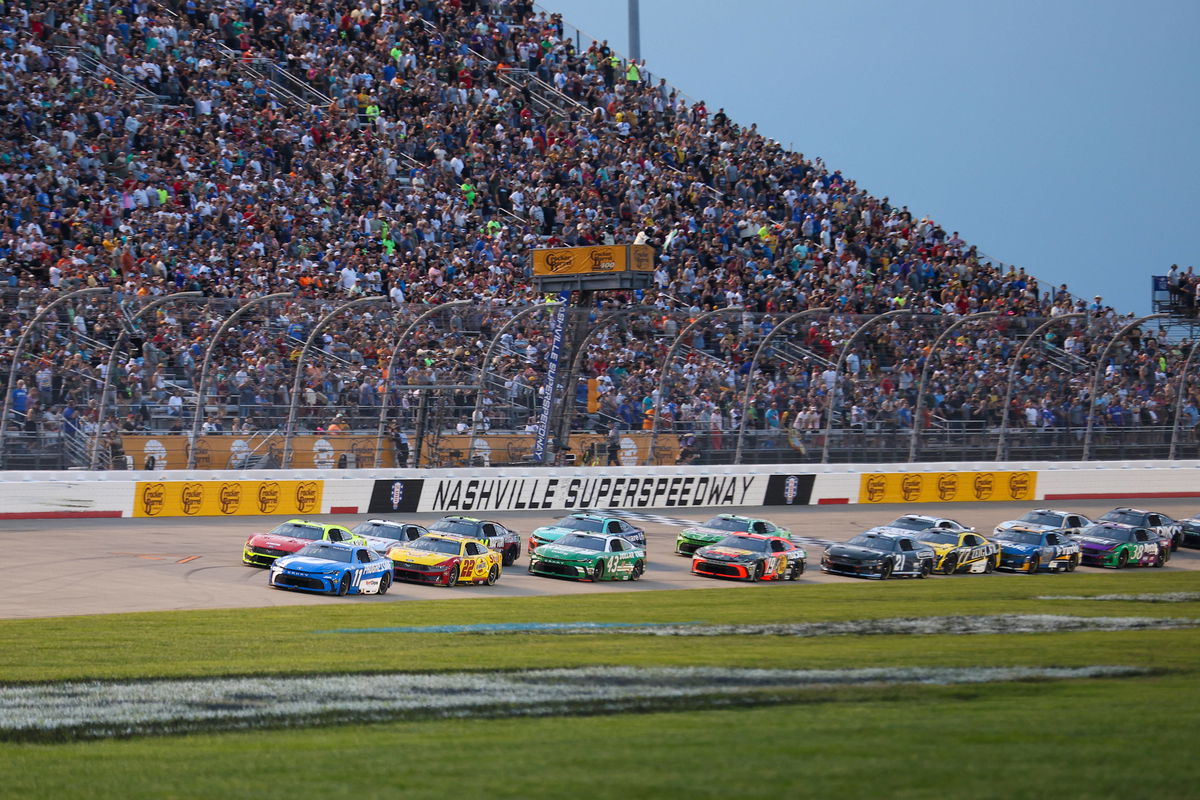
It was past midnight on the East Coast when the checkered flag finally dropped at Nashville Superspeedway. Somewhere in the grandstands, fans who had shown up hours earlier for a Sunday night race were still there. They were tired, hoarse, and facing a Monday morning that wasn’t going to dawn on them any later than usual. This is what the sport has become for the blue-collar America that built NASCAR. And someone inside the sport has finally had enough.
Watch What’s Trending Now!
“I’ll just say right now I’m too old for this. I am officially too old for night races. I’ll be the cranky old man here. I can’t do this anymore,” Jeff Gluck said during the latest episode of The Teardown podcast. “Yes, it was rain delayed for an hour, but this was a four hour race. Three hours 59 minutes is what I’m seeing here and you’re starting it on Sunday night. I mean people have to work tomorrow and especially like blue collar NASCAR fans, people have jobs where they got to get up early. Come on now. It just can’t just be me that doesn’t like night races.”
His statement might seem personal, but it makes sense, and it touches a broader issue. Honestly, a race past the standard timings may not seem too huge an issue for television executives or business sponsors, but for people who work blue-collar jobs, it is a hassle. For example, if a race concludes after midnight, a manufacturing worker who clocks in at five a.m. on Monday cannot get a complete sleep. The same goes for mechanics, electricians, construction workers, truck drivers, and warehouse workers. And there is a deep irony in all of it.
These are the exact demographics of people who built the sport from the dirt up. Now they are the ones having to choose between watching the races live and getting enough sleep to function the next day at work. And the Nashville weekend only reinforced that reality in the most exhausting way possible.

When is a late-night race TOO late?! 😅 Did you miss The Teardown live? Catch up here! 🎙️ Spotify: open.spotify.com/episode/6dzU9r… Apple: podcasts.apple.com/us/podcast/mus… YouTube: youtube.com/live/4awj0apQ1… @jeff_gluck | @Jordan_Bianchi
The entire Nashville race weekend had been plagued by weather every single day. The Craftsman Truck Series race started more than two and a half hours late on Thursday, Cup qualifying was canceled on Saturday, and a weather system from the north rolled in again on Sunday, with rain beginning to fall around 5:45 p.m. before a 6:20 p.m. CT green flag. And Nashville Superspeedway was a sellout, which was also its fourth consecutive Sunday sellout, meaning the fans who showed up for a Sunday night race had to wait through an 80-minute delay before any racing began.
When the race eventually got underway, it became a cautious marathon that lasted three hours and fifty-nine minutes under green-and-yellow conditions. Many viewers from the East Coast had already crossed into Monday morning by the time the checkered flag waved.
The length became impossible to ignore, even though the race itself was packed with action.
There were 11 cautions for 77 laps under yellow. A horrific brake rotor failure sent Connor Zilisch’s No. 88 Chevrolet violently slamming into the Turn 1 wall, flames erupting from the right-front corner of the car. A near-identical breakdown for teammate Ross Chastain ten laps later brought out another long yellow while safety personnel cleared fluid and debris from the track.
Stage 3 was even more chaotic. A couple of multi-car crashes knocked out drivers Kyle Larson and Bubba Wallace, which again created a lot of restarts. An event that had already begun later than many spectators would have liked was further prolonged by the extra time needed to clean up each crash and get the race underway in safe conditions.
The bigger issue is that Nashville was not an isolated event. Just a week earlier, NASCAR fans experienced a marathon run at Charlotte Motor Speedway in the Coca-Cola 600. The longest race in NASCAR history was eventually called off after 373 out of 400 laps due to bad weather conditions. NASCAR suspended action because of lightning close to the speedway and then declared Daniel Suarez the winner.
Fortunately, NASCAR has choices to tackle this.
- Moving race start times earlier in the day would be the most straightforward solution, especially for events that are likely to experience weather disruptions (or irrespective).
- The stage caution breaks can also be considered by the sport, which routinely adds significant time to races. It would also be beneficial to cut down on needless pace laps after incidents.
- Developing effective wet-weather tires for oval racing remains another long-term solution that could prevent lengthy rain delays altogether.
- Reducing the distance of typical intermediate-track races from 400 miles to 300 miles could be the most drastic solution. A change like this could eliminate 45 to 60 minutes from race broadcasts right away, while marquee distances for major events like the Coca-Cola 600 and Daytona 500 can be maintained.
Long races wouldn’t be eliminated by any of those methods completely. However, they would show that NASCAR is aware of its target demographic.
Still, the sport is not completely unaware of the problem. In 2025, NASCAR’s chief brand officer, Tim Clark, confirmed the organization was actively seeking a new creative agency to help reconnect with its “working-class, Americana” roots.
This came after then-NASCAR President Steve Phelps admitted in 2019: “I think we chased a new fan at the expense of an existing fan. We’ll never do that again.”
That said, many found it embarrassing that NASCAR had to hire an outside firm. “You should have never lost the blue-collar fan, NASCAR. Say you’re sorry. Apologize to all the people you out-priced,” Kenny Wallace said.
Because if the sport continues making it harder for blue-collar fans to watch from start to finish, it risks creating a future where the people who built NASCAR are no longer able to enjoy it.