
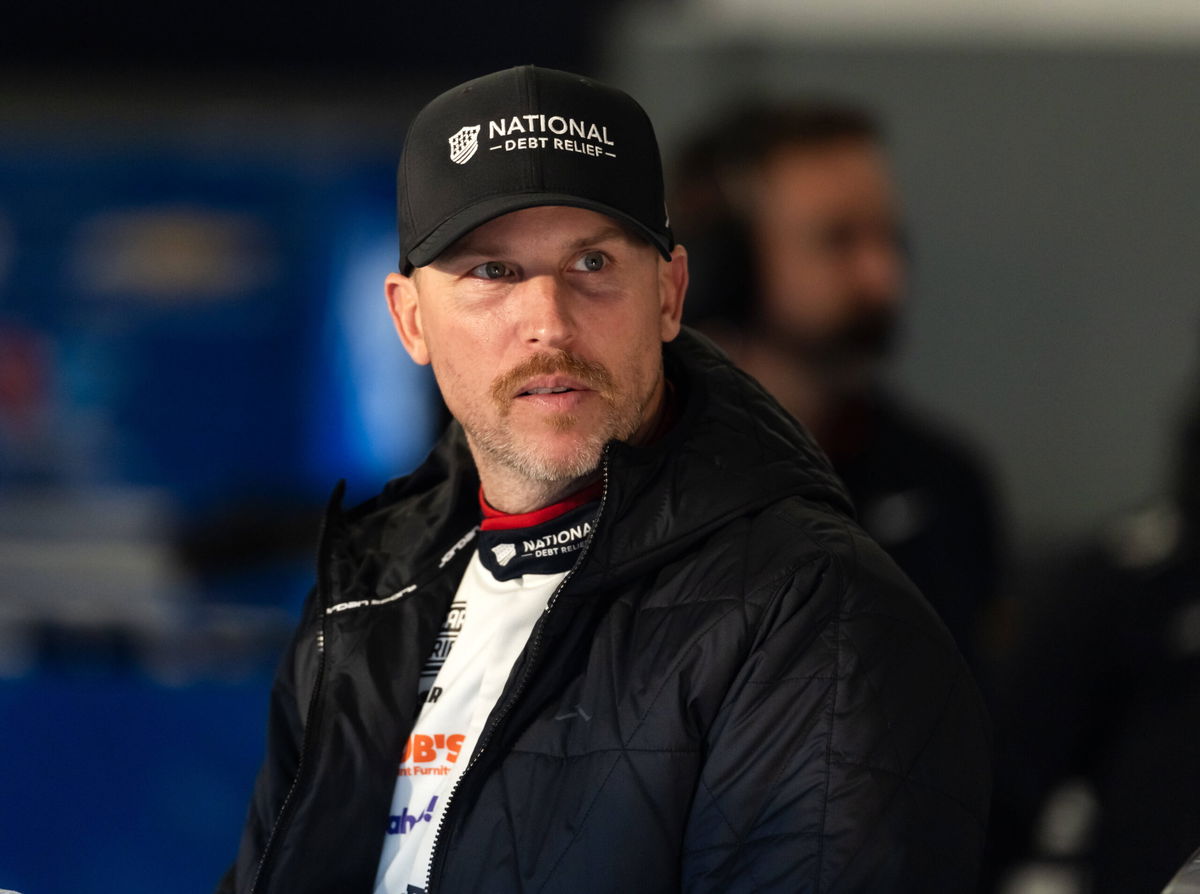
Denny Hamlin looked like he had everything lined up at Las Vegas. The Joe Gibbs Racing driver seized the pole for Sunday’s South Point 400, putting himself in prime position to claw back ground on Chase leader Kyle Larson, who qualified sixth. It was the kind of starting spot that could have changed the championship picture. But Hamlin’s promising afternoon quickly turned into a frustrating fight, with one mistake leaving him battling a wounded car and watching a golden opportunity slip further away.
Watch What’s Trending Now!
“I am chewing the steering wheel because I’m so fricking mad about stage 1, stage 2, and the position I’m in. I know that the car is damaged. I know that I damaged it, and so I’m p*****, and I’m driving p***** the whole race. I could have easily wrecked the car again with the way I was driving, but I was trying to get everything I could out of it,” Denny Hamlin revealed on the Actions Detrimental podcast.
And that perfectly summed up his Las Vegas disaster. The Joe Gibbs Racing driver started from pole and looked like he had the fastest car in the field, leading the opening 39 laps and appearing perfectly positioned to attack Kyle Larson’s Chase lead.
Instead, a controversial pit call, a desperate recovery attempt and a Stage 1 spin turned a potential championship statement into a 16th-place finish. The first major turning point came with the Lap 44 caution for Zane Smith.
Hamlin had already made a green-flag pit stop, leaving him with nine-lap-old tires when the caution arrived. Chris Gayle called him back to pit road for two fresh tires, surrendering valuable track position. Hamlin restarted around 10th while several cars stayed out.
The decision also helped Larson, who had fallen a lap down after stopping to fix his ill-handling No. 5 Chevrolet, return to the lead lap with the wave-around. Gayle later acknowledged the call was not ideal in hindsight, while Hamlin said he would have rejected it had he known Larson’s situation.
Hamlin then had to fight his way forward and was running fourth with three laps remaining in the stage. However, he went high in Turns 3 and 4 while chasing Christopher Bell and Ryan Blaney. The No. 11 lost grip in the marbles and spun onto the apron.
NASCAR did not throw a caution because Hamlin avoided the wall and continued. However, the incident damaged the splitter on the No. 11 Toyota and fundamentally changed its handling. Hamlin later questioned the situation from the perspective of the championship because he was trying to collect every point possible.
The damage was significant. Gayle explained that diffuser strakes had been worn away, the diffuser edge was broken, and some of the stays underneath the car were bent. This, in turn, created a major aerodynamic disadvantage in traffic. Yet the No. 11 still had speed.
Hamlin said he could run top-five lap times once he got into clean air, even with roughly 20 laps on the tires. Whenever another car moved out of his way, the Toyota suddenly came alive, but on restarts and in traffic it struggled to turn. That only made Hamlin more frustrated because he knew the car still had potential.
Then the fuel-pressure issue made the recovery even harder. During the final stage, the No. 11 suddenly lost fuel pressure and shut off. This unexpected event forced Hamlin to reset the system, switch the fuel pump, and restart the car. He dropped deep into the field and had to restart around 25th.
Hamlin believed that if he could have restarted around 11th, the damaged Toyota still had enough long-run pace to fight for a top-10 finish. Instead, JGR had to decide whether to sacrifice more track position to repair the car or trust its remaining speed. They chose the latter, and Hamlin eventually recovered only to 16th.
Kyle Larson’s afternoon provided the perfect contrast. The No. 5 Chevrolet had also struggled badly with its handling. However, crew chief Cliff Daniels made the aggressive decision to sacrifice track position for a major adjustment. The team spent roughly 26 seconds on pit road to change the car’s front ride heights and crossweight.
Larson lost a lap but emerged with a much better car, used a later caution to take the wave-around, and recovered through the field. Despite another late scare, he finished second behind Chase Briscoe. The championship consequences in the end were brutal.
Hamlin entered Las Vegas just 26 points behind Larson, but his 16th-place finish allowed Larson to extend the advantage to 40 points. Hamlin knew the initial mistake was his, admitted he spent the race driving angry, and acknowledged that he could have wrecked again trying to recover. What made the result sting was knowing the wounded No. 11 still had enough speed to salvage a strong finish. However, one problem after another turned a pole-winning weekend into another major championship setback.