
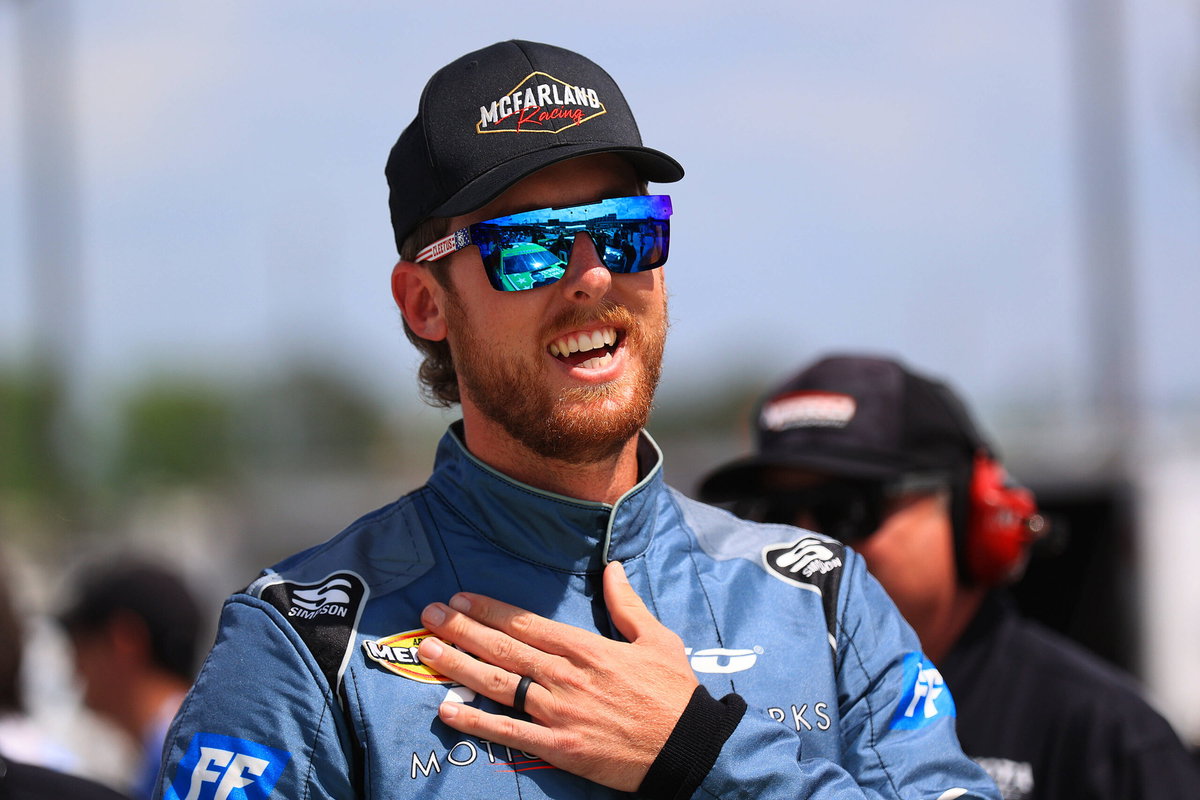
For years, Cleetus McFarland has watched drivers take on the challenges of Freedom Factory, the Florida racetrack he brought back to life. This weekend, however, the YouTube personality and track owner has a different perspective waiting for him. Instead of overseeing the action from the sidelines, McFarland is preparing to experience the venue’s character from behind the wheel of a Late Model for the first time at his track. And with the track’s history, its familiar challenges and a special family legacy coming together for one event, this is more than another racing appearance for the owner.
Watch What’s Trending Now!
McFarland’s first Super Late Model outing at Freedom Factory comes as part of the 11th annual Bill Bigley Sr. Memorial 128, the season-ending event for the United Auto Racing Alliance (UARA) National division. The 128-lap race brings together some of the country’s leading short-track competitors, with a $30,000 winner’s purse adding to the stakes. The entry list also features NASCAR Cup Series driver Carson Hocevar, alongside Ty Majeski, Tristan McKee, and Caden Kvapil.
Although this is his first Late Model race at his home facility, McFarland is not a newcomer to the discipline. He made his Super Late Model debut at Berlin Raceway in August and returned to competition at New Smyrna Speedway earlier this month. His latest outing, however, gives him the opportunity to measure himself against a track he knows from an entirely different position.
And his first impression of the surface might surprise those familiar with its reputation.
“I’ve heard all the complaining from the other Late Model drivers about how bumpy it is for so many years,” McFarland said in conversation with Short Track Scene. “Today, I understand that that’s completely invalid. The track is not too rough to race. I love it. I thought it was awesome.”
What’s the Biggest Thing You’re Looking Forward to From Dodge’s NASCAR Comeback?
He acknowledged that the bumps initially made the experience feel particularly aggressive, comparing them to the ones drivers encounter entering Turn 3 at Charlotte Motor Speedway. But rather than viewing the uneven surface as something that needs correcting, he found an element of enjoyment in having to adapt to it.
“I was thinking about it for a second. I was like, wow, this is kind of violent. And then I was like, wait. This wouldn’t be fun at all if it was a smooth surface. I mean, if it was a perfect surface, we’d all be sleeping in our cars,” he added.
That assessment also appears to have settled one question about the track’s future. When asked whether getting behind the wheel might convince him to repave the circuit, McFarland was quick to dismiss the possibility.
“No, no,” he responded. “I thought today would maybe open my eyes to like, wow, this needs to be repaved. I definitely don’t think it does. And I don’t plan on it.”
His enthusiasm extended beyond the condition of the track. Cleetus McFarland was encouraged by the progress made during practice, reporting that he had finished around 14th among approximately 40 cars. With his team finding improvements every time the car went out, he was targeting a top-15 qualifying position before the main event.
The significance of this appearance becomes clearer when considering how Freedom Factory came into existence. Originally known as DeSoto Speedway, the 3/8-mile asphalt oval opened in the early 1970s and became a familiar destination for Florida’s short-track racing community. However, the facility had been sitting unused for approximately two years when Cleetus McFarland purchased the property in January 2020.
Owning a racetrack had long been a dream for the car enthusiast, who wanted a dedicated space for the vehicles and projects featured on his YouTube channel. The abandoned property offered that opportunity, although bringing it back required considerable work. When Cleetus McFarland first acquired it, vegetation had taken over sections of the facility, with weeds even growing through the racing surface.
He renamed it Freedom Factory and set about restoring the venue while building an identity that combined traditional motorsports with the automotive entertainment his audience had come to expect. The facility eventually welcomed spectators for its first public event in February 2021, following extensive renovations. Since then, it has hosted everything from circle-track competitions to burnout events and its signature Crown Victoria races.
But the return of traditional stock car racing has remained an important part of that revival.
The Bill Bigley Sr. Memorial carries a particularly meaningful connection to the property. Its inaugural edition was held at DeSoto Speedway in 2016. Following the track’s closure, the event moved to 417 Southern Speedway in Punta Gorda before eventually returning to its original home at Freedom Factory in 2023.
For the Bigley family, the race is about preserving the memory of Bill Bigley Sr. His grandson, Dylan Bigley, previously explained that his father established the memorial to honor his grandfather, who had introduced racing to the family and supported several generations of competitors. Dylan has described the event as something that means the world to his family.
McFarland recognizes that history, too. Speaking about the occasion, he acknowledged the sentimental value it holds for the Bigleys while highlighting the role it has played in rebuilding the venue’s stock car racing programme.
“For me, the race also kind of signifies us bringing back stock car racing here because we didn’t do much of it until the Bigley came along,” he explained.
He also credited UARA and its team for helping establish that growth, adding that he did not believe stock car racing at Freedom Factory would have developed in the same way without their involvement.
That commitment to keeping grassroots racing alive has parallels elsewhere in the NASCAR world. Three-time Cup champion Tony Stewart, for instance, purchased Eldora Speedway in 2004, taking responsibility for a venue that has become one of American dirt racing’s most important destinations.
Beyond track ownership, NASCAR personalities Dale Earnhardt Jr., Jeff Burton, Kevin Harvick, and Justin Marks have also invested in the short-track ecosystem through their joint ownership of the CARS Tour, helping provide a platform for regional Late Model competitors and emerging talent.
For Cleetus McFarland, the responsibility is more personal. Freedom Factory is not simply another venue on the racing calendar; it is a facility whose revival has become closely tied to his own journey in motorsports. Hosting established short-track events, bringing NASCAR names to Bradenton and giving local competitors a place to race all contribute to the future he envisioned when he purchased the abandoned property.
Now, with his first Late Model race at the venue approaching, Cleetus McFarland gets to experience another side of that achievement. The track has already given him a playground for his automotive ambitions and a home for the racing community he helped rebuild. This time, he gets to be part of the action on the other side of the catch fence.