
Essentials Inside The Story
- NASCAR might not be able to discourage teams from fuel-saving tactics.
- These tactics that have plagued superspeedway racing in the past few years.
- And this is changing the way driver and teams think.
Every time the yellow flag flies during a cup race, Chase Briscoe finds himself flicking the engine on his No. 19 Toyota. It has become a… way of doing things. He even admitted last year that there were races where he kept saving fuel out of pure habit, not need. But that instinct didn’t come from nowhere. It is a byproduct of racing in NASCAR’s Next Gen car, which has quietly rewired how drivers think, and Ricky Stenhouse Jr. will agree.
Watch What’s Trending Now!
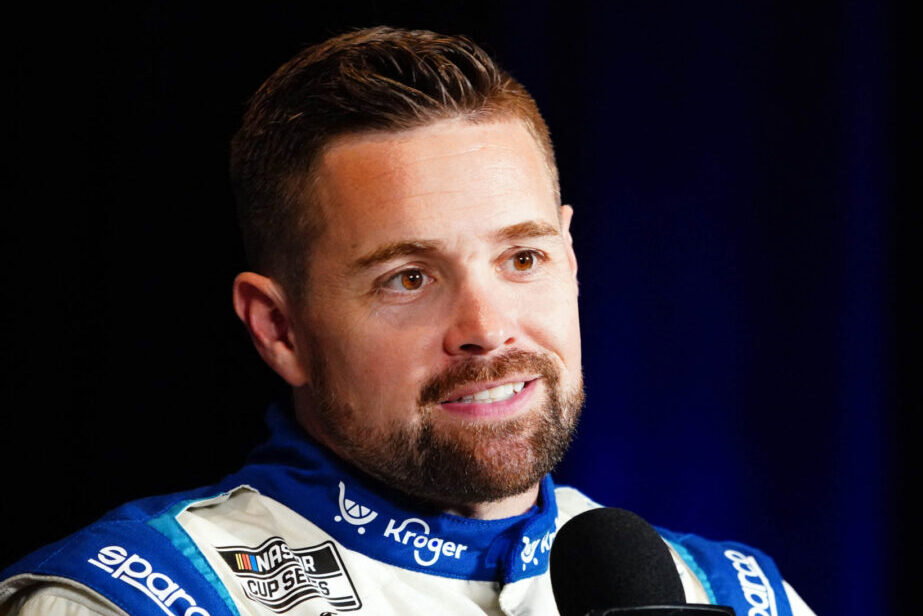
In an interview with SiriusXM NASCAR Radio, Stenhouse spoke about how the Next Gen car can’t help but produce fuel saving on superspeedways. He circled a big factor behind that to be the pit stops, and to be more precise, the quicker nature of the pit stops.
“You can’t fill your race car full of gas as quickly as you can change the tires. So, you used to be able to fill your car full of gas while you were hitting five lug nuts because it took forever compared to what it does now. So, I guess some of it is a product of the single lugs, maybe,” he opined.
Here’s the thing: When NASCAR introduced the Next Gen car in 2022, one of its defining features was its single lug nut wheels. In the Gen 6 car, there were five lug nuts. Therefore, the time it takes to take off and put back four lug nuts is significantly less than the time it takes to do the same with 20.
Because of this, Stenhouse claimed that it is more of the Next Gen car, which indirectly ends up producing the fuel-saving behavior on track.
“It used to be your tires took the longest. And now your fuel takes the longest. So, that’s your limiting factor. I guess it is more of the race car than anything now,” he added.
It’s worth mentioning that Stenhouse is no stranger to the ways and nature of superspeedway racing. All four of his Cup wins have come at plate tracks. And to his point, the average time for a pit stop in the Gen 6 era was 11-13 seconds. But in the Next Gen era, that time is 9-11 seconds. Between the two extremes, it is a difference of 4 seconds, which may not seem like a lot. But in motorsports, that’s the difference between night and day, or a win or a top 5.

⛽ "The biggest thing it used to be your tires took the longest and now your fuel takes the longest and that's the limiting factor." @StenhouseJr on if the Gen 7 car is the main reason to blame for fuel conservation at superspeedways. More ➡️ sxm.app.link/NASCARIntervie…
As a direct address of the fuel-saving tactics that have plagued superspeedway racing in the past few years, NASCAR introduced a radical change to Talladega. While last season the first and the second stage ended on lap 60 and 120, this season the first stage would go until lap 98, the second until lap 143, and the final stage until lap 188.
This means that the first stage would be a lot longer and the last two stages, a lot shorter. The aim is to discourage fuel savings by drivers in the final two stages, so they race it out with a full throttle. But just like Ricky Stenhouse Jr., there’s another star driver who believes that may not end up happening.
NASCAR champion wants the Next Gen car to drive badly to prevent fuel saving
The 2023 Cup champion, Ryan Blaney, shared his thoughts on whether NASCAR shortening the last two stages at Talladega would help in reducing fuel savings from drivers.
“It’s not going to stop,” Ryan Blaney said earlier this week. “We’re still going to save gas, maybe just a little bit less than what we have.
He revealed that in discussions between NASCAR and drivers, they have raised the possibility of changing the car in a way that the fuel saving doesn’t become a factor. Blaney claimed that he wants the cars to ‘drive so bad’ that drivers are forced to pit for tires, and the fuel game becomes obsolete.
But on the other hand, there is Alan Gustafson, the crew chief for Chase Elliott, who simply ruled out there being a U-turn from fuel-saving tactics. “You just can’t unlearn things. As the margin in the cars has gotten less and less and less … you have to find some advantage, somehow.
“I think we all learned through the rules and the cars becoming extremely similar that you had to get advantages in other ways besides what, at the time, was conventional, and that was saving fuel and jumping people on pit stop cycles,” he mentioned earlier this week.
While Blaney’s point was more on the lines of finding a solution to combat the problem, Gustafson’s has more in common with Stenhouse. This is to say that both of them claimed that the very nature of the Next Gen car has led to the birth of fuel-saving tactics. And as Gustafson claimed, even if the rules are changed or the cars are opened up more, fuel-saving tactics would remain.