

It was Carson Hocevar’s moment to dazzle. Two weeks after his maiden Cup Series victory in Talladega, Hocevar made his way to the 2026 Met Gala, where he became the first NASCAR driver to attend the event since Jeff Gordon in 2010. Looking dapper, Hocevar put the stock car racing world in front of an audience that is not always connected to the racetrack. As evidenced by Dale Earnhardt Jr.’s reaction afterward, it was just what the sport needed.
Watch What’s Trending Now!
“Listen, I think that was fantastic,” Earnhardt said on his podcast, Dale Jr. Download, “And the reason why, I would have never expected a driver to be invited to that. I don’t even know what it is. I think it’s a little bit of a celebration of fashion and art. Doesn’t matter.”
Hocevar, who became NASCAR’s 208th driver to win a Cup Series race, followed his impressive performance in Talladega with a win in the Truck Series race in Texas. In the Wurth 400 two days later, he earned pole position ahead of teammate Daniel Suarez, which marked Spire Motorsports’ first-ever front-row lockout at this level.
In a matter of weeks, the 23-year-old became one of the most talked-about names in NASCAR, which explains his presence at the Metropolitan Museum of Art in New York for what is arguably the year’s biggest fashion event.

Just a conversation between two dudes: "Carson Hocevar went to the Met Gala" "What is the Met Gala?" "It's a place where people get dressed up in weird clothes, a big deal" "That's good"
Earnhardt Jr’s nod comes at a crucial time, as Hocevar’s Met Gala appearance was not widely appreciated by the NASCAR community. However, visibility of sport is also key, and Earnhardt claimed that representation is needed everywhere.
“We need drivers, not all of them, we don’t need them all going to this thing, we need one,” he said. “We need one over here, one over there, and one doing this thing and one doing that thing. We need our drivers in these unusual spaces, connecting with people that aren’t connected to our sport.”
Viewership has been a major issue for NASCAR, with numbers steadily dwindling over the years. In the early 2000s, the average audience per race hovered around 10 million viewers. A decade later, that figure had dropped to roughly 5 million. By 2025, the average fell further to just 2.45 million viewers, marking another sharp year-over-year decline of nearly 500,000. Appearances from some of its biggest stars at mainstream events could help NASCAR tap into newer audiences and potentially slow that downward trend.
Imago
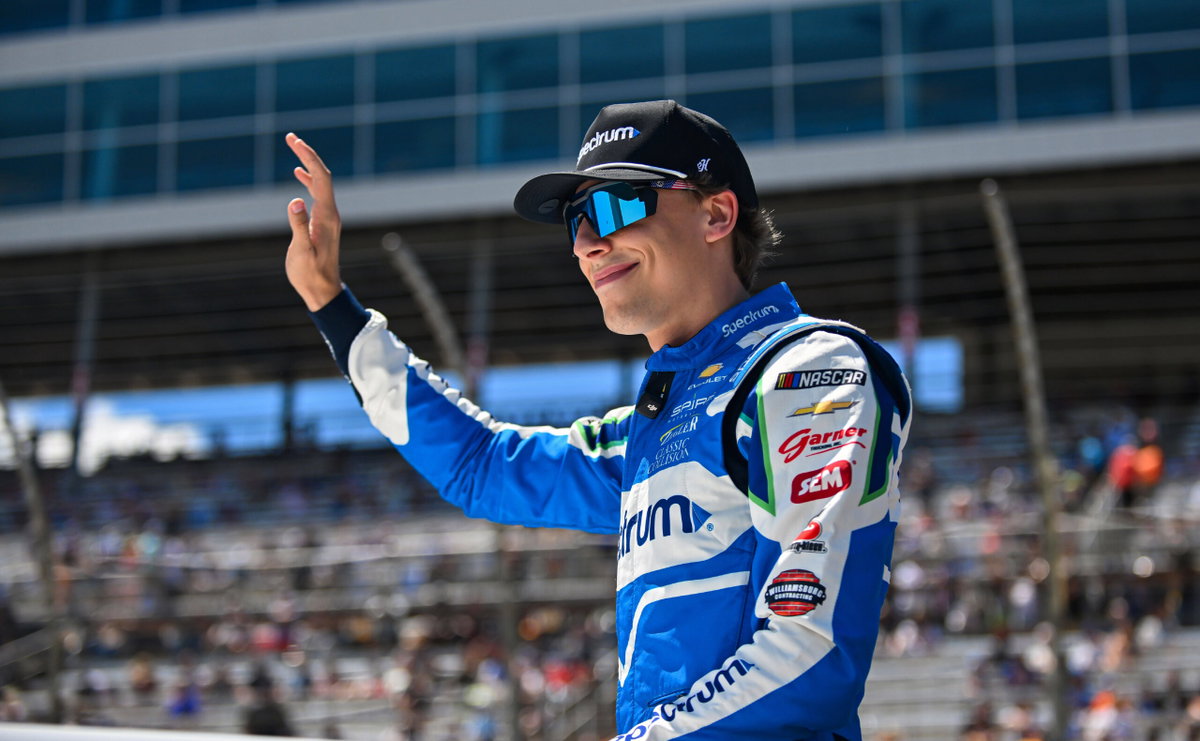
FORT WORTH, TX – MAY 03: Carson Hocevar 77 Spire Motorsports Spectrum Chevrolet waives to fans during driver introductions before the Wurth 400 in the NASCAR, Motorsport, USA Cup Series on Sunday, May 3, 2026 at the Texas Motor Speedway in Fort Worth, TX. Photo by Austin McAfee/Icon Sportswire AUTO: MAY 03 NASCAR Cup Series Wurth 400 EDITORIAL USE ONLY Icon260503024
Hocevar admitted it was a surreal experience away from the world of NASCAR and sports as a whole, though he also acknowledged it was slightly outside his comfort zone.
Carson Hocevar is not very confident in a suit
Give Carson Hocevar racing overalls, and he’ll cruise effortlessly in races, as he proved in Talladega and Texas, but replace that with a tuxedo, and he gets shaky. “I’m confident racing and putting a race suit on, but when I put this suit on, it’s hard for me to get this confident,” he said in an interview.
Hocevar kept things classy for the occasion, wearing a dark gray suit paired with a white shirt and black tie. He completed the look with a subtle lapel pin, giving off a clean, polished appearance fitting for the star-studded event under the lights.

Yes, NASCAR driver and Talladega winner Carson Hocevar really is at the Met Gala.


“I get to wear this watch,” he continued in the interview. “My dad’s first watch he ever gave me, so I wanted to wear that tonight. And then my mom is super proud. I think she’s more proud that I’m here than winning Talladega.”


they did

Hocevar also hoped to run into pop sensation Sabrina Carpenter at the gala. Whether that actually happened remains unclear, as no pictures of the two together have surfaced online so far, making it seem somewhat unlikely.