Imago
Nigel Kinrade
Imago
Nigel Kinrade
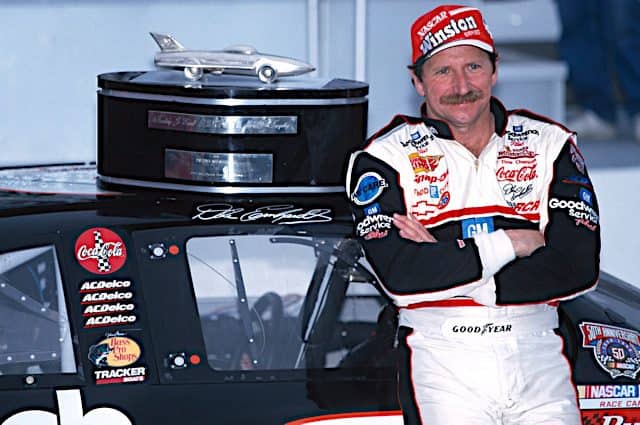
A love-hate relationship. That’s the best way to describe Dale Earnhardt‘s bond with the Daytona International Speedway and the Daytona 500 race. For the No. 3 driver, the victory lane of the ‘Great American Race’ was always a fleeting dream until 1998. And NASCAR’s very own singer, Luke Combs, perfectly captures the heartwarming feeling of that victory.


Multiple close calls and frustrating tragedies defined his experience at the track with that race. “20 years of trying, 20 years of frustration,” was his only feeling about the race. So in 1998, when he finally won the Daytona 500, there was nothing greater for him and his fans.
Watch What’s Trending Now!
By that time, he was already a seven-time champion in the NASCAR Cup Series. You could argue that he had achieved almost everything there was to achieve, except the elusive Daytona victory. No wonder, when he won it, he was sitting back in the motor coach a week later to watch that replay. Because–
“I just wanted to make sure.” That was the effect and the burden that numerous losses and runner-up finishes had on Dale Earnhardt. Luke Combs is able to retell the same tale and same poignant feeling of almost being there yet being unable to win through the verses of his latest song, Daytona 499.
Luke Combs Pays Tribute To Dale Earnhardt & His Own NASCAR-Loving Roots With Beautiful Heartbreaker, “Daytona 499” – @WhiskeyRiff https://t.co/1WwFfmjY4J
— Adam Stern (@A_S12) March 21, 2026
We could’ve been Earnhardt in that three car
Down in victory lane
Standin’ on the hood with that Goodwrench
Wasting good champagne
We could’ve been burning out ‘stead of burning out
Before that finish line
But we were Daytona 499
Yeah, we could’ve been Earnhardt in that three car
Just like ’98
Standin’ on the hood with that Goodwrench
Wasting good champagne
We could’ve been burning out ‘stead of burning out
Before that finish line
But we were Daytona 499
He compares Earnhardt’s victory to his own relationship in the song. He and his girlfriend were leading positively. But it seemed like they were going too fast. So they had plenty good tires, not enough gas. And right at the finish line, they were Daytona 499.
It is the same emotion that Dale Earnhardt would’ve felt when he was running in the lead. Only a few turns away from the finish line, either his car would give up on him, or he would face a crash. Or somehow, he would lose out to another driver. And that’s why Combs’ song calls out his tragedy, comparing it with his own for moving too fast.
Unfortunately, as the song ends, the listeners and Combs himself are unable to shake off the victory in his relationship. So his story remains a tragedy that was never able to redeem itself as Earnhardt did in 1998. Perhaps that is why the song is called Daytona 499, as they were never able to ride to the end of the final mile.
But this is not the first time Luke Combs has collaborated with NASCAR.
NASCAR’s very own singer, Luke Combs
Luke Combs was born and raised in North Carolina. So it’s no wonder that he tries to incorporate his NASCAR-loving roots into his music. Earlier, he released a music video featuring the likes of Dale Earnhardt Jr. and Richard Petty.
His song, Back In The Saddle, is another banger from his latest album, The Way I Am. For the music video of that song, Combs invited Dale Earnhardt Jr. and Richard Petty to join in. Luke Combs is a winner of three Grammy Award nominations, two iHeartRadio Music Awards, and four Academy of Country Music Awards
He is also a six-time Country Music Association awardee, including the 2021 and 2022 Entertainer of the Year, which is their highest honor. Combs is a well-known figure in NASCAR. After all, he performed Blue Collar Boys and Angels Workin’ Overtime from his album for the 2020 NASCAR Cup Series Championship race during NBC’s coverage.
Blue Collar Boys was never performed previously on television, and Angels Workin’ Overtime was never performed across any national media. It won’t be a surprise if NASCAR and Combs collaborate on something similar again this year.
Written by

Edited by

Suyashdeep Sason