
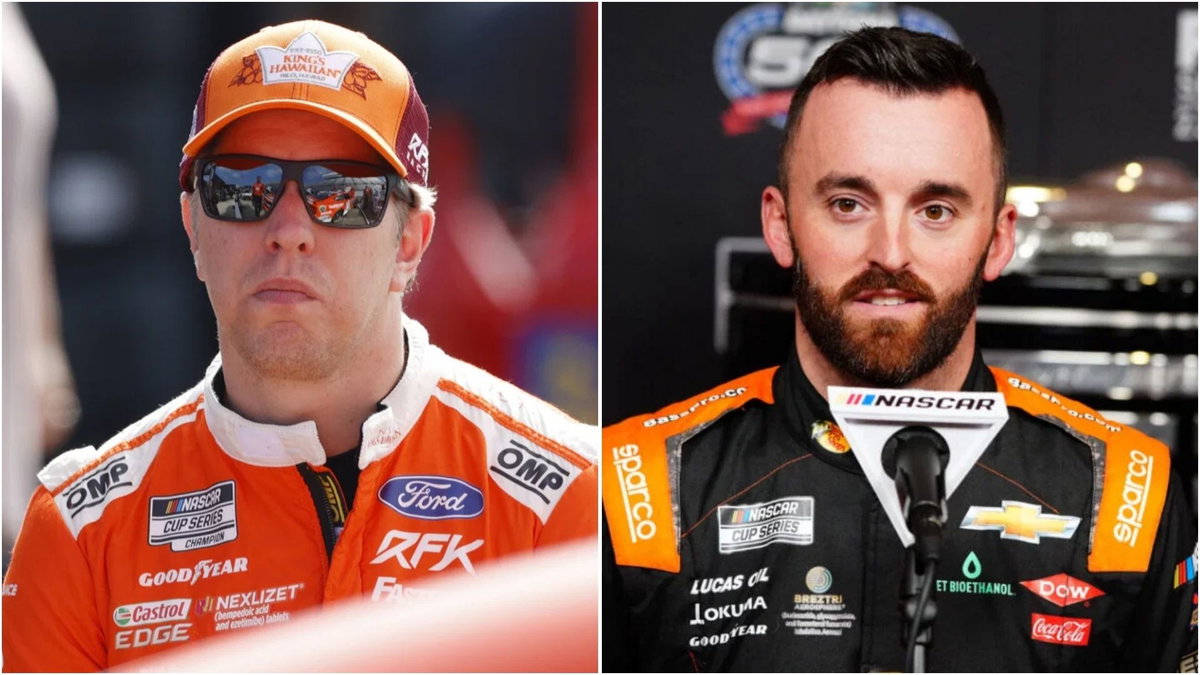
During the NASCAR Cup Series race in Nashville, Brad Keselowski’s car was wrecked in Stage 3, effectively ending his night. The perpetrator of this was Austin Dillon. The story, however, starts much earlier, when the RCR racer was left spinning after Keselowski bumped into him.
Watch What’s Trending Now!
As soon as Keselowski’s car was wrecked, his spotter knew what had happened. “The 3 (Austin Dillon) wrecked you on purpose; he’s mad at you from earlier,” spotter TJ Majors told the driver over the team radio, as reported by NASCAR journalist Jordan Bianchi. However, Dale Earnhardt Jr. didn’t readily accept Keselowski’s camp’s suspicion of revenge, which led to an intriguing discussion about where aggressive racing ends and payback starts.
“My opinion is that did he try to wreck you on purpose? I don’t think he did,” Junior said on his podcast Dale Jr. Download. “Did he give a s*** that you got wrecked? No. But I don’t think, considering everything that they’ve had to go through the last couple of weeks, that they want to be out there wrecking people.”
Dale Earnhardt Jr. is no stranger to vengeful racing. In 2008, he admitted to intentionally running into Kyle Busch in the closing laps of a race in retaliation for an incident that had happened earlier in the season. Although in 2018 the two confirmed that it wasn’t intentional, there were other incidents in his career where Earnhardt Jr. showed his tough side.
After the incident on Lap 145 when Keselowski spun Dillon, the latter was not too happy. When his contact led to Keselowski’s night ending just 47 laps later, the very obvious blame was on him. However, the RCR driver was not aware of what exactly had even happened.
“Why did everyone check up there?” he said, per Matt Weaver. “I was already on the brake pedal.”
After hearing from his spotter, Keselowski spoke to the Amazon crew about the incident and blamed Dillon for what had happened on the track.
“I don’t know. I know I got hit from behind. Can’t really put myself in somebody else’s head. But it’s a shame. I felt like we had just made the adjustments on the car we needed to be competitive. It’s pretty clear he wrecked me intentionally after seeing that replay. So turnabout’s fair play,” Brad Keselowski said to the Prime team.
Keselowski’s spotter, Majors, who is the co-host on Dale Earnhardt Jr.’s podcast, spoke about the incident and why he felt that Dillon wrecked the No. 6 car on purpose.
“Just watching it, to me, he’s just tracking him. Out of the corner, he’s like, ‘Oh, I’m going where he goes.’ He’s looking for him,” Majors said.
Even NASCAR has landed closer to Dale Jr.’s side than Brad’s.
Senior Director of Racing Communications Amanda Ellis said on the official NASCAR Hauler Talk Podcast that before choosing not to impose a penalty on Dillon, competition strategist Scott Miller examined SMT telemetry and radio communications.
“Scott Miller pulled all the data from that incident, and we knew pretty quickly that Austin was out of the throttle, and they both were at the time of the incident. They obviously tangled on the track, and then the incident happened, right?” she clarified.
Ellis especially cited broadcast analysts Steve Letarte and Dale Earnhardt Jr., who both believed the action did not qualify as deliberate retribution.
“To your point, TV also kind of made that judgment call that they didn’t think it was on purpose, even though they had a difference of opinion about the race. We think it was more of a racing incident in NASCAR’s opinion.”
This was not the first incident between the two drivers. At Michigan in 2021, Keselowski made contact with Dillon, which sent him outside the retaining wall. Another incident happened in New Hampshire in 2022. Despite suspicion and frustration, NASCAR apparently didn’t find enough telemetry, audio, or driving input to cross that same line. Which leaves Nashville in that uncomfortable NASCAR gray area. Nobody completely believes it was accidental, but nobody can prove it wasn’t racing either.
And today, more than ever, that distinction is important.
Ryan Preece’s penalty was recently upheld by NASCAR, which mostly relied on radio remarks and intent analysis in the wake of his encounter with Ty Gibbs at Texas Motor Speedway. In that instance, statements made over the radio were included in the evidence.
With the NASCAR Cup Series headed to Michigan, it will be interesting to see if the two clash once again on the track for a repeat of the 2021 race. After all the buildup, things could get really heated if that happens.