
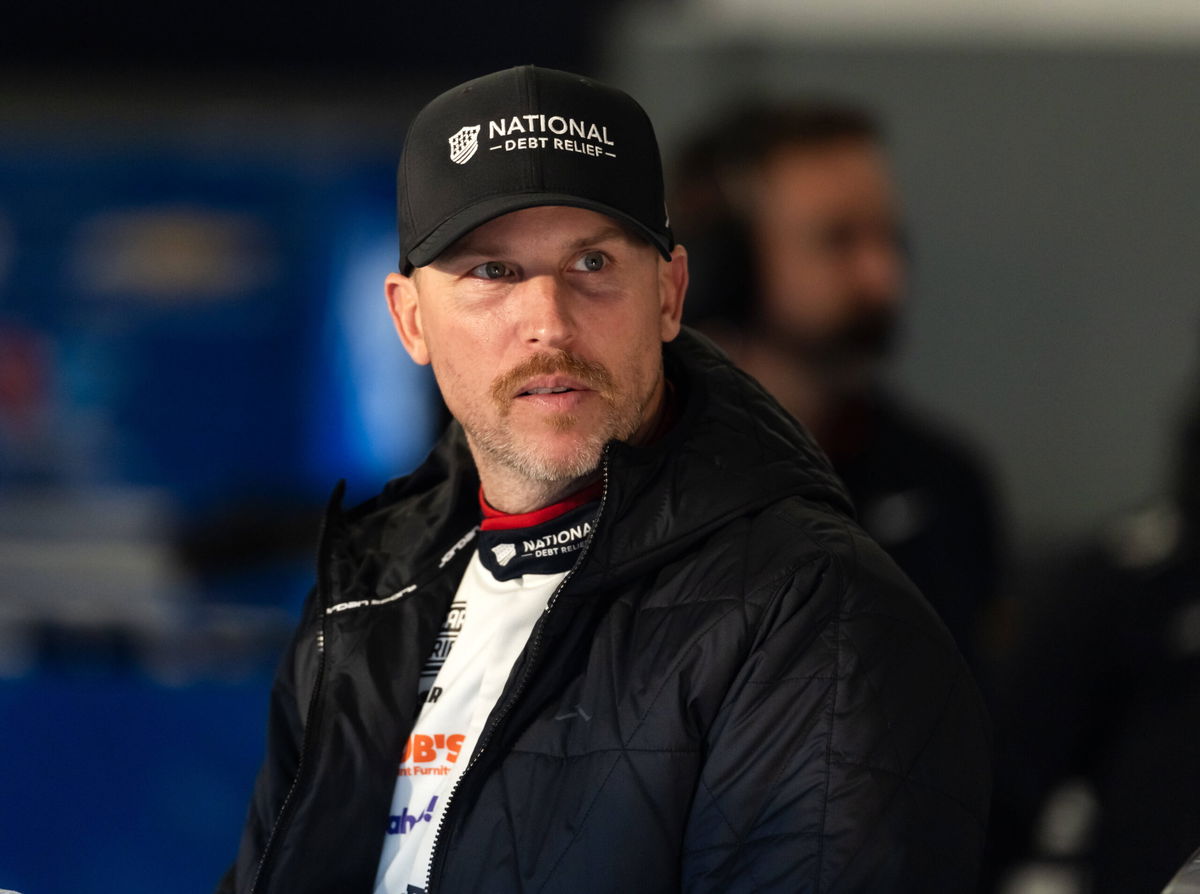
Denny Hamlin looked every bit like a championship contender at Las Vegas. After securing pole position, the 23XI Racing star settled into the top five through the opening stage and appeared to be in control of his race. Then, with the stage winding down, everything changed. A moment on track put Hamlin in a difficult spot and triggered a NASCAR decision that quickly caught Dale Earnhardt Jr.’s attention.
Watch What’s Trending Now!
“You’ve got Denny and them winning the lawsuit and them having this great year and now Denny’s in this opportunity, sitting in this opportunity to win the championship, and he spins out like, clearly spins down across the racetrack in front of traffic. That’s a car spinning out. I’ve seen him throw yellows for cars glancing off the wall, right? And continuing on without issue. So, I was surprised,” Dale Earnhardt Jr. was referring to the decision that followed Denny Hamlin’s Stage 1 spin at Las Vegas, where NASCAR opted to keep the green flag out with only three laps remaining.
Hamlin had started from the pole and was running fourth when his No. 11 Toyota snapped around in Turns 3 and 4. The car slid across the apron before Hamlin continued, but NASCAR never stopped the race. That decision mattered because Hamlin was already trying to recover from an earlier strategic mistake.
When Zane Smith brought out the first caution on Lap 43, Hamlin came to pit road for right-side tires. That dropped him to ninth for the restart and, more importantly, allowed Kyle Larson to take the wave-around and return to the lead lap after falling a lap behind during an earlier lengthy pit stop.
Hamlin worked his way back toward the front and was fourth when he spun. He later admitted he was pushing to recover the track position he had lost, saying he went higher in Turns 3 and 4 and encountered marbles that sent the car around. The spin itself was costly, but the bigger problem came when the Toyota slid across the apron. Hamlin initially believed he had escaped without damage, only to discover that the car had sustained damage underneath and at both ends.
“At the time, I didn’t think there was anything wrong with the car,” Hamlin said on his Actions Detrimental podcast. “I heard it that something underneath scraped the bottom as I’m spinning coming down the track, but I realized very quickly once we got back, I knew that it wasn’t just traffic. We had a major problem with the car.”
Hamlin said the damage took away what he believed was a race-winning car. He managed to recover to 11th before another problem struck just before a restart. A brief fuel-pickup issue caused the No. 11 to cut out, sending him back outside the top 20. He eventually recovered to finish 16th.
The result was particularly painful because Larson did almost the exact opposite. After his early struggles, Larson used the wave-around, recovered through the field and finished second. Hamlin earned only 22 points and lost another 14 to his championship rival. Larson’s advantage over Hamlin grew from 26 points entering Charlotte to 40 with five races remaining.
That is where Dale Jr.’s criticism becomes more significant. Hamlin’s relationship with NASCAR has been contentious for years, and the latest incident arrives after one of the biggest battles between a team owner and the sanctioning body in NASCAR history.
In 2024, Hamlin’s 23XI Racing and Front Row Motorsports filed an antitrust lawsuit against NASCAR and CEO Jim France. They accused the organization of anti-competitive practices involving the charter system, racetrack exclusivity, Next Gen technology and NASCAR’s control over parts and suppliers. The teams argued that NASCAR’s structure limited competition and put teams at a disadvantage.
Hamlin has also been one of NASCAR’s most outspoken critics of the Next Gen car. He argued that the car “wasn’t ready” when it debuted in 2022 and has repeatedly questioned NASCAR’s reluctance to make changes that drivers and fans have demanded, including additional horsepower.
Then there are the on-track incidents that have put Hamlin in NASCAR’s spotlight. In 2023, he was fined $50,000 and docked 25 points after admitting he intentionally wrecked Ross Chastain on the final lap at Phoenix. NASCAR cited rules against manipulating the outcome of a race and actions detrimental to the sport, while Hamlin argued that the incident was part of hard racing.
That history makes Dale Jr.’s point about consistency especially relevant. Hamlin has spent years questioning NASCAR’s decisions, while NASCAR has also penalized him for actions and comments that officials considered violations. Now, with Hamlin chasing his first Cup championship and 23XI having just prevailed in its legal fight with NASCAR, another decision involving the No. 11 car was bound to attract attention.
Still, there is a reasonable explanation for why NASCAR did not throw the yellow. The incident came just three laps from the end of the stage, and Hamlin’s car remained mobile after the spin. NASCAR has discretion to determine whether a car that spins but does not create an obstruction requires a caution.
The sport also recently changed its stage-break procedure, giving officials a mechanism to end a stage when a caution occurs inside the final 10 laps rather than allowing the race to restart only to immediately enter another caution period.
But that is precisely why the decision caught Dale Jr. off guard. He has seen NASCAR throw cautions for cars that merely glance off the wall and continue without obvious problems. Hamlin’s Toyota, meanwhile, visibly spun across the racing surface before sliding onto the apron. Whether NASCAR judged the track sufficiently clear or simply chose not to interrupt the stage, the decision created the exact kind of inconsistency Dale Jr. expected people to question.
Hamlin himself did not turn the incident into another fight with NASCAR. His post-race frustration was directed primarily at himself and his team’s missed opportunities. He admitted he was pressing for stage points and said he had taken his eye off the ball at the end of the stage.
That may ultimately be what separates this controversy from some of Hamlin’s previous battles with NASCAR. The sanctioning body made the call, but Hamlin’s own spin, the earlier pit-road decision and the later fuel issue all contributed to the 16th-place finish.