
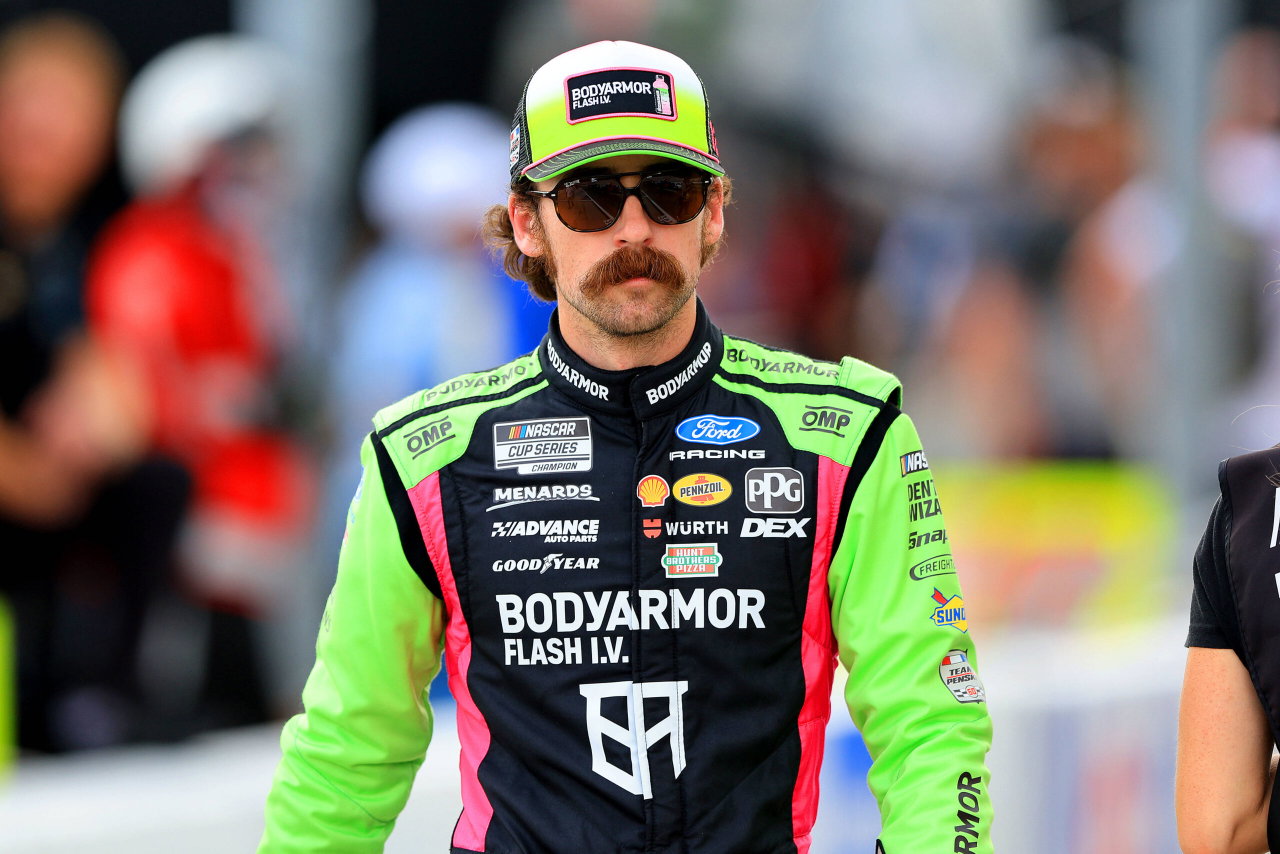
The Chase is almost here, and Denny Hamlin will enter NASCAR’s postseason as the No. 1 seed. That gives the Joe Gibbs Racing veteran a 25-point advantage over second-place Ryan Blaney when the championship battle begins. On paper, it looks meaningful. But Blaney believes Hamlin’s cushion is anything but secure. The Team Penske driver has seen how quickly points gaps can change under NASCAR’s new format.
Watch What’s Trending Now!
“It’s definitely not safe, but it’s better than starting 50 behind them. You know you’re not playing catch-up; you have to hold serve, so it’s definitely not safe. But like I, it’s better than coming from behind,” Ryan Blaney told Steven Taranto when asked whether the 25-point advantage was enough to protect the regular-season leader.
Blaney’s response gets to the heart of NASCAR’s new Chase format. The No. 1 seed does have an advantage. But it is not large enough to create much breathing room once the postseason begins.
16 drivers advance to The Chase. Unlike the previous system, however, the field is re-seeded only once – after the conclusion of the regular season. Each driver’s starting total is determined solely by where they finished in the standings.
The No. 1 seed starts The Chase with 2,100 points. Second place begins with 2,075, while third starts at 2,065. The totals continue downward until the 16th driver starts with 2,000.
That creates an important distinction at the top of the standings. Hamlin receives a 25-point advantage over the second seed. But from second to third, the gap is only five points. The same narrow separation continues through the remainder of the field.
The idea was to reward the driver who performed best throughout the regular season without making the championship battle effectively decided before it began. However, the 2026 regular season has also already demonstrated just how quickly drivers can gain ground when they put together strong races.
The new scoring system gives victories even greater importance. A Cup Series win is now worth 55 points, up from the previous 40-point value. A driver can score a maximum of 76 points in a single race by winning, collecting 10 points in each stage and earning the fastest-lap bonus.
That means one exceptional Sunday for Blaney (or others) can erase a significant portion of Hamlin’s advantage. His teammate Joey Logano is an example of how quickly fortunes can change. After falling as low as 20th in the standings during the summer, he recovered strongly enough to start the Chase in 9th place in a span of just six races.
Ryan Preece provided an even more dramatic example. Entering the final regular-season race outside the cutline, Preece won the Coke Zero Sugar 400 at Daytona. That single result propelled him into the postseason and pushed Shane van Gisbergen out.
Those swings show why Hamlin cannot simply rely on his regular-season performance. And Blaney is not the only driver who believes the cushion can disappear quickly. Tyler Reddick, who is 35 points behind Hamlin, offered a similar assessment when asked whether that deficit was significant.
“It’s not,” Reddick said of the 35-point gap. However, he acknowledged that closing it may not be easy if both drivers perform at a consistently high level. If Reddick finishes second at Darlington while Hamlin finishes third, for example, the points gain would be minimal.
Stage points could produce another small swing. But neither result would dramatically change the championship picture. Reddick believes the real separation will come when one driver starts winning while another struggles.
With all that being said, the Chase still offers a better road to the championship when compared with the earlier playoff format. In that, after the 26-race regular season, the top 16 drivers had their base totals reset to 2,000 points. Their accumulated bonus points were then added to that figure.
The field faced another reset after each three-race round. Those who survived moved forward with a new base total, along with eligible bonus points accumulated during the playoff races.
That process continued until the championship race at Phoenix Raceway. The final four drivers then had their totals completely reset to 5,000 points, with no playoff points added. The highest finisher among those four won the championship.
The 2026 system takes a fundamentally different approach. There are no three-race elimination rounds and no winner-take-all finale. Instead, the points are reset only once at the beginning of The Chase. From there, the 16 contenders fight across all 10 remaining races, with the driver who accumulates the most points ultimately winning the championship.
That keeps every driver mathematically involved throughout the postseason. For Hamlin, the 25-point advantage is therefore valuable. But it is not protection. The No. 1 seed has earned the best possible starting position. Now, he has to prove he can hold it.