
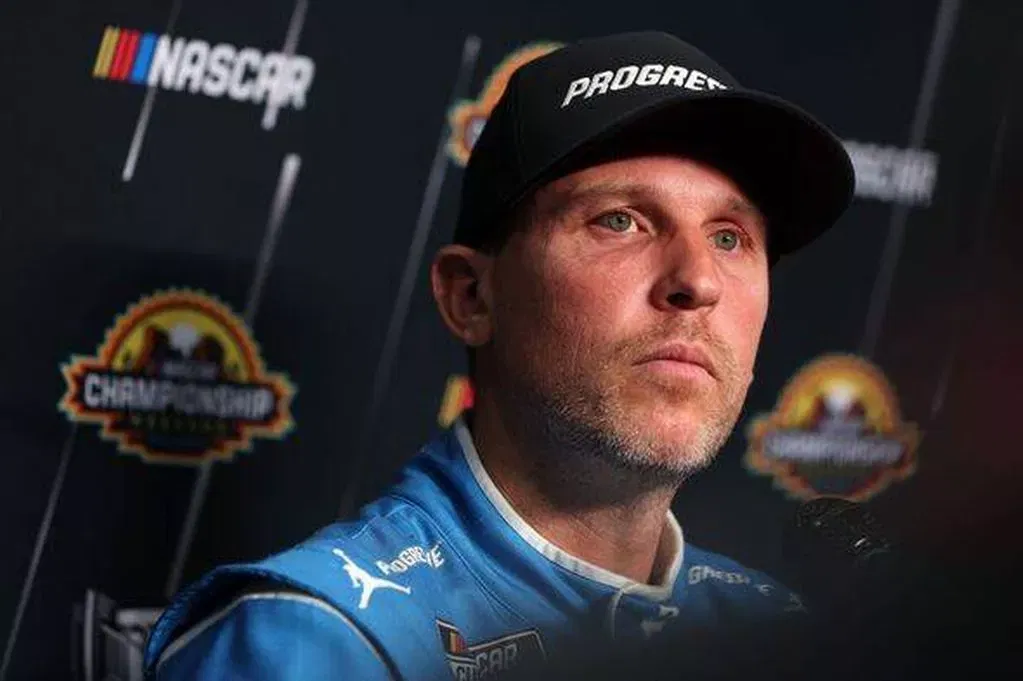
Qualifying has become increasingly important in a season where every point matters. Denny Hamlin, who leads the Cup Series with four pole positions in 2026, knows that better than most. Starting up front not only provides clean air but also influences pit strategy, track position, and sometimes the outcome of the race itself. Hamlin didn’t hold back when the discussion turned to whether the qualifying order ought to be more arbitrary. Instead, the Joe Gibbs Racing driver launched into an unexpectedly fervent defense of NASCAR’s present structure.
Watch What’s Trending Now!
Denny Hamlin says qualifying should reward performance, not luck
“So randomness is not good for sports because I tried to give the example well, what if Brad Keselowski, he’s on the bubble, we’re going to Dover as the regular season finale? You think it’s fair for Brad Keselowski to draw the number 36 pill and he or the number one pill, and he has to go out first? No. It should be he he had ample time throughout the season to accumulate points,” Hamlin said on his Actions Detrimental podcast.
“Wherever he [Keselowski] is in points, that’s 30% of the metric. And then it’s 50% of where you are, or it’s 70% of where you finished last week. So I think what Kelly and Toby are saying is that, oh, you just had a bad week, and you have to race the next week with your arm tied behind your back. And I just don’t get that because you should be able to overcome it,” he added.
Hamlin didn’t really dance around the point when explaining how he feels qualifying should work in NASCAR. And to understand why he feels so strongly about it, it’s important to take a look at how qualifying currently works.
The order is determined using a performance metric that combines 30% owner points standings and 70% previous-race finish. As a result, drivers with stronger combined scores qualify later in the session. That matters because later often means better.
Cars are divided into Group 1 and Group 2. The higher-performing teams are placed in the later group. On most oval tracks (Pocono Raceway, Kansas Speedway, and Phoenix Raceway), drivers get a single timed lap. They are given two laps at short courses like Richmond Raceway and Bristol Motor Speedway. The 20-minute group format used in road courses is very different.
However, formats are not at issue in Denny Hamlin‘s argument. Instead, he is discussing opportunity. He argues that as sessions go, track conditions get better. Grip shifts, temperatures drop, and rubber is wiped off. If qualifying becomes random, a playoff driver could simply lose out because of when they rolled onto the racetrack.
Hamlin also refuted the notion that a poor qualifying place is caused by a single poor result. Because the formula isn’t dependent on a single race, he believes NASCAR already gives drivers plenty of time to recuperate. Qualifying includes season-long owner points. If a contender ends up qualifying early, Hamlin believes they should still be able to drive through the field.
For Hamlin, qualifying should remain a reward for teams that have already earned the right to start later and run faster. And in 2026, Joe Gibbs Racing gave him a Toyota capable of doing just that.
Denny Hamlin’s crew chief isn’t ready to celebrate yet
Hamlin is currently one of the favorites for the Cup Series championship following his recent surge in form. Four victories, including a three-race winning streak at Nashville, Michigan, and Pocono, have him just 19 points behind Tyler Reddick, who began the season with five wins in the first nine races.
But his crew chief, Chris Gayle, who has seen his driver end a season in heartbreak at the last moment before, is not buying into the hype just yet.
“I was just talking to one of the engineers, and I’m like, you know, you don’t want to be greedy,” Gayle said to Sirius XM NASCAR Radio after the Great American Getaway 2026. “You think about this kind of… these kinds of runs in your dreams, right? Of being able to go on a great winning stretch, three poles, all the rest.”
Hamlin’s camp was bullish heading into last year’s season finale in Phoenix. As part of the Championship 4, he truly believed 2025 would be his year, and after leading 208 laps, more than anyone else, it looked like everything would finally fall into place. But then came a cruel twist.
After William Byron cut a tire and hit the wall, Hamlin brought his No. 11 Toyota down pit road for four fresh tires, while Kyle Larson took only two and gained crucial track position for the overtime restart. Hamlin restarted behind Larson and could not recover, finishing sixth as Larson secured his second Cup Series championship.
That’s what Gayle remembers. In racing, momentum seems unstoppable until all of a sudden it isn’t. The No. 11 team appears to be the benchmark at the moment. The more difficult part will be demonstrating that they can maintain that state when the unavoidable bad day comes.