
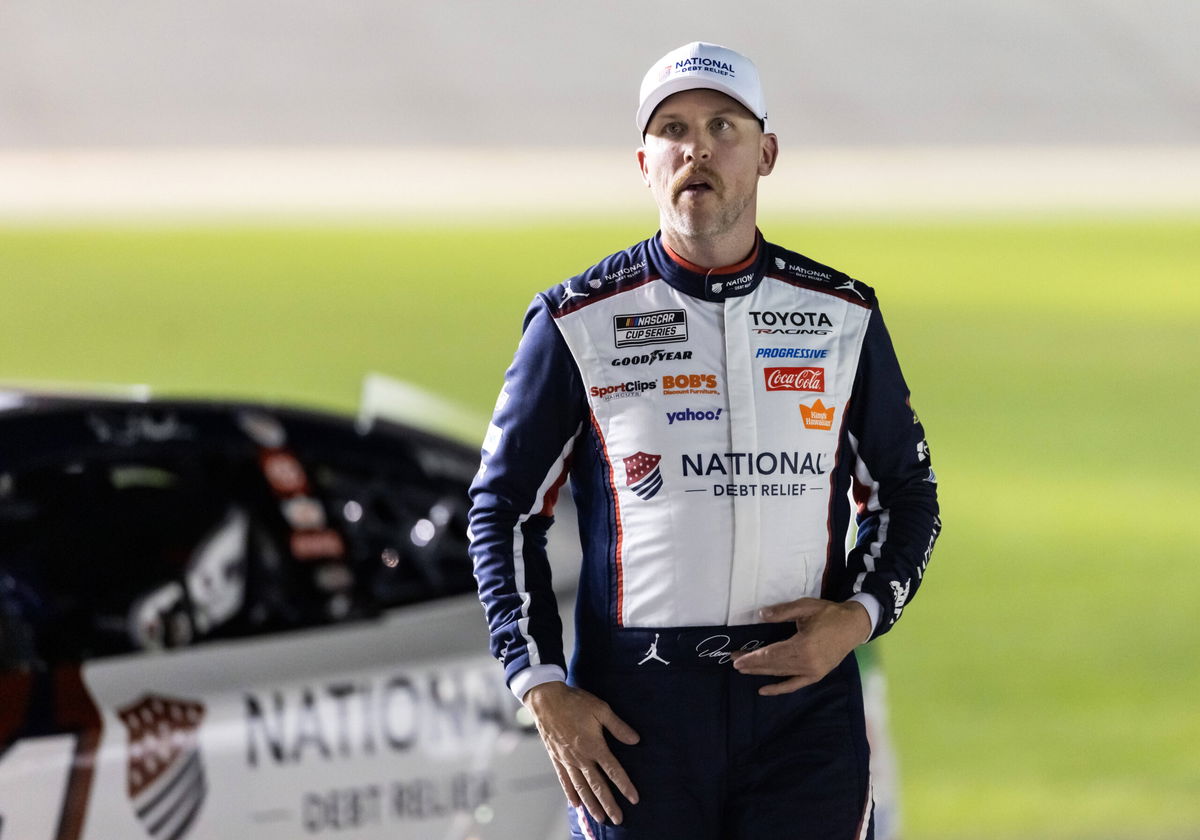
Denny Hamlin did what he needed to do at Charlotte, finishing fifth ahead of Kyle Larson, yet somehow still lost ground in the championship fight. The Joe Gibbs Racing veteran surrendered another nine points to the leader, and his frustration went beyond a lack of long-run speed.
Watch What’s Trending Now!
With qualifying washed out by bad weather, Hamlin was left wondering whether a better starting position could have saved him from a pit-road headache involving rookie Connor Zilisch. Now, NASCAR’s qualifying format has become part of his complaint.
“I certainly felt like we could’ve got a little better pit selection there and, you know, wouldn’t have had, you know, the, the 88. But they, they worked with us the whole race, um, Connor and his team, uh, pitted second time by a couple times, so I appreciate that. And, um, yeah, we’ll just, we gotta pick up the performance,” Hamlin said in a post-race interview.
Denny Hamlin left Charlotte Motor Speedway with another top-five finish, but the No. 11 team had to overcome several setbacks to get there. The Joe Gibbs Racing driver worked his way into the top 10 during the opening 35 laps of the Bank of America 400. However, the first major pit stop quickly changed his afternoon, leaving Hamlin with lost track position and a penalty to overcome.
The trouble started during the competition caution on Lap 37. As Hamlin was pulling out of his stall, Connor Zilisch’s No. 88 Chevrolet obstructed his path, preventing the veteran from completing a clean stop. Hamlin dropped outside the top 20, and matters worsened when a crew member stumbled over the wall while trying to collect a rolling right-front tire during the aforementioned pit stop. NASCAR handed the team a safety violation, sending Hamlin to the rear for the restart.
Rather than let the incident ruin his race, Hamlin began working his way back through traffic. He reached 14th by the end of the opening stage, while Larson continued his strong form by taking the stage win. Hamlin found more speed in the middle segment and climbed to third before Stage 2 ended. His fight with Larson also grew more intense on a Lap 123 restart, when Hamlin moved the No. 5 Chevrolet out of his way. Larson slipped to seventh before recovering to fourth by the stage break.
Hamlin remained competitive in the final stage, running among the top five for much of the stretch. However, he could not hold his position through the closing laps, losing places to Ryan Blaney and Josh Berry before settling for fifth. Larson finished sixth, but Hamlin still lost nine points to the championship leader. He remained second in the standings, now 49 points behind Larson, with Christopher Bell just two points back and Chase Briscoe gaining ground after consecutive wins.
Hamlin pointed to the car’s fading long-run pace as another reason he could not challenge for more. He said the Toyota had been stronger earlier in the day, but the changing conditions left the team without the same advantage once the track cooled and speeds increased. The pit-road issue was frustrating, but Hamlin also knew that better performance would be necessary to keep his title hopes alive.
The starting order was another part of the story. Rain and other inclement weather forced NASCAR to cancel qualifying at Charlotte, meaning the field was set using the series’ qualifying metric rather than a timed session. The formula uses 70% of a car’s finishing position in the previous race and 30% of its position in the owner standings. The lower the resulting score, the better the starting spot.
Hamlin started 12th under that system and believed a stronger starting position might have given his team a better pit-stall selection. That, in turn, could have helped avoid the awkward situation with Zilisch’s car. Still, he did not direct his frustration at the rookie. Hamlin praised Zilisch and his crew for working around the problem by adjusting their pit timing at later stops to help the No. 11 team.
The metric offers NASCAR a way to set the grid when weather wipes out qualifying, but it cannot account for every challenge teams encounter once they reach pit road. Hamlin’s experience showed how starting position, stall placement and a single congested stop can combine to undo an otherwise strong recovery.
The focus now shifts to Phoenix Raceway, where Hamlin dominated last fall by leading 208 of 319 laps. He finished fifth there in March, and another strong performance could help him close the gap to Larson. With four races left and Bell close behind, Hamlin will need cleaner execution and better long-run speed to stay in the championship fight.