Imago
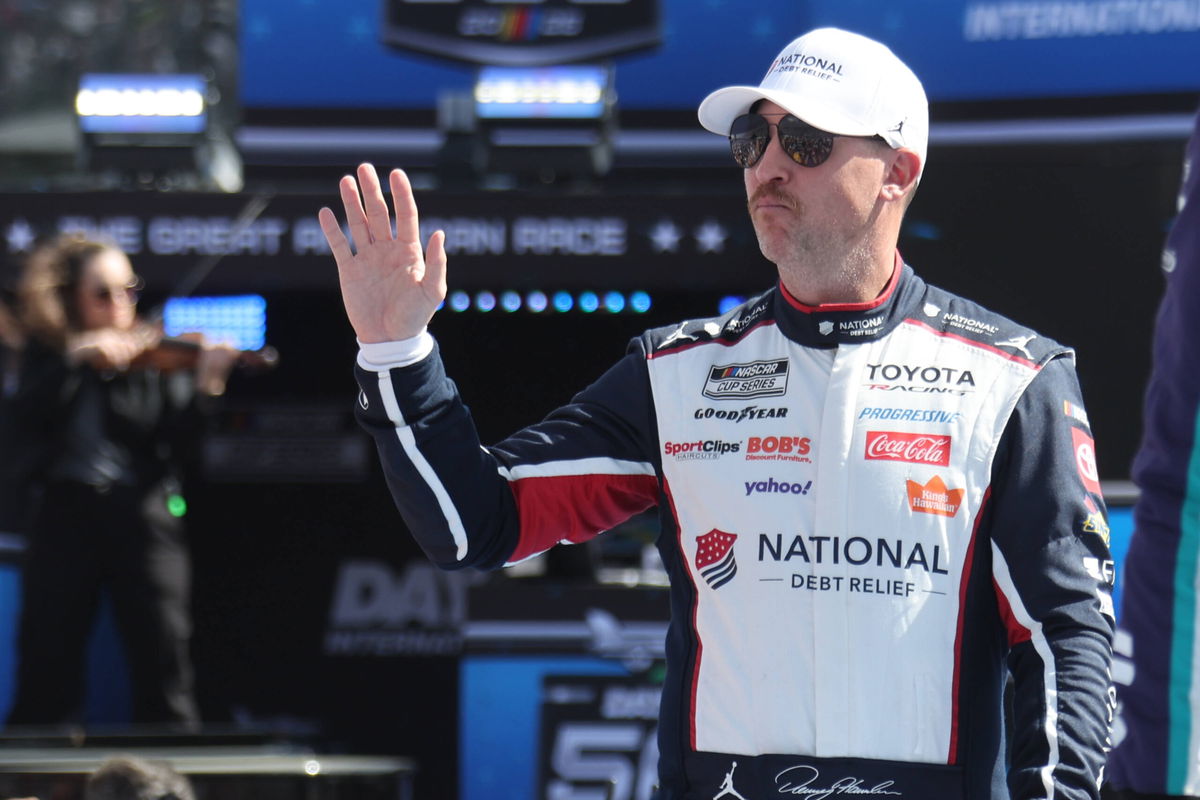
DAYTONA BEACH, FL – FEBRUARY 15: Denny Hamlin 11 Joe Gibbs Racing National Debt Relief Toyota waves to the crowd prior to the running of the 68th NASCAR, Motorsport, USA Cup Series Daytona 500 on February 15, 2026 at Daytona International Speedway in Daytona Beach, FL. Photo by Jeff Robinson/Icon Sportswire AUTO: FEB 15 NASCAR Cup Series Daytona 500 EDITORIAL USE ONLY Icon2602151518500
Imago
DAYTONA BEACH, FL – FEBRUARY 15: Denny Hamlin 11 Joe Gibbs Racing National Debt Relief Toyota waves to the crowd prior to the running of the 68th NASCAR, Motorsport, USA Cup Series Daytona 500 on February 15, 2026 at Daytona International Speedway in Daytona Beach, FL. Photo by Jeff Robinson/Icon Sportswire AUTO: FEB 15 NASCAR Cup Series Daytona 500 EDITORIAL USE ONLY Icon2602151518500
For the past week, Denny Hamlin has been constantly denying his interest in the race for the most NASCAR Cup Series wins. Neither does he want to challenge his immediate competitor, Kyle Busch, nor is he interested in surpassing Dale Earnhardt by the time he retires from the sport. However, in his podcast Actions Detrimental, he made a rather surprising admission that will surely turn some heads.


Denny Hamlin revisits old wounds from his career
In a motorsports driver’s career, no win is guaranteed. Often, they count it as a missed opportunity or wins that were ‘meant’ to be theirs but couldn’t happen for some reason. It is a rather serious discussion that often gives the drivers a sense of accomplishment for what could have been. When his co-host was asking Denny Hamlin about how many wins he would have had, had he not been unlucky, Hamlin had a very straightforward answer.
“I should; this is not an exaggeration. 61… I’d have 75. Yes. I far lost more than I lucked into.” By ‘lucked into,’ he means the wins that he ended up gaining for no apparent reason other than being in the right place at the right time. Hamlin has the reputation for being the guy who relies on data.
So this time around, he made his calculations based on the wins that were almost nearly his. It all starts with his host listing down tracks:
“Wins lost early in Richmond with a flat tire. At Bristol with water in the fuel tank. Phoenix Mike Ford’s fuel miscalculation. Martinsville master switch. Sonoma final turn. The Auto Club: broken back. Indy times three.”
And then, Hamlin starts adding his own input while admitting that his most coveted race has been his most disastrous one so far. “Oh, Indy has crushed me. How about Phoenix 2025? I have no doubt we would have far more wins on the layup wins that were right there that just got ripped away. Oh, Pocono. F*** It’s a piece of tape.”
“I mean, I don’t know. I just, golly, in this moment, I like never want to race a car ever again. My fun meter’s pegged.” -Denny Hamlin shares his disappointment after losing out on the championship.
Presenting Partner: The Pit Stop Diecasts https://t.co/YtYiFPH7Zy pic.twitter.com/V45UmCkJBb
— Frontstretch (@Frontstretch) November 3, 2025
So somehow, the count takes his wins from 61 to 75. In that case, he would have already surpassed Kyle Busch and instead be challenging Dale Earnhardt’s Cup Series legacy.
So far, Hamlin has regularly downplayed his intentions about trying to beat any of these drivers in the win count. But this latest revelation by him makes it clear that Hamlin does keep good track of his statistics.
He might not show it publicly a lot, but he is as competitive as any other driver on track. For instance, when asked about the wins he would have by the end of his career, Hamlin knew it would be around 67. That is because he knows that his average is 3.5 wins a season, and by 2027, that’s his best bet.
But those aren’t the only numbers that Denny Hamlin plays with in his mind. According to him, there is a specific ratio for the car’s performance on track.
Denny Hamlin’s 50/50 rule for racing a NASCAR weekend
A NASCAR weekend is pretty difficult in itself. Changing track conditions, different types of tarmac, and sometimes different car bodies too (short-track package). With so many variables coming up front, the drivers do not get enough time to practice and sort out their race cars on track.
So how does their car’s performance translate into actual results for the weekend with such a low amount of practice? That’s because of the 50-50 rule.
According to Denny Hamlin, “The 50/50 rule is 50% of your success is going to be dictated by what the team brings to the racetrack. The other 50% is going to be dictated by what changes you make between Saturday and Sunday. And like a 100% car that is dominant, nobody can touch it.
“Just absolutely you lead every lap. You can win races pretty easily with a 95% car. You typically win races with a 90% car. 85%: you start needing help. Like that’s a top-five car, but it’s fringe. You start getting down to 80-75; that’s barely in the top 10.”
Hamlin’s own experience is enough to list it out with perfect examples. In Vegas, they were able to hit that ceiling easily. Their car was a ‘rocket ship,’ which brought more than 95% to the track. Hence, Hamlin won it easily.
But this time around, their team could only bring forth 38% worth of development. It would cap their final development at 88%. That is nearly good enough for a win, but it does not guarantee victory. No wonder his car was only able to finish in P11 at Darlington.
Hamlin accurately breaks down his results from the way his car’s development took place during those weekends. His results from the race in Darlington might not be as impressive, but those calculations are mind-boggling nonetheless.
Written by

Edited by

Suyashdeep Sason