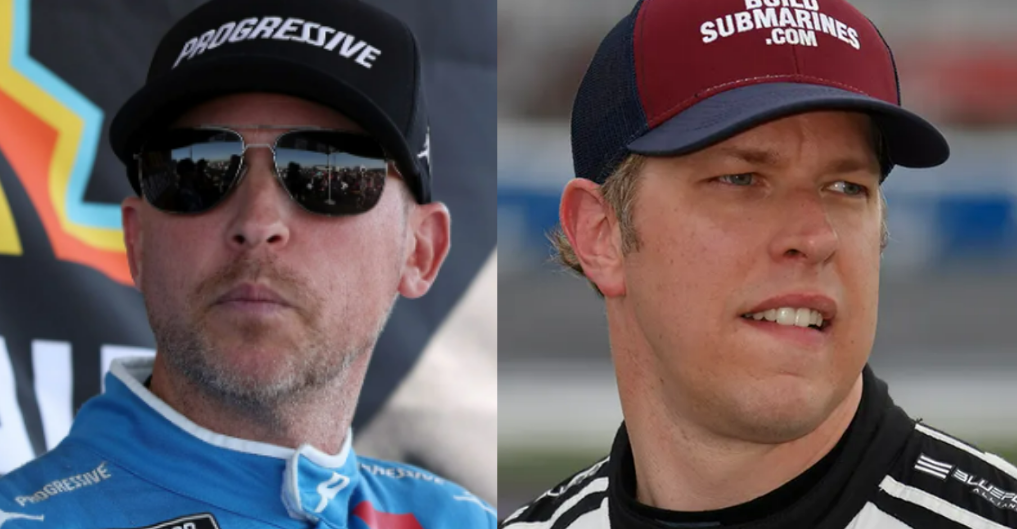
If there’s one thing certain about Denny Hamlin, it is that he will step in to defend his drivers. It all started after the Daytona 500 when Brad Keselowski didn’t hold back on Hamlin’s 23XI Racing driver, as they both vied for victory. After the last lap crash wiped out the 2012 Cup champion’s shot at a victory, Keselowski blasted the 26-year-old’s move as stupid. But as criticism poured in, Hamlin quickly stepped in, and he wasn’t about to let his driver take the fall alone.
Watch What’s Trending Now!
Reflecting on the chaotic finish, Hamlin took time to address the situation on his Actions Detrimental podcast.
“Yeah, Brad said this was a dumb move. Obviously, he’s saying that because he’s upset. I understand, but it should be Riley. Like when a car is this close to being? At this point in the race, when he has this run to win, should he even? Is he even concerned if there’s a car? No way, right?” Hamlin defended with full confidence.
All in all, Riley first believed he was making the move that could win him the Daytona 500, and Brad Keselowski believed it was reckless.
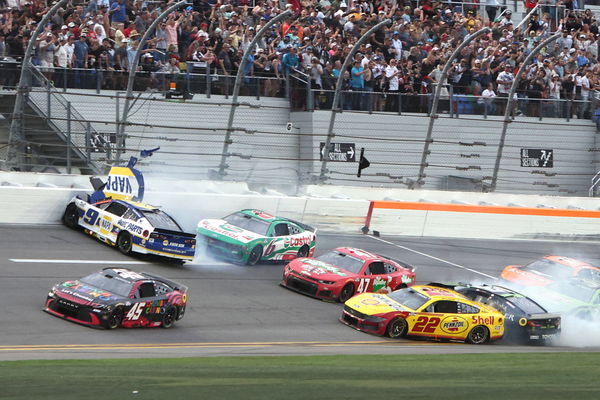
Keselowski, who had built up a massive run, had no room to react. The contact ignited a multi-car crash at the start/finish line while Tyler Reddick slipped through the carnage to capture his first Daytona 500 triumph.
The drama has been building for an entire lap. A crash in Turn 1 on the white flag lap thinned the pack and left a select few, including Reddick, Herbst, and Keselowski, to battle for the win.
Chase Elliott jumped to the lead with a push from Zane Smith while 23XI Racing teammates Reddick and Herbst lined up behind, right before turns three and four.
Coming off the final corner, Reddick ducked to Elliott’s left in search of clean air. Herbst faced a split-second decision and chose the top lane, attempting to block and harness RFK Racing‘s co-owner and No. 6 driver’s momentum.
Imago
DAYTONA BEACH, FL – FEBRUARY 15: Tyler Reddick 45 23XI Racing Chumba Casino Toyota leads to the checkered flag as Riley Herbst 35 23XI Racing Blind Lemon Toyota, Joey Logano 22 Team Penske Shell Pennzoil Ford and Chase Elliott 9 Hendrick Motorsports Napa Auto Parts Chevrolet crash behind him during the running of the 68th NASCAR, Motorsport, USA Cup Series Daytona 500 on February 15, 2026 at Daytona International Speedway in Daytona Beach, FL. Photo by Jeff Robinson/Icon Sportswire AUTO: FEB 15 NASCAR Cup Series Daytona 500 EDITORIAL USE ONLY Icon2602153549500
But Keselowski’s run was too strong, and in his view, Herbst’s block had no chance of succeeding.
“Oh [Herbst] just wrecked me out of nowhere for no reason,” Keselowski said post-race. “That was one of the dumbest things I’ve ever seen. He had no chance at blocking my run. I had a huge run. I don’t know if I could have gotten [Tyler Reddick] or [Ricky Stenhouse Jr.], but I would have liked to find out because my run was coming fast. And [Herbst] just wrecked himself and us. Pretty Stupid.”
However, Hamlin wasn’t buying the criticism. His defense underscores the split perspective that defines superspeedway racing—aggression versus judgment, opportunity versus timing.
The 26-year-old saw a leading shot at Daytona 500 glory. Keselowski saw a desperate block that cost them both. In the end, the gamble backfired, and Reddick was the one celebrating while the debate raged on.
However, as time will eventually heal all things, Hamlin may just have a few suggestions up his sleeve to make the Daytona 500 a better racing experience.
Denny Hamlin’s bid to improve racing at Daytona
The Joe Gibbs Racing driver believes the answer to better racing at Daytona International Speedway is simple – turn up the speed. The three-time Daytona 500 winner has already taken the idea to NASCAR leadership.
After watching the sport’s biggest race evolve into a fuel mileage chess match in the next-gen era on Sunday, Hamlin says the fix won’t come from slowing things down but from making drivers hang on.
“There’s a way, but we’re going to have to increase the speeds by a lot,” he said. “You’re going to make it where handling matters. That’s going to spread the field, that’s going to make it to where … it’ll look a little more like racing from the past.”
Since the debut of the next-gen car in 2022, superspeedway races have tightened the field and encouraged fuel conservation, with drivers lifting early and teams prioritizing pit-road strategy over raw on-track moves. The result, Hamlin argues, is racing that looks more calculated than chaotic.
His proposal is to increase the speed significantly, so handling becomes a factor again. Faster cars would naturally stretch the pack and put control back in the driver’s hands, and reduce the incentive to ride around conserving fuel.
With the current Cup car limiting how much teams can manipulate components, much of the competitive edge now comes on pit road, where teams stretch fuel windows, skip fresh tires, and save time during stops.
Hamlin’s vision would tilt the balance toward throttle control, car handling, and pure speed and away from conservation strategy.