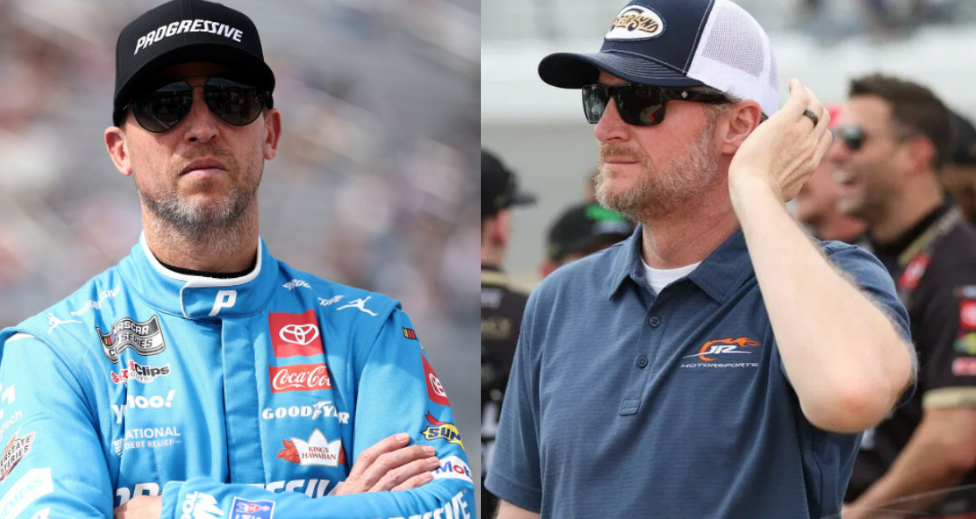
Where there is smoke, there’s usually a fire, and both Denny Hamlin and Dale Junior believe superspeedway racing has one. Film has quietly become the storyline of tracks like Daytona, and not for the right reasons. The next-gen car is once again under scrutiny, and as frustration mounts, Hamlin says there is a solution. With Dale Junior echoing similar concerns, the pressure is mounting on NASCAR to act.
Watch What’s Trending Now!
Denny Hamlin isn’t tiptoeing around the issue anymore. If superspeedway racing feels stuck, he believes NASCAR knows exactly why and exactly where to look.
“Generally speaking, these cars are just too planted into the racetrack… The reason they have so much drag is that we have one of the biggest spoilers we’ve ever had… we have these big spoilers because we’re running more horsepower…The reason we’re running more horsepower on the superspeedways is the engine builders wanted to create more common engine packages…In my opinion, we should reduce the horsepower slightly. But Dale Junior feels as though the drag is what is killing the racing,” he said on his Actions Detrimental podcast.
For Hamlin, the problem is not just strategy; it’s the aerodynamic and power balance.
Historically, NASCAR used restricted plates at tracks like Daytona International Speedway and Talladega to reduce engine power and cap speeds for safety, a practice that compressed the field into tight packs and forced drafting as the only way to go fast.
Those plates were replaced after the 2019 Daytona 500 by tapered spacers and heavier aerodynamics to manage horsepower and speed. Hamlin says the combination now creates too much drag, making it nearly impossible to break out of line and race aggressively.
With cars glued to the track and air dictating momentum, pulling out of line often stalls or runs before it even develops. Instead of bold passes, the final stage often becomes a fuel-saving chess match, with track position gained on pit road rather than through pure speed.
However, the frustration isn’t coming from Hamlin alone.
Imago
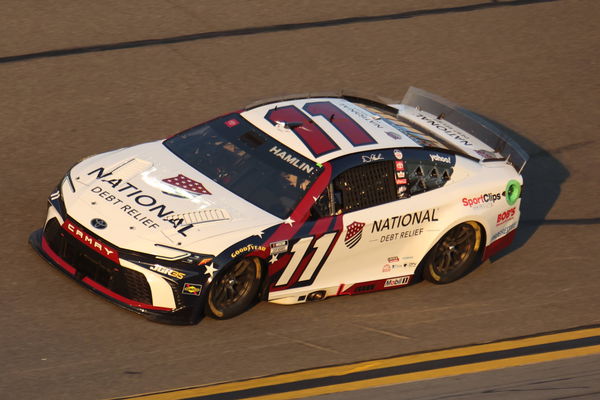
DAYTONA BEACH, FL – FEBRUARY 13: Denny Hamlin 11 Joe Gibbs Racing National Debt Relief Toyota races into turn 4 during practice for the NASCAR, Motorsport, USA Cup Series Daytona 500 on February 13, 2026 at Daytona International Speedway in Daytona Beach,FL. Photo by Jeff Robinson/Icon Sportswire AUTO: FEB 13 NASCAR Cup Series Daytona 500 EDITORIAL USE ONLY Icon2602133392500
Earlier, before the podcast, when asked by a reporter, “Is that fixable? Does that need to be fixed, that type of racing? Is there a fix to that?”
Denny Hamlin made it clear that he does not believe the current racing style necessarily requires a solution. He explained, “Well, I doubt there’s a fix to it because we’re just going to figure out the next way to exploit it, and I don’t know that it needs to be fixed.” Hamlin compared the strategy-heavy nature of today’s racing to a competitive game, saying, “It would be like asking if you need to change how chess is played,” emphasizing that teams are constantly adjusting to each other in order to gain an edge.
Still, he admitted that if NASCAR truly wanted to change the pack-style racing, “there’s a way,” but it would require major adjustments, adding, “You’re going to have to increase the speeds by a lot… you’re going to have to make it to where handling matters.”
Hamlin also suggested a potential solution: a new race package that eliminates fuel-saving strategies, stating, “Let a few of us come up with a package that we think you won’t see any fuel saving… that would be the only fix.”
A week ago, the conversation around race quality only got louder, and Dale Earnhardt Jr. had added fuel to the debate. Junior pointed out that the shift due to caution and fuel-saving racing isn’t random; it is strategic.
With the next-gen cars taking longer to refill during pit stops, teams understand that every extra second on pit road costs critical track position, especially late in the race.
To avoid the risk, crews have adapted. Instead of pushing flat out, drivers are instructed to conserve fuel whenever possible, which means less time spent refueling and a better chance of restarting near the front when it matters most.
“So they go out there, and they save as much as they can,” the 51-year-old veteran said. “And they have to put less in the car, spend less time on pit road, and they’re trying to put themselves in position late in the race with track position to go out there and maybe have a shot at winning. And it’s frustrating to watch them ride around. But I feel like if they don’t change anything, people will have to set themselves apart.”
Junior was careful not to place the blame squarely on NASCAR. In his view, teams are simply exploiting the system as it exists.
Even Hamlin found himself at the center of this debate, as two of his 23XI Racing drivers were accused of controlling the pace late in the Daytona 500 while stretching their fuel window.
After the race, he did shy away from addressing the fuel-saving trend and suggested that NASCAR may need to take bold steps to fix it, including dialing back horsepower and aerodynamics to put the emphasis back on throttle and racing.
For all the criticism about strategy and fuel saving, one thing hasn’t changed—the Daytona 500 remains a juggernaut.
Daytona 500 still triumphs through all chaos
A rainy Sunday at Daytona International Speedway delivered a packed house, reinforcing why the event is still called the Great American Race. The 2.5-mile super speedway is so fast that roughly 15 football stadiums could fit within its footprint. That scale allows it to post one of the largest single-day crowds in global sports.
According to Jeff Gluck of The Athletic, NASCAR announced a race with an attendance of 150,000 fans, with approximately 450,000 attending across Speedweeks. Gluck noted it was the first time in at least a decade that NASCAR publicly shared attendance figures.
The race also marked the 11th consecutive sellout. To put it into perspective, that’s enough people to fill Michigan Stadium multiple times or pack SoFi Stadium over and over.
That’s what makes the current debates important: the Grandstands are full. The demand is undeniable. As the Cup series heads to EchoPark Speedway, the lingering question remains. If NASCAR can address the superspeedway product, could the on-track action eventually match the spectacle in the stands?