
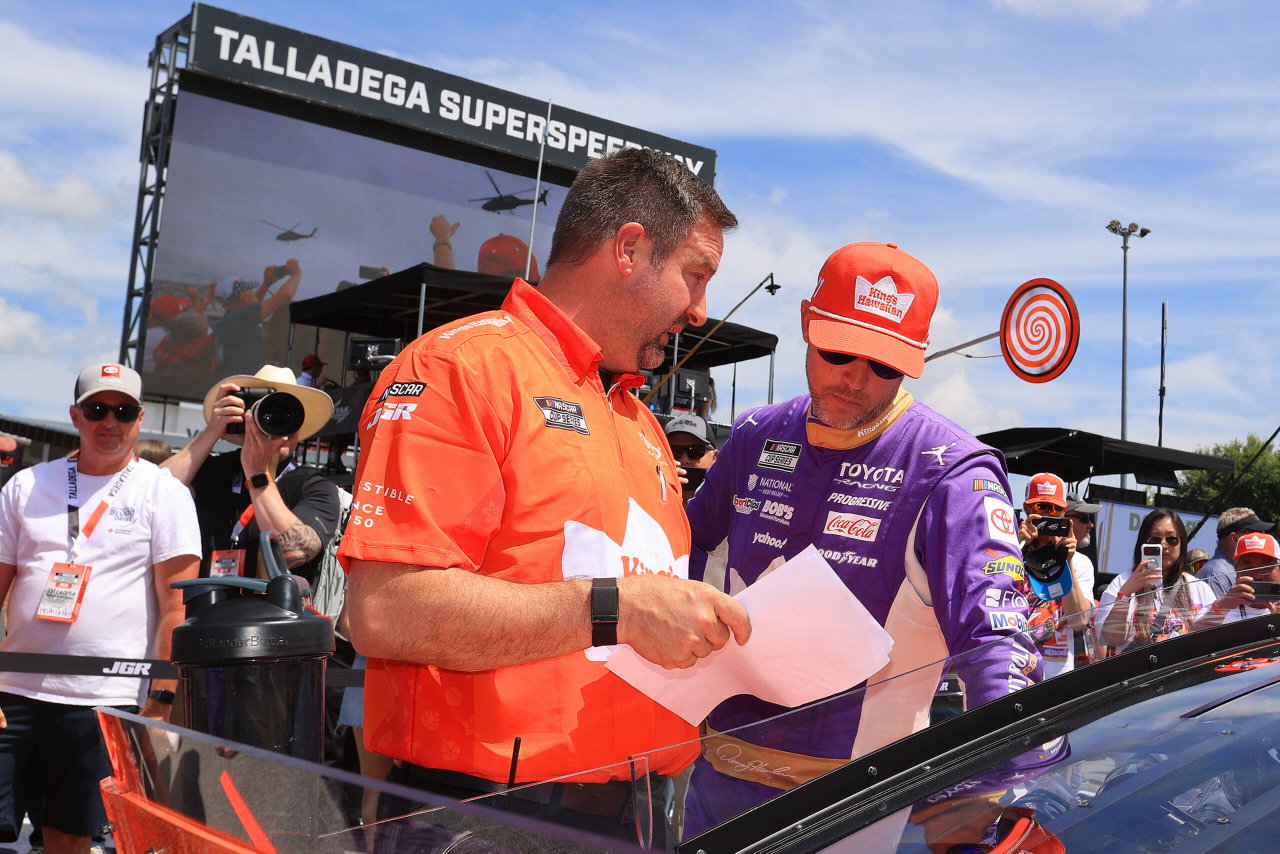
Denny Hamlin needed Martinsville to be the afternoon that changed his championship fortunes. Starting from pole, the Joe Gibbs Racing driver had an opportunity to put Kyle Larson under pressure and close the gap before the final race at Homestead. Instead, a strategy decision during the opening stage left him fighting to recover from a deficit that would prove difficult to overcome.
Watch What’s Trending Now!
The thinking behind the call was understandable. Martinsville has a history of producing early cautions, and Hamlin’s team believed staying out could pay dividends if another interruption brought the field back together. But when the race unfolded differently, the No. 11 team found itself exposed. Crew chief Chris Gayle has now explained why the gamble looked appealing and how quickly it went wrong.
“Yeah. That was part of our thought,” Gayle told Matt Weaver. “There’s typically cautions. We also were very aware of the pace, and the pace was kind of trending one way, and then it just dramatically changed on us very late, where there wasn’t anything you could do about it. Then you didn’t get the caution, and then that looked, that just left you in a spot where you were sitting ducks when you’re going to, okay, be P14 or P15, whatever we finish that stage.”
The No. 11 team’s decision revolved around preserving track position rather than committing to a green-flag pit stop. With cautions a familiar feature of Martinsville’s opening stage, Gayle saw an opportunity to keep Hamlin on the lead lap and potentially benefit from a yellow that would reset the field.
The problem was the assumption that the race would follow its usual pattern. Green-flag pit stops began around Lap 62, with several championship contenders heading down pit road. Hamlin, Ryan Preece and Larson stayed out, while Ty Gibbs was among the leaders who elected to pit. The fresh-tire advantage soon became apparent.
Hamlin initially managed to hold his position, but the No. 11 Toyota began losing ground as cars on newer tires worked their way forward. By Lap 84, Preece had taken the lead, and the drivers who had stopped were closing rapidly. Hamlin eventually slipped outside the top 10, with Larson suffering a similar decline.
What made the gamble particularly damaging was the absence of a caution. The opening 130 laps ran uninterrupted, leaving Hamlin without the opportunity to regain the track position his team had sacrificed. William Byron eventually won the stage, while Hamlin crossed the line 17th without scoring a single stage point.
It was not just Hamlin and Gayle who misjudged the situation. Larson and Hendrick Motorsports crew chief Cliff Daniels made a similar decision, keeping the No. 5 Chevrolet on track in anticipation of an early caution. Daniels had reason to consider that possibility, particularly after the previous five Martinsville races had all featured a Stage 1 caution.
This time, however, the pattern broke. Larson dropped to 23rd and was lapped before the stage ended. The decision left both championship contenders dealing with the consequences of essentially the same strategic calculation, although Larson eventually benefited from a free pass later in the race.
That is where the Martinsville strategy deserves closer scrutiny. Historical data can help crew chiefs identify trends, anticipate tire degradation, and calculate when a pit stop might offer the greatest advantage. But a pattern is not a guarantee. Expecting a caution because previous races produced one is a calculated risk, not a substitute for responding to the conditions developing on the track.
Gayle’s explanation also highlights how the changing pace complicated the decision. Once cars on fresher tires began catching the leaders, Hamlin’s team had surrendered much of its track position without receiving the caution that could have made the gamble worthwhile. By the time the consequences became unavoidable, there was little left to salvage from the opening-stage strategy.
For Hamlin, the damage extended beyond missing out on stage points. He entered Martinsville 73 points behind Larson and needed a substantial points haul to keep his championship ambitions realistic. Christopher Bell, meanwhile, finished fourth in the opening stage and collected valuable points, giving himself an opportunity to move closer to Larson.
The afternoon became even more complicated when Bell was penalized for speeding on pit road during green-flag stops. Later, on Lap 216, Joey Logano made contact with Bell entering Turn 1, sending both the No. 20 Toyota and Hamlin spinning. Both drivers continued, but the incident added another obstacle to Hamlin’s recovery.
Hamlin eventually finished sixth, while Larson recovered to ninth and Bell finished tenth. The final points picture put Larson at 2,469, Bell at 2,402, and Hamlin at 2,399. Bell had moved into second, 67 points behind Larson, while Hamlin slipped to third, 70 points back.
The irony is that Hamlin actually gained three points on Larson during the race. Yet that offered little consolation when Bell gained ground and moved ahead of him in the championship standings. Hamlin had entered Martinsville needing to exploit any weakness in Larson’s position. Instead, his own team’s opening-stage gamble helped turn a potentially defining afternoon into another missed opportunity.
Larson was hardly dominant. He spent much of the race recovering from the same strategic mistake and never seriously challenged for the win. But he limited the damage, finished inside the top 10, and retained a substantial championship advantage. His rivals had opportunities to make the fight considerably tighter and failed to take them.
That is what makes Martinsville more significant for Hamlin than it was for Larson. The No. 11 team had the speed to contend, a pole position to work from, and a championship deficit that demanded aggression. But the decision to wait for a caution that never came left Hamlin playing catch-up. With Homestead remaining, he still has a mathematical chance, but the opportunity to put Larson under real pressure has largely passed.