
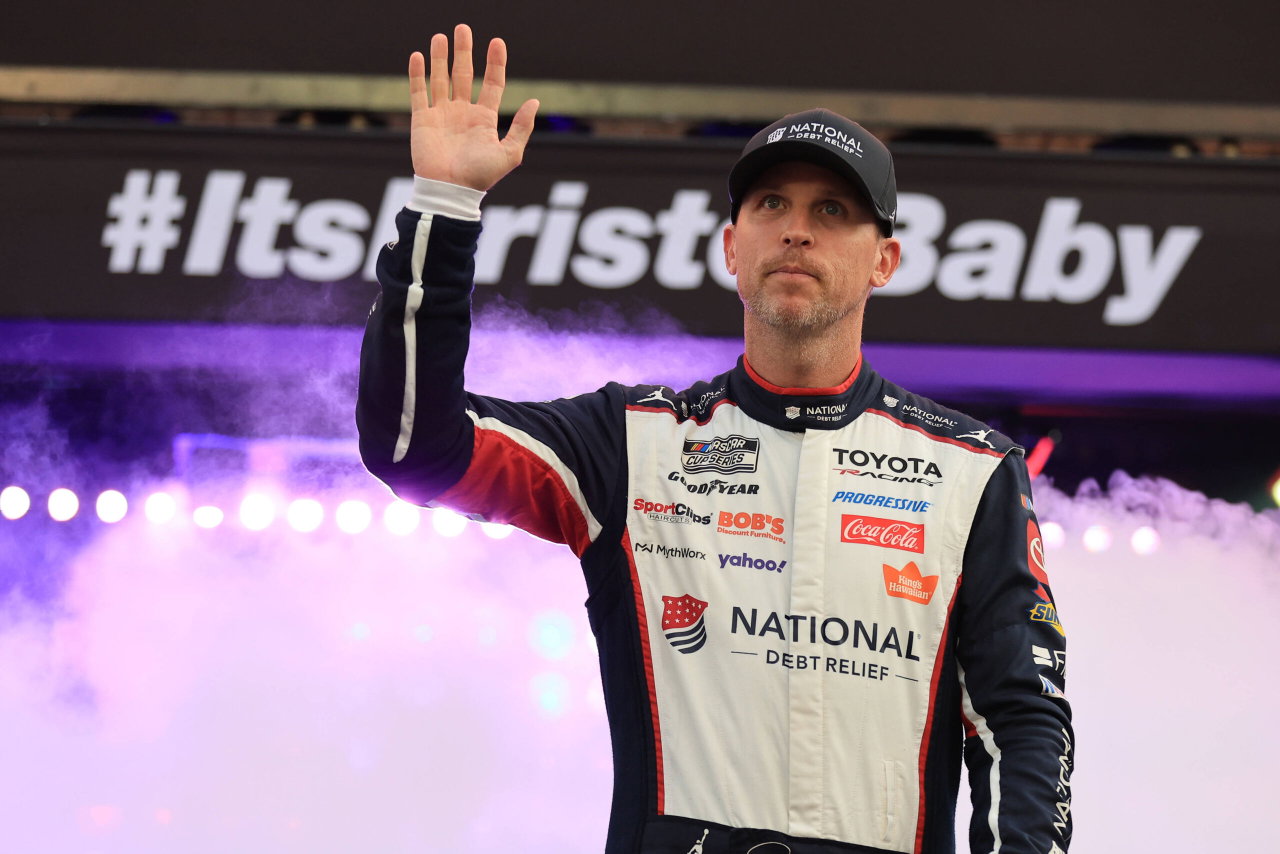
Every garage, every grandstand and every group chat has the same guy. He has watched Denny Hamlin lose championships since the days when people still said “Nextel Cup” out loud, and he will tell you the whole thing is a curse. A blown electrical switch, a late yellow, a stray piece of debris, a tire that let go at the worst possible moment. Ask him about it and he’ll recite the list like a man reading a charge sheet against the universe. He deserves some sympathy, because most of what he says is true. But after Las Vegas a few days ago, the list has quietly turned into something else. It has become a comfortable place to stand, and Hamlin, who turns 46 next month, is running out of time to keep standing there.
Watch What’s Trending Now!
Here is what Las Vegas looked like for Hamlin. He had the pole. Joe Gibbs Racing had all four of its Toyotas running one through four early, and the No. 11 was the car to beat. He finished 16th. Kyle Larson started the day badly, fought his way back and took second, which stretched his championship lead to 40 points. A pit call, a spin and a fuel-pressure problem did the damage, and each one has a different owner. That mix is the point of this whole column.
Nobody needs to argue that Hamlin is great
Before anything else, this is not a hit piece. Hamlin has 64 Cup wins as of October 7, 2026, which puts him ninth on the all-time list. He owns three Daytona 500s, three Southern 500s, eight wins at Pocono and 52 poles. He made his 750th start at Bristol in September and his 752nd at Las Vegas. You don’t stack that kind of résumé by accident, and you certainly don’t do it by waiting around for a good car.
He has also had a monster 2026. He won four races in the regular season, grabbed 14 top fives and 17 top tens, took four poles and led 880 laps. That earned him the No. 1 seed, and he walked into the Chase with 2,100 points, 55 clear of Larson. NASCAR noted his average finish had dropped to 8.1 by the time he locked up that top seed, on pace for the best mark of his career. So the equipment excuse is dead. The Gibbs cars are fast and Hamlin is fast, and the system handed him a lead before the first green flag even dropped.
That is what makes this so uncomfortable. When a guy with a slow car loses, you feel bad and move on. When a guy with the best regular season of his life and the best seed in the field starts bleeding points, the questions get harder.
The bad luck is real, and pretending otherwise would be silly
If you want to defend Hamlin, there is plenty of material, and it deserves a fair hearing. Start with Martinsville in 2012. Hamlin was in a three-way fight with Brad Keselowski and Jimmie Johnson when his car just shut off. A broken bolt on the master electrical switch cost him 34 laps and left him 33rd. There is no armchair theory that fixes that one. A bolt broke, and a title went with it.
Homestead in 2014 is another one where siding with him takes no effort. He stayed out while the other Championship 4 drivers pitted, took the lead with 14 laps to go and watched Kevin Harvick fall outside the top 10 after his stop. The math was sitting right there for him. Then two cautions in the last 15 laps wiped out the edge he had built, Harvick passed him on the restart and Hamlin ended up seventh despite leading 50 laps. You can’t draw that up as a driver error because it wasn’t one.
Phoenix in 2021 broke his heart in a more clinical way. A rotor failed on a lapped car, the debris brought out a caution with about 30 laps left, and the final stop became everything. Larson’s first-place pit stall helped his crew turn an 11.8-second stop that moved him from fourth to first. Hamlin restarted second, finished third and watched Larson take both the race and the title. Sometimes the whole season comes down to which stall you drew, and that is a miserable way to lose.
Then there is Phoenix 2025, and this is the one that should end any serious “choker” talk. Hamlin started from the pole and led 208 of 319 laps. He fought a clutch problem, recovered from a slow stop and kept the fastest car up front for nearly the entire championship race. With three laps left in the scheduled distance, he was leading William Byron by almost three seconds. Then Byron had a tire failure and crashed, the caution sent the race to overtime, and everything Hamlin had built for 300 laps got put on a coin flip. He took four tires, Larson took two and restarted ahead of him, and Larson finished third to Hamlin’s sixth. That was enough to hand Larson the championship.
One honest footnote belongs here, since the goal is fairness to both sides. Crew chief Chris Gayle has defended the four-tire call, and it was not an obvious blunder. But Larson’s team looked at that restart and decided track position mattered more than fresh rubber, and they were right on the day. The break was real, but what you do after the break is also part of racing. That idea is going to keep coming back.
Then there are the losses that don’t fit the luck story
The harder part of Hamlin’s history is the part his defenders tend to skip. Take 2010. He came to Homestead with a 15-point lead on Johnson. A week earlier at Phoenix, he had led 190 laps and still needed an extra stop because of bad carburetor settings that wrecked his fuel mileage. At Homestead he qualified 37th, got stuck in traffic and eventually damaged his suspension in a three-wide mess. Johnson finished second and collected his fifth straight championship. Hamlin has said himself that he should have won that title, and he has admitted Johnson got inside his head and made him second-guess what had made him good. That is a driver telling you, years later, that not everything was fate.
Homestead in 2019 was a different kind of mistake. Hamlin was getting stronger as the night went on, and with 58 laps left his team piled a bunch of tape on the grille to help the car. It choked off too much airflow, the engine overheated and he had to pit from third. He finished 10th and Kyle Busch drove off with the championship. Chris Gabehart, his crew chief then, took the blame later and said the team got too aggressive chasing the win. That isn’t luck. That is a smart group of people getting greedy at the exact moment greed gets punished.
The 2017 playoff run tells a quieter story. At Martinsville, Chase Elliott was leading with three laps to go when Hamlin hit him and spun him out. Hamlin apologized afterward. Two weeks later at Phoenix, the two collided again, this time wrecking Hamlin’s car and helping end his title run. Hamlin later admitted the Martinsville incident set the “rules of engagement” between them. None of that makes Elliott’s Phoenix move fair, which is a separate argument. It does mean the second incident didn’t come out of nowhere, and championships sometimes die weeks before the race that gets blamed.
Kansas in 2025 fits right here too. Hamlin had the dominant car, led 159 laps and won both stages, though he had lost much of his power steering late. On the final overtime restart he went after Bubba Wallace for the lead, got tight and made contact, which let Elliott slip by and win. Hamlin said afterward he would have given Wallace more room if he could replay it, while standing by his decision to race hard. So there was a car problem, a hard decision and a bad result, and all three were true at once.
Las Vegas had every flavor of Hamlin trouble in one race
This is why last weekend works so well as a case study. NASCAR went back to a 10-race Chase for 2026, with no Championship 4 and no weekly eliminations. The regular-season champion gets a 25-point head start, and the driver with the most points after 10 races wins the title. That format gives a driver more room to survive one rotten day. It also takes away the places to hide, because nobody can blame a one-race shootout when the sample is this big.
Hamlin started the Chase 55 points ahead of Larson, and five races later he is 40 behind. The first four weeks explain how fast that swing happened. Hamlin ran 18th at Darlington, ninth at Gateway, eighth at Bristol and third at Kansas. Larson ran fifth, first, second and first. At Kansas, Larson scored 76 points by winning both stages, the race and the fastest-lap point. Hamlin’s third place would normally be a very good championship day, and Larson still took 25 points off him.
Then came Las Vegas, and the opening hour looked perfect. Hamlin led 39 of the first 80 laps. Then Zane Smith spun, and seven lead-lap cars stayed out. Hamlin’s team pitted him for two tires and he restarted ninth, while Christopher Bell and Ty Gibbs held the track position Hamlin had just handed away. After the race, Gayle owned it without any hedging. “I probably should not have pitted there,” he said. That kind of honesty deserves respect, and it was also the first domino.
Hamlin drove back to fourth, which tells you the car was fine. But Bell and Ryan Blaney were ahead of him, and track position at a 1.5-mile track is hard to earn back once somebody else has it. With three laps left in the opening stage, Hamlin went high chasing spots and got into the marbles. The No. 11 spun. He missed the wall, but the car crossed the apron and picked up splitter damage. He explained later that the team had been telling him every point mattered. Think about how that sounds. The team makes a call that costs him spots, and the driver tries to erase it with a move that costs him more.
The fuel-pressure problem came later and cost him 12 positions, and that one was pure machinery with nobody’s fingerprints on it. He recovered to 16th. So was Las Vegas a choke? No. Was it just bad luck? Also no. It was a little of both, plus one human error that started the whole chain.
Larson is making the contrast impossible to miss
Here is where Larson becomes more than the guy sitting 40 points up. He did not look like a monster coming into this Chase. He was the seventh seed and hadn’t won a race during the regular season, having gone through a 51-race winless streak in the Cup Series. But the speed was always there underneath. NASCAR’s preseason Chase breakdown had him fifth in season-long speed, second in defense and second on restarts, with the Hendrick No. 5 pit crew ranked first. The ingredients existed, and they just weren’t getting cooked into results.
Then the Chase began and everything clicked. He ran fifth at Darlington, first at Gateway, second at Bristol, first at Kansas and second at Las Vegas. That is five top fives in five races with a 2.2 average finish. And the key detail is that he hasn’t avoided trouble. Las Vegas is the proof. He lost spots early, spent 26 seconds on pit road for big adjustments and fell a lap down. A caution gave him the wave-around, but that only got him back on the lead lap. He still had to drive his way to second, and he did.
That is the difference worth watching. Hamlin isn’t losing because he lacks speed. Larson is showing what it looks like when a team keeps a bad day from becoming a lost day. The irony is that Hamlin had been better than Larson on the exact kind of tracks now deciding this thing. Before the Kansas, Las Vegas and Charlotte stretch, Hamlin had three intermediate-track wins in 2026, a 4.9 average finish and a 115.2 Driver Rating across NASCAR’s wider intermediate sample. On the core 1.5-mile tracks, his average finish was 2.6 with a 128.2 rating. And yet Larson won Kansas and took second at Las Vegas. Hamlin built the better season, and Larson is having the better Chase. Titles go to the second one.
The new format was supposed to help him
There is a reason the 2026 system should have been Hamlin’s best shot at finally ending this. For years, the old playoff structure was part of the excuse. One caution in the wrong place and the whole Championship 4 could flip over. A driver could dominate the year and watch it come down to one afternoon at Homestead or Phoenix. NASCAR dumped that for 2026. Sixteen drivers get 10 races, nobody gets eliminated, and the title goes to whoever has the most points at the end.
That should do exactly what it’s doing right now, which is separate unlucky races from patterns. And Hamlin walked into it with about every advantage you could ask for. He had the best regular season, the points lead, the speed, the intermediate-track résumé and the experience. He also has zero DNFs in 2026, which is an easy fact to miss. He isn’t losing this thing because he keeps wrecking or blowing engines.
His first five Chase finishes are 18th, ninth, eighth, third and 16th, an average of 10.8. That isn’t a collapse. It’s a string of races where he left something on the table every week. Honestly, that hurts the bad-luck argument more than a DNF would. A blown engine hands you an easy reason. A third-place finish on the same afternoon the guy you’re chasing scores 76 points hands you a much harder question.
The clock is part of the story now
For most of his career, Hamlin could answer the championship question with “there’s always next year.” That answer is getting shorter. He is 45, his contract with Joe Gibbs Racing runs through 2027, and he has said more than once that he plans to step away from Cup racing after that season. After one of his June wins this year, he talked again about how the weeks were wearing on his body. None of that means he’s slowing down, and 2026 proves the opposite. It means he’s put an expiration date on his own story.
If this year doesn’t work, 2027 is still out there. After that, the answer can’t keep being “maybe next year” because he has already told NASCAR where he’s headed. That gives the last five races real weight. Charlotte is next on October 11. Then it’s back to Phoenix, where he came within three laps of the 2025 title. Talladega follows with its usual chaos, then Martinsville, which is tangled up with both his 2012 electrical failure and his 2017 run-in with Elliott. The finale is at Homestead, where he lost the 2010 and 2019 championships. If you were writing a redemption script, you probably wouldn’t make it this on-the-nose.
The thing is, Hamlin doesn’t need a trophy to prove he’s great. He has said so himself, and he’s right. The 64 wins, the Daytona 500s and the longevity stay on the books either way. What’s missing isn’t greatness. It’s completion, and those two things are not the same.
The question that’s left
There are two ways to remember Hamlin if the title never comes. One version says he was among the best drivers of his era, a man with 64 wins who somehow spent a whole career one trophy short. The other says that after enough shots at it, the repeated failure to close becomes part of the résumé too. Both are fair, and that’s what makes him so hard to write about. Some of these losses were flat-out stolen. The 2012 bolt, the 2014 cautions, the 2021 debris and the 2025 tire failure were not his doing.
But other moments sit differently. He admitted he second-guessed himself in 2010. His team got greedy with the tape in 2019. His aggression helped build the Elliott feud in 2017, and a hard late move cost him a win at Kansas in 2025. At Las Vegas, his team gave away track position, he tried to take it back and made the damage worse. That’s too many different causes to stuff in one box, which is why anyone who says it’s all luck or all choking deserves a raised eyebrow.
So the 40-point gap isn’t a death sentence. A 76-point day is still possible and five races remain. It matters because Larson has already erased a 55-point deficit in half the Chase, and Hamlin has to do something he’s been asked to do for almost 20 years. He has to take a title chance and leave nothing for circumstance to decide.
If he pulls it off, all the blown bolts and bad cautions turn into the scars of a story that finally ended right. If he doesn’t, the guy in the grandstand with the list will have plenty of fresh material. And when the last race of Hamlin’s career is over, will “bad luck” still explain it, or will it be the oldest excuse in the garage that finally ran out of laps?