
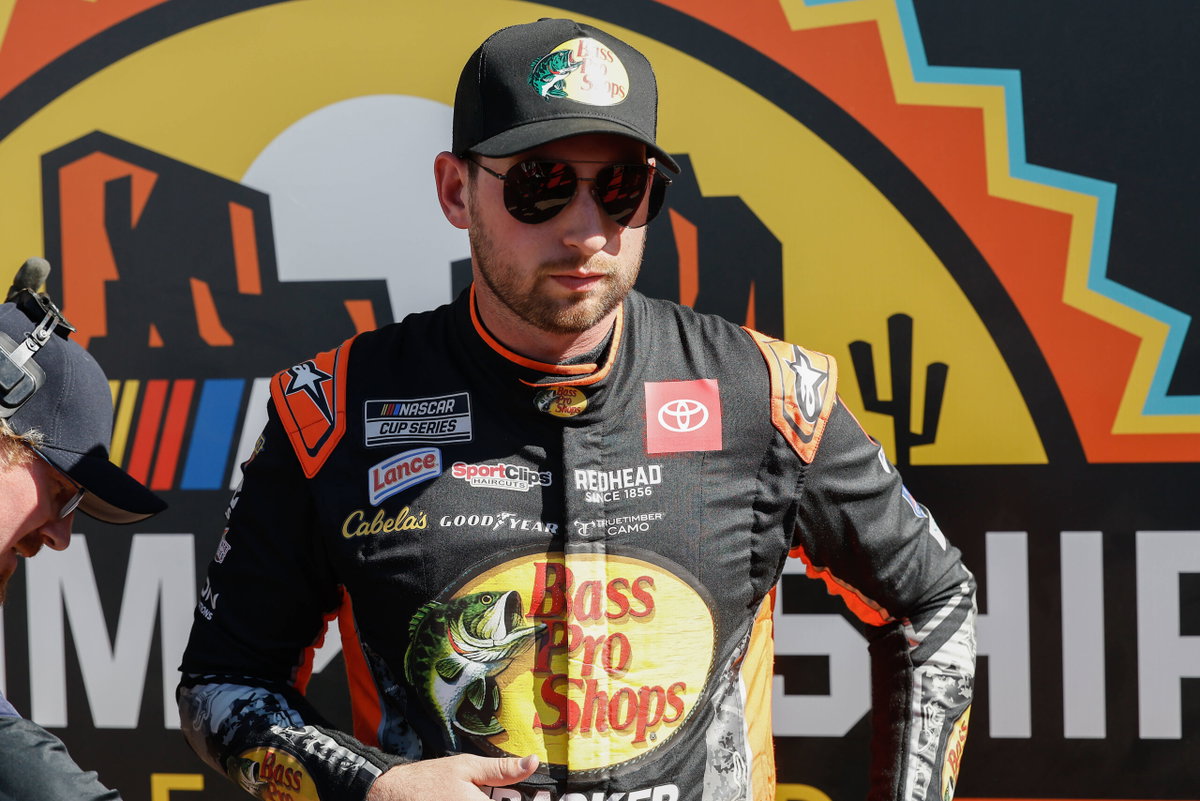
Being the last car on the bottom at Talladega can end a driver’s day before it really starts. Chase Briscoe, who started the YellaWood 500 from the pole, says that was the one spot he refused to be in during Stage 1. He explained the call afterward.
Watch What’s Trending Now!
“The only time I can think of is maybe when we were coming off that green flag pit stop,” Briscoe told the media, Bob Pockrass reported on X. “Denny was, I think, the tail end of the field. And the Chevys had a ton of momentum. So I just went with them. I didn’t want to just slow down and get behind him and be the last car on the bottom.”
The moment came as the field worked through green-flag stops after a long fuel-saving run. Briscoe had been running with Joe Gibbs Racing teammates Denny Hamlin and Ty Gibbs, but when the Chevrolet group gathered speed in the outside lane, he moved over to join it. Gibbs followed, leaving Hamlin without either partner.
Hamlin’s frustration was immediate.
“F****** 19, I’m so sick of this s***. He is the f****** worst,” he said over the team radio, referring to Briscoe, who drives the No. 19 car.
Briscoe explained he avoided slowing to join Hamlin because it would have left him last on the bottom.
The decision came after an opening stretch in which saving fuel had slowed the field considerably. Drivers were trying to stretch their runs and avoid an extra stop, but the strategy also made it difficult to maintain the momentum needed to move through traffic. The RFK group broke away from that approach, creating a sizable advantage while the other drivers continued managing their fuel mileage.
For Briscoe, staying with the Chevrolet line offered a chance to make progress without sacrificing track position. Slowing down to reach Hamlin could have left him at the back of a slower-moving group, with little guarantee that the Toyota line would regain speed. Once the Chevrolets began pulling away, the opportunity to join them became more attractive than waiting for his teammate.
The exchange unfolded during a stage shaped by an unconventional strategy. RFK Racing’s Chris Buescher, Ryan Preece and Brad Keselowski abandoned the fuel-saving approach and worked as a three-car group. They built a sizable gap on the field, leaving everyone else to race for the remaining top-10 spots.
Their advantage grew to more than 40 seconds as the stage progressed, which showed how much fuel conservation had affected the field. The three drivers were able to work together while others continued trying to balance speed with fuel mileage. That left the chasing pack with fewer opportunities to challenge the leaders before the stage ended.
The stage results show how the sequence played out. Buescher won, followed by Preece and Keselowski, with Kyle Larson fourth. Briscoe took seventh, while Hamlin fell to 17th and missed out on stage points. Several factors shaped the order, but the loss of his two drafting partners left Hamlin exposed at a critical moment.
Title fight complicates Toyota’s drafting plans
The stakes were heightened because Hamlin, Briscoe, Christopher Bell and Tyler Reddick were all title contenders driving Toyotas. That created a problem Chevrolet did not share.
Larson was the leading Chevrolet driver in the championship picture, so he could count on help from teammates with nothing to lose. Toyota’s contenders had to weigh manufacturer cooperation against the fact that their drafting partners were also direct rivals for the title.
Joe Gibbs Racing crew chief Adam Stevens had acknowledged the issue before the race.
“That’s something that we’re going to have to battle against, and it’s a one-horse race over there (with Chevrolet). And they have the resources to put toward it. So, if it comes down to group decision-making, we’re at a disadvantage, for sure.”
JGR has faced similar tensions between teamwork and individual ambition before. In 2025, Hamlin and Gibbs had an on-track dispute at New Hampshire, with Hamlin and Bell both pursuing the championship. Although that incident involved racing for position rather than a drafting decision, it highlighted the challenge of managing teammates who are also competing against one another for results.
The Talladega moment presented a different situation, but the underlying tension remained: drivers must balance helping their organization with protecting their own championship chances.
Even a successful move could prove temporary if a lane lost momentum or another group gained an advantage. For championship contenders, those decisions carried added pressure because stage points and the final result both mattered.
The race itself offered little payoff for either driver’s plan. Larson won in overtime after a chaotic finish that included a late multicar wreck and Joey Logano’s flip. Hamlin recovered to finish eighth, while Briscoe, who had run third in Stage 2, was caught in a late accident and finished 33rd.
Briscoe’s strong second-stage result showed that his afternoon had improved after the opening-stage decision, but the late wreck ultimately ended his chance to convert that progress into a competitive finish.
Hamlin, meanwhile, survived the closing chaos and brought his car home in the top 10, although Larson’s victory widened the gap at the top of the championship standings.
“We’re obviously talking about it tomorrow. I don’t really know which part he’s talking about. I’m assuming that’s the part. Just have to go back and watch.”
Until that conversation is reported, the radio outburst alone is not evidence of a lasting rift between the teammates.