
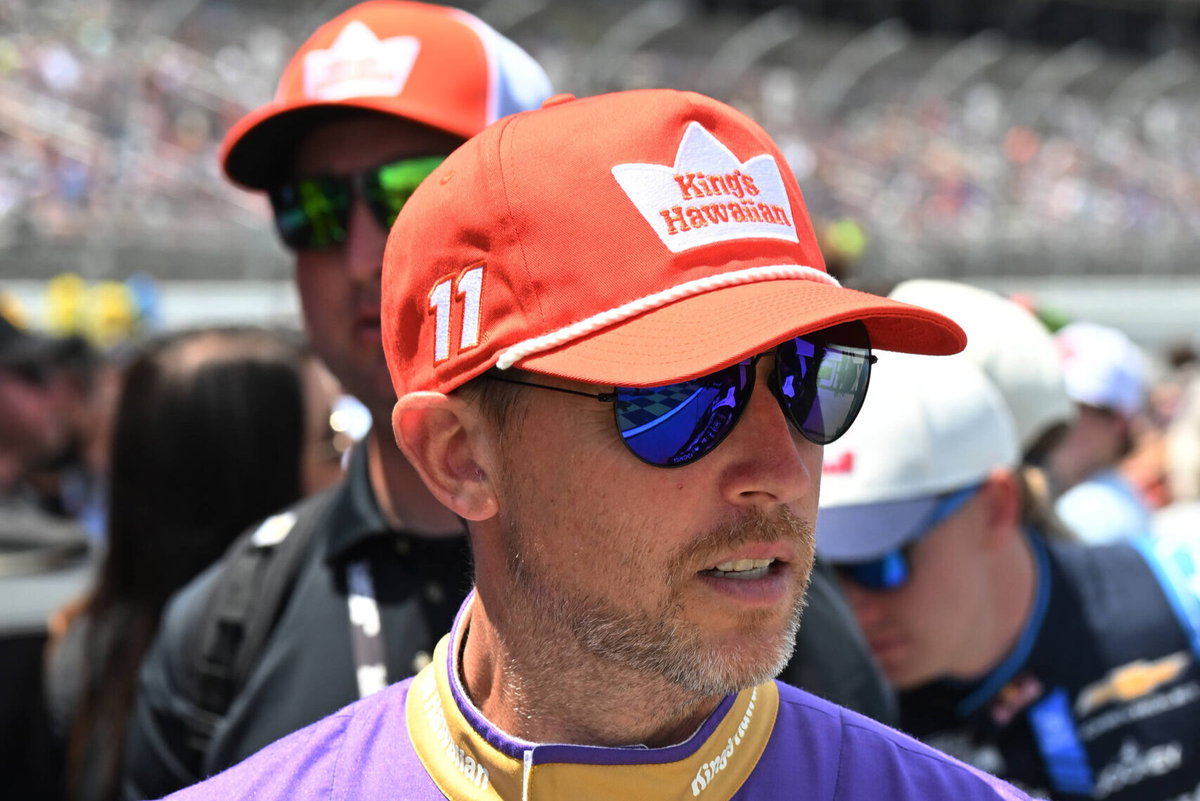
Denny Hamlin’s Iowa weekend was destined to be difficult from the moment his No. 11 Toyota hit the track on Saturday. He broke his brake pedal during practice, leaving Joe Gibbs Racing working late into the night to find a solution. But when the problems persisted, NASCAR’s rules left the team with no way to replace the pads before the race.
Watch What’s Trending Now!
This has now sparked a debate over whether the rulebook needs a safety exception. Former Hendrick Motorsports crew chief Steve Letarte shared his thoughts on the incident on Inside the Race.
“He finished great. He was out there all day, yes, but what would we have done if we had run five laps…that would have just felt like we had done a disservice to the fan who came to cheer on Denny Hamlin,” Letarte said.
Hamlin quickly realized after getting on track in Iowa that his No. 11 Toyota did not have adequate or consistent brake pressure. Joe Gibbs Racing crew chief Chris Gayle recognized that the problem could potentially end the team’s race before it even began.
Hamlin was not alone. JGR teammate Chase Briscoe experienced similar brake problems, while 23XI Racing’s Riley Herbst also struggled in his Toyota. Bubba Wallace’s No. 23 Toyota team was dealing with issues of its own, forcing them to spend hours in the garage making adjustments.
Teams were permitted to bleed their brake lines before the race without penalty. They could also replace rotors if they were cracked. But the brake pads were different.
NASCAR does not allow teams to change brake pads during a race weekend before the green flag. The only opportunity comes after the race begins, meaning a team would have to accept losing laps. Hamlin, as such, had to deal with an uncomfortable situation.
The team believed the pads could have been defective. However, NASCAR’s rules did not provide an avenue to replace them simply because the team believed something was wrong.
Hamlin later said his brake pedal went straight to the floor by Lap 3. Briscoe encountered the same problem by the start of the second stage. Despite that, both drivers managed to fight through the physical challenge. Hamlin finished fifth, one place ahead of Briscoe.
Denny Hamlin said he would have been happy with a top-25 finish given what the team expected after Saturday. But he also questioned why there was no way out once the problem became obvious.
Hamlin explained that the braking system contains multiple components, including calipers, rotors, master cylinders, lines and fluid. NASCAR controls several of those components, while teams select their brake pads. The concern from NASCAR is that allowing teams to change pads could open the door to manipulation.
Denny Hamlin said he would have been happy with a top-25 finish given what the team expected after Saturday. But he also questioned why there was no way out once the problem became obvious.
Hamlin explained that the braking system contains multiple components, including calipers, rotors, master cylinders, lines, and fluid. NASCAR controls several of those components, while teams select their brake pads. The concern from NASCAR is that allowing teams to change pads could open the door to manipulation.
Starting from pit lane or several laps down could make the decision costly enough to prevent abuse. For Letarte, that would strike a better balance between competition and safety.
Because while rules need to prevent teams from exploiting loopholes, there is another consideration when a driver believes his brakes could fail. The fans came to watch Denny Hamlin race.
And if NASCAR forces a team to keep a potentially dangerous component simply because the rulebook offers no escape route, Letarte believes the sport risks losing sight of who the rules are ultimately meant to serve.