
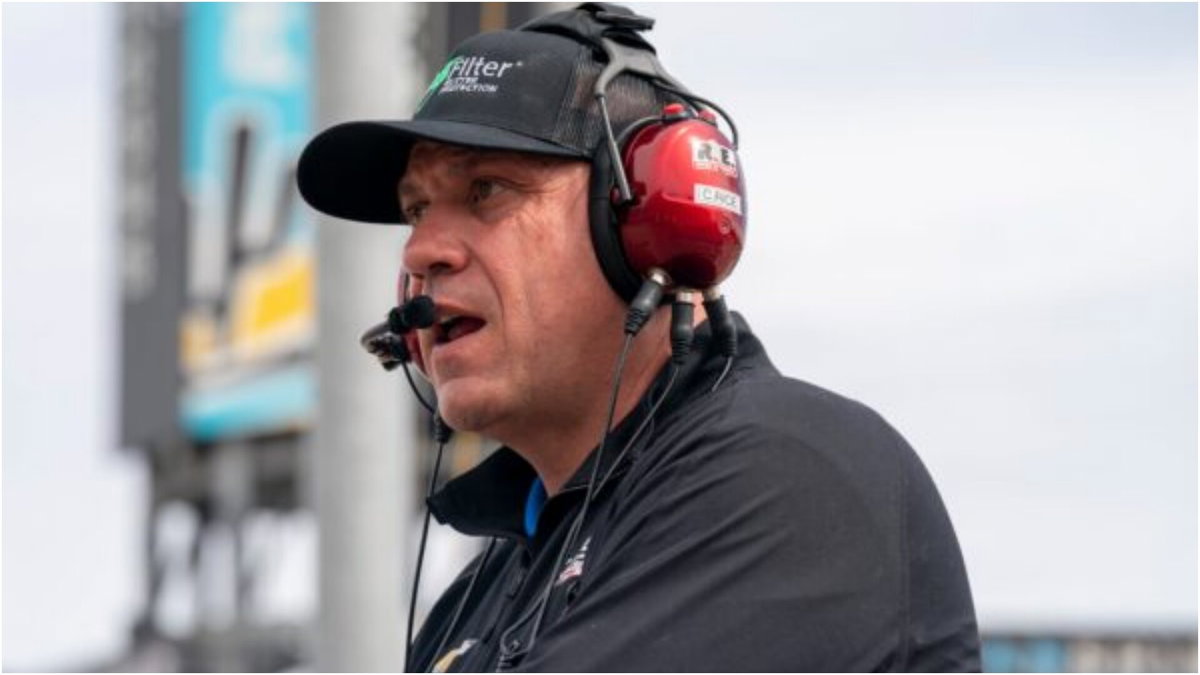
Carson Hocevar may have just found himself an unlikely ally. While Brad Keselowski, Denny Hamlin, Ryan Blaney, and several other Cup stars have made it clear they aren’t exactly thrilled with the Spire driver’s antics or the way the organization handles it, Kaulig Racing CEO Chris Rice seems to be asking a very different question: what if NASCAR actually needs a guy like Hocevar?
Watch What’s Trending Now!
“But at the end of the day, what do we need in NASCAR? We need rivalries,”Kaulig Racing CEO Chris Rice said when asked about the growing criticism surrounding Carson Hocevar. “There was Dale Earnhardt, there was Darrell Waltrip, there was Mark Martin. There were all these people that were rivalries. Now, everybody wears these white gloves. They get all upset.”
And it’s true. If we go down memory lane, NASCAR’s most memorable rivalries were built around competitors who could battle fiercely on the track without allowing those conflicts to completely destroy their relationships away from it. Take, for example, Dale Earnhardt and Darrell Waltrip.
The “frenemies”, an endearing term they loved to use while describing their equation, were fierce competitors, and their personalities often made their battles no less compelling than the racing itself. Away from competition, the two developed a deep friendship and maintained mutual respect.
“I don’t know if I knew him as a race car driver or as a friend,” Waltrip said in 2024. “We were frenemies. We were friends sometimes. We were enemies sometimes. We were friends off the track, but we were usually enemies on the track.
“Had a lot of respect for Dale, but there were times when I wanted to kill him and that’s just the way it was. And the same way he felt about me. I’m sure that there were times when he probably wanted to kill me, but we were just frenemies.”
Unfortunately, those days are long gone. With NASCAR’s sponsors now pushing for corporate and PR-trained brand of drivers, cultivating rivalries has become a rarity. And in Hocevar’s case, a full blown controversy.
At Darlington, the Spire Motorsports driver was involved in contact with Brad Keselowski. The incident became especially contentious because of how Hocevar responded afterward. The controversy continued to generate discussion well after the race with Keselowski’s fierce response.
The situation escalated further at Bristol when Hocevar and Ryan Blaney made contact late in the race. The incident ended Blaney’s night and sent him into another difficult result during the Chase. Once the race was over, however, the disagreement moved from the racetrack to pit road.
Blaney confronted Hocevar, and the exchange quickly became physical before others stepped in to separate the two drivers. Moreover, a clip captured RFK Racing’s Ryan Preece and Wood Brothers Racing’s Josh Berry mocking and “chirping” at Hocevar while he was trying to hype up the Bristol crowd. Berry was seen repeatedly making a “talking hands” gesture to mock Hocevar’s talkative nature.
The incidents have also prompted criticism of the organization behind Hocevar. Hamlin’s comments came after the Darlington controversy and the way the situation surrounding Hocevar was handled. The Joe Gibbs Racing driver questioned whether Spire’s leadership was doing enough to manage its young driver.
“You want me to talk about Spire? I’ll talk about Spire,” Hamlin said on the Actions Detrimental podcast. “There’s no adults in that room. Clearly. In that building. No adults. That’s my opinion. Because, how can you honestly think that’s what’s best for your company? If you’re running a serious organization? I think they’re unserious. Anything else?”
Mast later turned his attention toward Spire co-owner Jeff Dickerson after watching his interview following the Bristol confrontation. Dickerson had discussed the incident publicly and defended Hocevar. However, Mast believed the team owner should have stayed away from the television cameras instead of adding to the conversation.
“I watched it all. I’m like, man, I don’t know you. I know your name and hear about you all the time, but you need to stay the hell off TV. You don’t need the interviews. Just get away and do something else, man. And, that’s not good,” Rick Mast said.
Rice does not appear to believe Hocevar should simply be left without accountability. Instead, he explained that his own method would involve dealing with the driver directly and making sure he understands what is expected of him.
“What would I tell you I would do? Here’s what I would do. I would bring him in and make him feel loved. That’s the first thing I would do. I wouldn’t make him feel like an outcast. The kid has speed. He does great. I enjoy watching him race. Some of the stuff he does makes me laugh cause it’s not my car.”
That is where the subtle message toward Spire becomes apparent. Rice is not directly accusing Dickerson or Spire of mishandling Hocevar. But his description of bringing the driver into the office, supporting him, and having conversations about maturity presents a different model of leadership. Rice also believes the outrage surrounding Hocevar illustrates something NASCAR may actually need.
“But it doesn’t make me feel like he drives for a bunch of people that’s not grown-ups.”
His criticism ultimately extends beyond Hocevar’s team to the drivers who have become increasingly frustrated with him. Rice argues that NASCAR cannot simultaneously demand compelling personalities and rivalries while expecting every driver to respond with restraint whenever another competitor crosses the line.
“We don’t own white gloves at Kaulig Racing. Leave your feelings at the door.”
For Rice, Hocevar’s polarizing presence is not necessarily a problem to be eliminated. If NASCAR wants rivalries like those that once defined the sport, he believes drivers should be allowed to compete aggressively, settle their differences, and still coexist when the helmets come off.