Imago
Image via NASCAR
Imago
Image via NASCAR
Essentials Inside The Story
- Mark Martin makes his debut as an exclusive columnist for EssentiallySports. He plans on doing 1-2 columns per month.
- He shares the key genesis for writing the column, touching upon a crash from his teenage days that left a lasting impact on him.
- With a still very large fan base, Martin looks forward to connecting more with his longtime fans, breaking the myth that he was just a NASCAR driver.
[Editor’s note: This is a joint column featuring Mark Martin’s views and written by EssentiallySports columnist Jerry Bonkowski]


Hey everyone, it’s Mark Martin here, and I’m excited to present my first column for EssentiallySports to you.
Watch What’s Trending Now!
Along with co-writer Jerry Bonkowski, I plan on bringing one-to-two columns each month to you. We’ll be talking about NASCAR, my overall racing career, my thoughts about racing today, how the sport has changed over the years, and much more.
The genesis for this column is my upcoming book, “Never Lift,” co-written with Mark “Bones” Bourcier – who has written a number of racing-related books, including “True Speed: My Racing Life” about Tony Stewart, “Wicked Fast” about Bentley Warren, as well as books about AJ Foyt, Mario Andretti and Richard Petty; Parnelli Jones; Ken Schrader; Richie Evans; Bill Simpson and many others.
The book is slated to hit bookstores around June. After it’s released, I’ll be going on an extended publicity tour around the country to promote it, sign autographs and take photos and meet with fans and give back to a sport that has been so good to me and my family for over 50 years.
The title of the book sums up the way I’ve lived my life in racing, from the first time I got into a car until the last race I ever ran. Speaking of racing, there’ve been some rumors floating around in recent months that I was going to come back to race again.
To that, I can unequivocally say, “I’m done. I don’t have the desire.”
But I still have a great passion and desire about the sport, the drivers, team owners, and particularly the fans. That’s why when my son, Matt, suggested the idea to me a few years ago about writing a book about my life, and share so many stories from my career, I quickly got on board.
Matt is really into books and pushed me into it. I knew it was going to be a long process – and it was, taking a little over four years to make it right, researching history and making sure every last detail was accurate and correct.
That’s what took so long with this book: every single thing in it is fleshed completely out and fact-checked. Everything is the way I saw it, but if there was something that went off of memory, the memory was also checked.
How many stories are in the book? Well, let’s just say this: the book is over 450 pages – and that’s without photos – and we just scratched the surface of all that happened to me during my career! That’s why I’m really looking forward to sharing so much about the book and my career with the readers of EssentiallySports.
I turn 67 years old next month and started racing young in my native Arkansas. When I got to racing in the ASA (American Speed Association) Series in the late 1970s, with Banjo Grimm at my side, I was able to outwork everybody, a trait that was essentially my calling card. Sure, you might be able to beat me in a race on the track, but I guarantee that no one worked harder to be the best than me.
One of the main reasons I wrote the book was to contrast the sport and just how life was when I was coming up. It’s a way for the grandkids and great-grandkids to know about a time in history that is so different than what they live in today. This book really encompasses what may be the golden years of motorsports.
People always talk about how I respected my fellow drivers and why they respected me. Well, there’s one particular story in the book that explains that.
In 1977, we went down to New Smyrna Speedway, which is about 12 miles from Daytona International Speedway. We figured we’d go down to New Smyrna for Speed Weeks and the World Series of Asphalt Racing, because I could race nine nights in a row and basically get two or three months’ worth of experience.
New Smyrna was a hotbed of pavement racing. One of the first nights I was running there, and one of my first races ever on pavement, this car in front of me was holding me up. I had about three years of dirt experience by then. Back home on dirt, when somebody was holding you up, you just give them a shot in the back bumper.
So, that’s what I did. The car I hit wobbled, turned forward, and slapped the wall. I’m just a teenager, 110 pounds, and I have crashed and hurt and sent Bobby Brack to the hospital. Bobby is a Florida late-model star, who I didn’t know. And of course, I went on about my business and went on about my racing and didn’t think much of it.
This was one of the first times I raced on pavement. But don’t think for a minute that that (crash) didn’t have an influence on me going forward because what I wanted the very most in racing was to be respected by guys like Dick Trickle and Tom Reffner and Bob Senneker and all those guys. They didn’t wreck people and they didn’t hurt them.
I really wanted the greatest short track racers in the nation to respect me. And how are they gonna respect me if I’m bumping or running or doing anything that they didn’t do?
I didn’t mean for this wreck (with Brack) to happen. But that was just my luck, I get this guy, give him a shot coming off (turn) four, and he wrecks and gets in the hospital.
That’s one of the reasons why I didn’t do bump and runs the rest of my career. Because of my luck, I would try a bump and run on someone, and it would kill him. That sounds dramatic, but I’m not a very lucky guy. I had a lot of bad luck in my career. And that’s the kind of luck that I would have.
Everybody else was doing it, but me doing it and then someone would lose their life, and I would have that on me. That one incident, it had an effect on me in multiple ways.
Anyway, the book goes from childhood through ASA and into NASCAR and has great explanations for why and how all the NASCAR stuff (his first tenure in NASCAR) went down in 1981, ‘82 and ’83, then failing and having to go back to Wisconsin and start my career all over again and work my way back up to the top level and win the ASA championship again for the fourth time before making another run at NASCAR.
I literally had a full racing career and a full book’s worth prior to my signing with Jack Roush and getting in the No. 6 car for Roush Racing (in 1988).
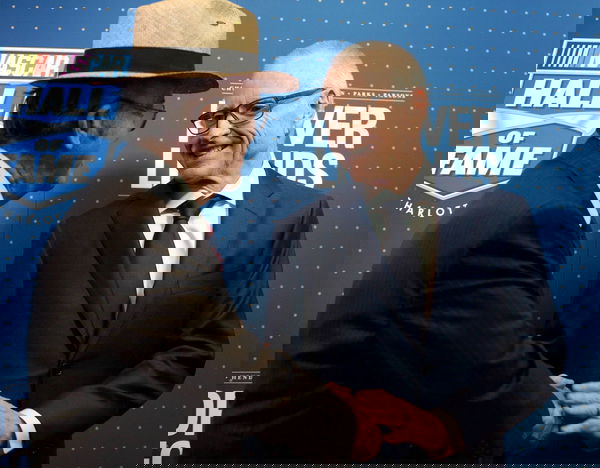
Imago
January 20, 2017 – Charlotte, NC, USA – NASCAR Motorsport USA Hall of Fame Inductee Mark Martin, right, shakes hands with team owner Jack Roush, left, prior to the NASCAR Hall of Fame Induction ceremony on Friday, Jan. 20, 2017, in Charlotte, N.C. NASCAR Hall of Fame – ZUMAm67_ 20170120_zaf_m67_019
And then I’d have a whole other NASCAR career after that.
Another story is when Waddell Wilson called me and asked if I want to drive the No. 28 (in 1982), the same 28 that went straight to Daytona and sat on the pole for the 500. But I turned it down. I told him that I’d rather do my own deal. I had three full-time employees that worked their guts out 16 hours a day, seven days a week, just like me. And I had all these people that had helped me get to those first Cup races and build a career and three ASA championships (1978, 1979 and 1980) up to that point (he won a fourth ASA title in 1986).
So what’s important for me in the book and all the columns we’ll have in the coming months is to share with the fans my foundation, what made me, the struggles I went through, the experiences that I had prior to NASCAR. Because people, a lot of fans just think of me as a NASCAR driver and I won a few races, but there’s so much more.
My story should be very inspiring to someone to stay true to their dream and to never give up. Let’s call this first column for EssentiallySports our pace lap and then get ready for the green flag. It’s going to be a memorable ride!