
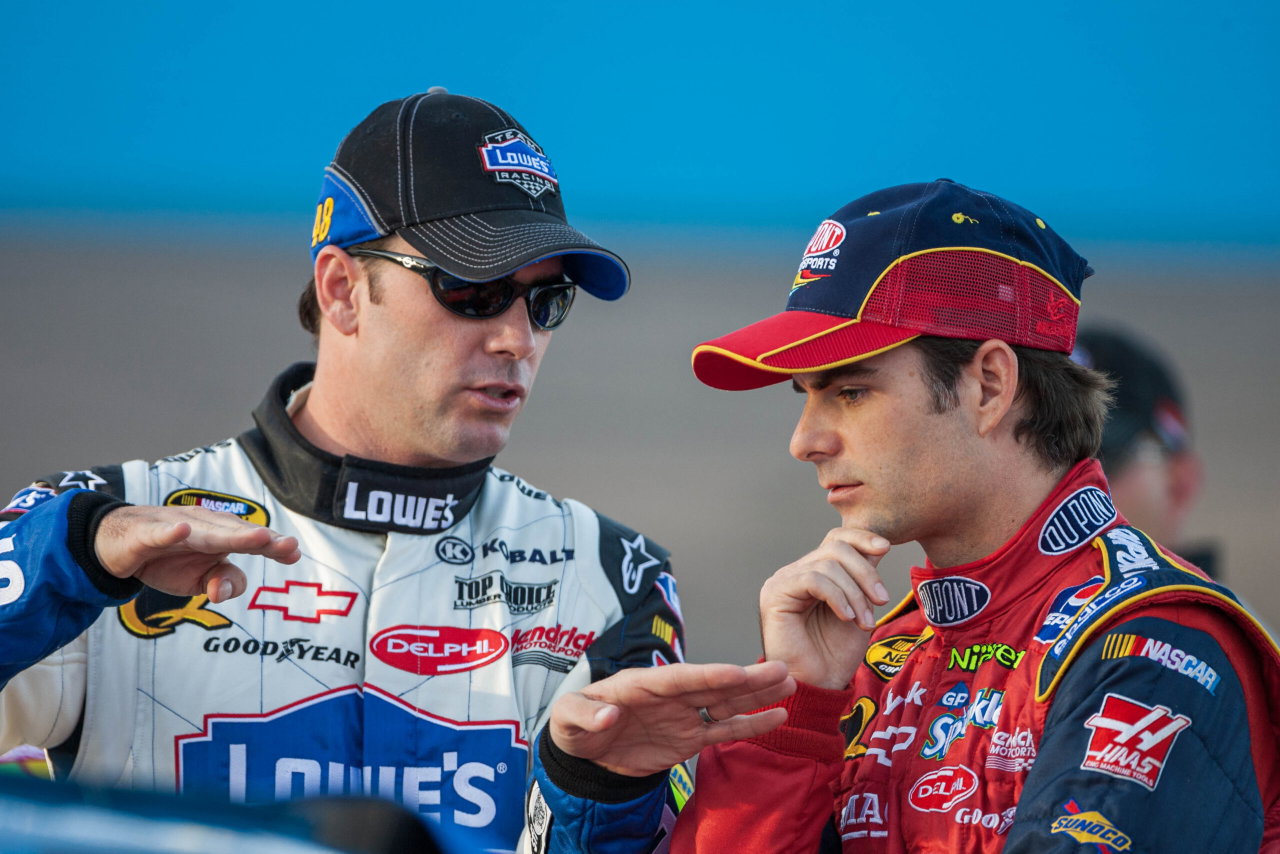
Jeff Gordon’s fifth championship never happened. A new hypothetical list of champions under NASCAR’s old points system argues the format took it from him. The specific wound is 2014, when he missed the Final 4 while chasing that title, and Kevin Harvick won it instead. Jimmie Johnson later proved the new Playoffs could be mastered. Gordon never got to prove the same.
Watch What’s Trending Now!
Fans today argue that NASCAR’s decision to go to the Chase format in 2004, followed by the elimination-style Playoffs in 2014, is why Gordon never realized his potential on track, as far as the numbers went. After looking at the fictitious list of where current drivers would be according to the Winston Cup format with their performances, the community did not hold back.
“Jeff Gordon was absolutely robbed once NASCAR started changing up their whole system,” wrote one fan in reply to the post on X.
According to the list of champions, had we still followed the Winston points system, Jeff Gordon would have claimed seven titles instead of his current four. Two of his subsequent trophies would have come in 2004 and 2005, when the Chase format was in place, followed by a final win in 2014 with the Playoffs system.
“Sickens me they robbed Jeff of being a 7-time champ,” chimed in another.
Is the Modified Tour Still Important Enough for NASCAR’s Future?
What happened in reality was completely different. The 2004 season saw a certain Kurt Busch claim NASCAR’s biggest prize while Gordon finished in P3 in the overall standings, behind his teammate Johnson in P2. 2005 saw Tony Stewart spoil the HMS party, with Gordon and Johnson finishing in P11 and P5, respectively. However, the year 2006 marked the start of a historic run for Johnson and the No. 48 team.
They went on to claim five consecutive titles until 2010, with Gordon finishing outside the top-5 in the overall standings three times. He did come close during the 2007 season, finishing in P2 behind his rival, with six wins and 30 top-10s. As a result, fans still think about how Gordon’s luck could have been turned around if NASCAR had not switched up the points system.
“I will forever say Jeff Gordon’s 2007 season was the best non-championship season ever. 30-top 10s. Only 6 times all season out of the top 10,” wrote one fan in agreement.
Many fans spoke about how the new formats were what hurt Gordon’s eventual success.
“I always felt the new formats cost Gordon championships,” wrote yet another.
Fast forward to the Playoffs era of the sport in 2014, when the ‘win, and you’re in’ style of racing was introduced, Gordon failed to qualify for the final round and ended up P6 in the title standings, followed by another near miss next year. In 2015, the former No. 24 driver qualified for the final round, but failed to capitalize, finishing P6 during the finale while the late Kyle Busch clinched his first title.
Had we followed the erstwhile Winston format, Gordon would have claimed his seventh title in 2014 itself, beating Kevin Harvick, who won it by claiming the season finale at Homestead-Miami during the first year of the Playoffs.
“7-time Gordon seems appropriate,” wrote a supporter of the old system, imagining what could have been for Gordon and his career.
While 7-time Gordon does sound appropriate, it remains a hypothetical scenario in front of Johnson’s tally of seven.
“Jeff Gordon is the driver who has been hurt the most by NASCAR’s garbage points system,” summed up another fan, yet again.
Fast forward to the current Next Gen era of the sport, the Winston Points System would also have handed Denny Hamlin his elusive first title in 2026, with teammate Christopher Bell hypothetically claiming the trophy from the previous two years. William Byron’s dominant 2023 season would have seen him crowned champion, with Kyle Larson retaining his title from his generational 2021 comeback.
The return of the Chase in 2026 has somewhat divided opinions yet again. While the old Winston format, which saw Gordon claim his four championships, isn’t back, fans have seemingly settled into a happy middle ground between the two.