
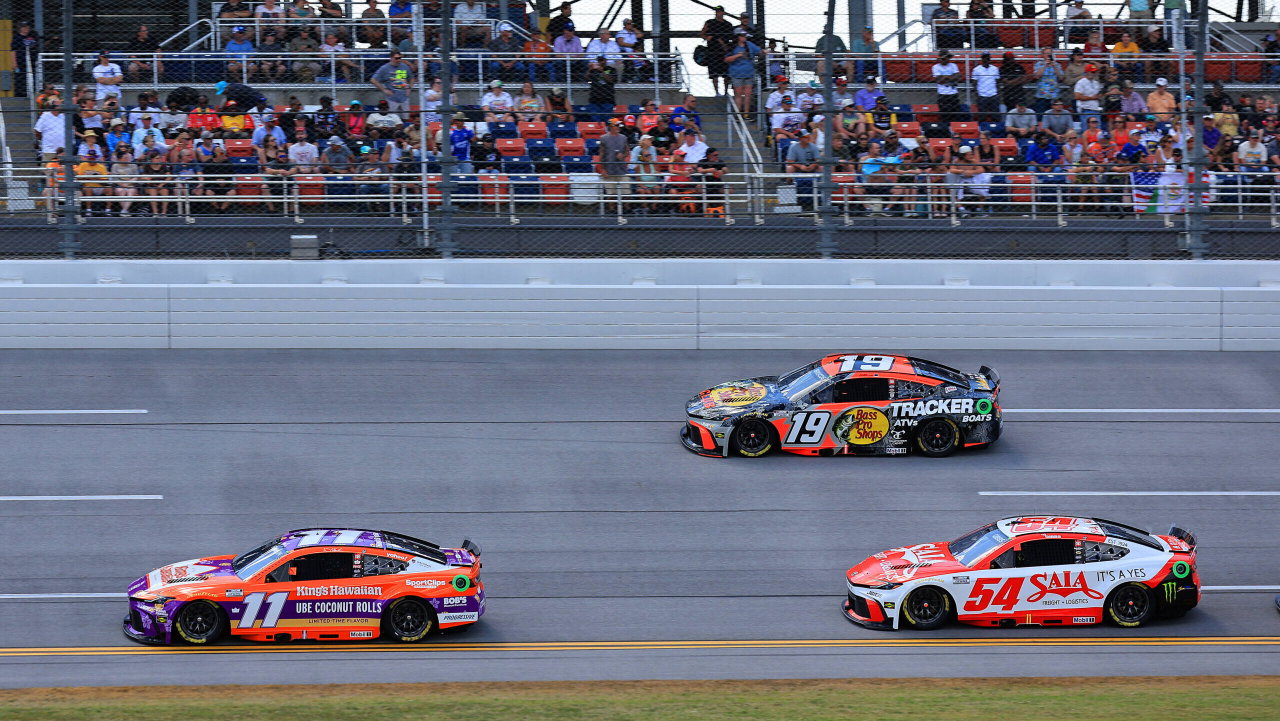
NASCAR addressed one of its most criticized stage-break procedures ahead of the Iowa Corn 350 last week. A natural caution occurring with 10 or fewer laps remaining in Stage 1 or 2 will now trigger the stage-break process. While the change was expected to eliminate some of the lengthy double-caution periods fans have complained about, it has also brought a new concern to light.
Watch What’s Trending Now!
23XI Racing spotter Freddie Kraft believes NASCAR is moving in the right direction. However, on a recent episode of the Door Bumper Clear podcast, he explained the larger problem, one he believes is out of the sanctioning body’s hands.
“I’m glad they did it. They fixed the wrong problem. You know what I mean? This happens, I don’t know, 10 times a year where we run into a stage break, but we still burn f***ing 10 laps every stage caution,” Kraft said.
The new rule addresses the situation where a caution comes out shortly before the scheduled end of a stage. Previously, NASCAR could run the caution in case of a racing incident to the stage finish. It then began another caution period for the stage break itself.
That could turn a few remaining green-flag laps into a lengthy stoppage. But according to Kraft, that scenario is not the real reason NASCAR cautions consume so much time.
The bigger issue is what happens during every normal stage break. Kraft explained that once the yellow comes out, pit road opens and NASCAR teams begin cycling through their stops.
Cars have to complete the pit cycle, the field has to be gathered back together, and drivers have to select their restart lanes. By the time all of that happens, several additional laps have been burned under caution. That means even if NASCAR eliminates the occasional double-caution scenario, fans will still be watching lengthy neutralized periods multiple times during a race.
He pointed to a recent example involving the No. 96 car of Anthony Alfredo during the O’Reilly Auto Parts race.
When the car spun during Stage 3 on lap 150, Kraft noted how quickly NASCAR was able to respond. The pace car picked up the field and pit road opened almost immediately. For Kraft, that was proof that the sanctioning body itself is capable of speeding up caution periods.
“So this is obviously not a f***ing NASCAR problem,” Kraft argued on the same episode of the podcast.
According to Kraft, who serves as Bubba Wallace’s primary spotter on the No. 23 team, television production is ultimately dictating much of the pace. NASCAR can have pit road ready within a lap or two, but the caution can continue while broadcasters finish commercial breaks and other segments.
Kraft’s point is that caution periods also give networks valuable broadcast time. NASCAR may be ready to go green, but the TV schedule can determine when the race actually resumes.
And if the goal is genuinely to shorten NASCAR races, Kraft believes removing unnecessary television-driven caution laps would make a far bigger difference than simply changing the occasional stage-break scenario.