
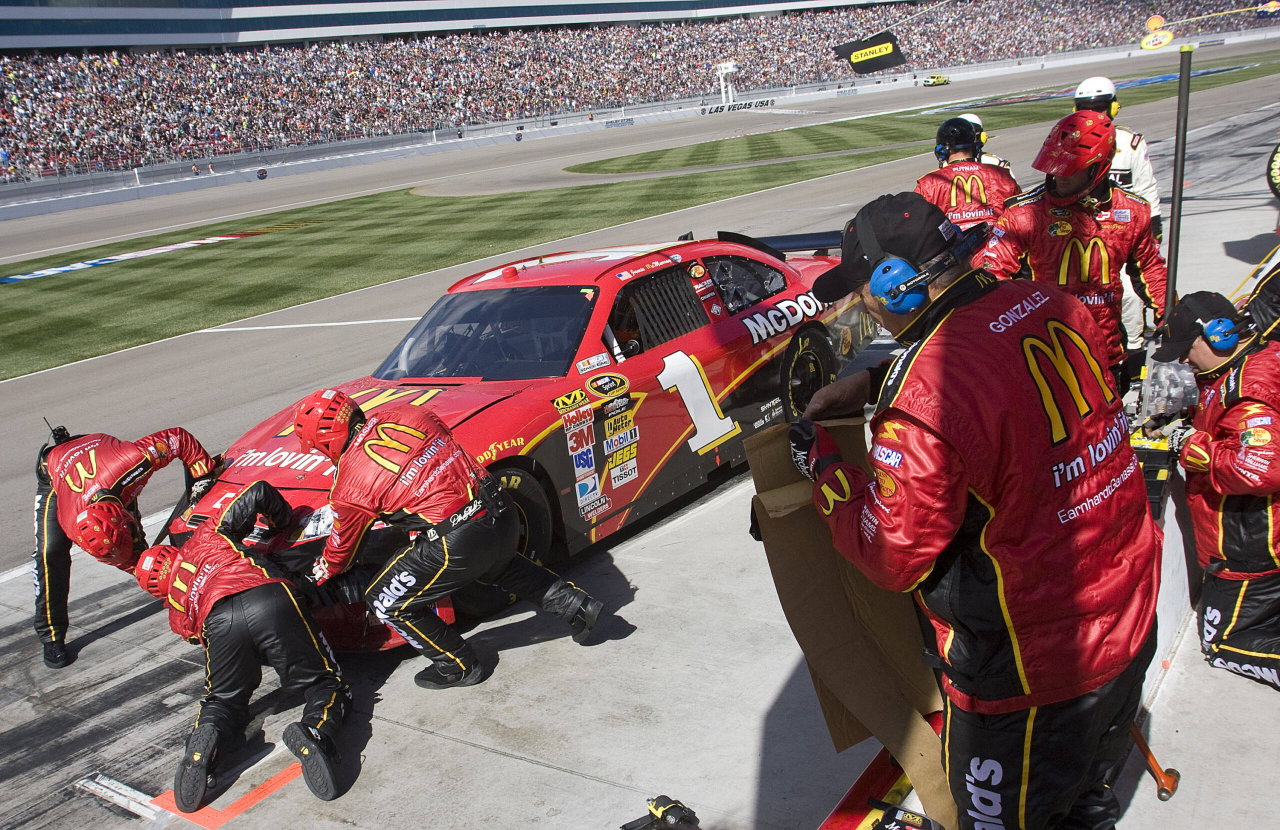
NASCAR, behind the scenes, is almost always working toward something new. Over the last decade, it introduced stage racing to Cup Series events, brought back the Chase by scrapping the old playoff system, and, in what was arguably its most polarizing decision, introduced the Next Gen car. That move also brought single-lug nuts to the Cup Series, something NASCAR had used for decades prior.
Watch What’s Trending Now!
Now, another major development involving them could be on the horizon, with rumors circulating around the garage that every single series at the national level will soon follow suit. Veteran crew chief Kevin “Bono” Manion didn’t hide what he had heard.
“Rumor has it down the road that the O’Reillys and Trucks will be on single lug at some point,” Manion said on the Door Bumper Clear podcast.
The Cup Series uses a single, center-locking lug nut on each wheel. It has been that way since 2022, when NASCAR introduced the radically different Next Gen car. The Truck and O’Reilly Series, meanwhile, have continued to use the long-standing five-lug system, which was introduced at the very beginning of NASCAR itself.
Moving to a single lug across all three series would completely change how NASCAR pit stops work at every level of the sport. Manion explained exactly why this is headed that way. The top Cup teams like Hendrick Motorsports and Joe Gibbs Racing train their pit crew athletes on single-lug systems. That is all they know. Many of them have never even touched a five-lug wheel.
“There are strictly Cup-only guys that maybe have only been brought up on a single lug nut and never even changed a wide five or a five-on-five pattern,” Manion added in the same podcast. “They don’t want to get them goofed up, so they just leave them on single lug.”
Freddie Kraft, who is Bubba Wallace’s primary spotter on the No. 23 team, pushed on this. He noted that Cup teams are pulling back from staffing the lower series because the two systems do not mix well. The muscle memory for changing five lugs is completely different from driving a single-lug gun. Coaches do not want a crew member spending Friday night wrestling five lugs on a Truck and then showing up Sunday to pit a Cup car.
The implications also go beyond training schedules. Think about what a NASCAR pit stop looks like in the Truck Series at Daytona. Right now, with 20 lug nuts to tighten per stop, teams spend 13 to 15 seconds on pit road. Most skip tires entirely and take fuel only to stay in the draft.
Track position at Daytona is everything, and a full tire stop costs too much time. That’s probably why, when the conversation turned to this change, Kraft brought up Daytona for the Trucks.
“So I’m saying the stage is probably 20 laps at Daytona, if even that, so,” the 23XI employee stated.
Single lug changes that math completely. A four-tire stop would take under 10 seconds, roughly the same time as a fuel-only stop. Teams would no longer have to choose between fresh rubber and staying with the pack. They would take both, every time.
That sounds like a good thing. But there is a serious risk attached.
At Daytona, trucks are running 180 miles per hour in tight packs. If a crew member rushes a single-lug stop to keep up and doesn’t lock the nut properly, that wheel could come off at speed. NASCAR’s penalty for that is a two-race suspension for the crew chief. Lose a wheel at Daytona, and your season could be over before February even ends.
The gap between the big teams and smaller ones could also widen. Crews from Hendrick and Gibbs will likely nail those nine-second stops. Independent Truck teams piecing together part-time help may not. The divide on pit road could be bigger than ever.
The single-lug rumor, for now, remains just that. But NASCAR dropped a welcome response to the Brickyard controversy ahead of the Iowa Corn 350 this weekend. They have taken steps to address another issue that has frustrated fans: lengthy stage-break cautions.
NASCAR responds to criticisms from fans
After the Brickyard 400 at Indianapolis last month, the sport introduced the Natural Stage Caution Rule. If a yellow flag comes out within 10 laps of a stage ending, that caution serves as the stage break. The race does not restart for a pointless one-lap sprint only to go yellow again immediately after.
NASCAR CEO Steve O’Donnell addressed it directly via a video released by the sport’s handle on X.
“Long periods of caution laps and not enough green-flag racing. We heard you, and we want to make a change,” he said.
The scoring still works cleanly. The top 10 at the moment the caution flies lock in their stage points. Race distances and scheduled stage lengths do not change. If Stage 1 is scheduled to end on Lap 30 but a crash brings out the yellow on Lap 25, the remaining five laps are run entirely under caution.
NASCAR rolls the wreck caution directly into the official stage break, allowing the field to pit and restart Stage 2 on Lap 31 as planned, without an awkward restart in between.
The NASCAR community has reacted positively to O’Donnell’s announcement. Although we haven’t seen it in effect yet, with no such incidents in Iowa, it signals that the sport is willing to make swift changes to improve the viewing experience.
Dale Earnhardt Jr., one of NASCAR’s most outspoken veterans, feels that this could lead to even more changes in the future. On an episode of The Dale Jr. Download podcast, he said, “I’ve never really known why they wouldn’t make a change, but we’re finally gonna do it… They’re still working on how they can shorten up standard traditional cautions, so we’re not done yet.”
If Earnhardt Jr. is right, the stage-break rule may only be the beginning. The bigger question now is how far NASCAR is willing to go to make its races move faster.