
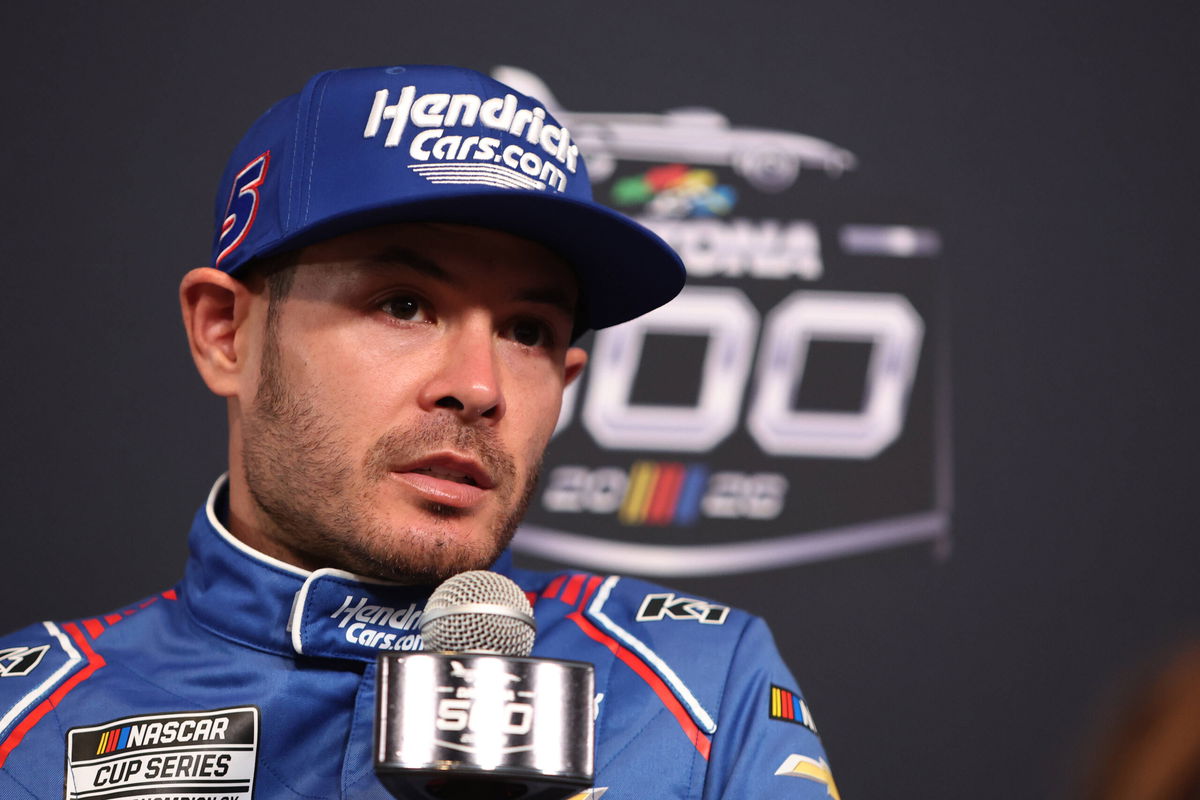
NASCAR has worked hard to create parity across the Cup Series, giving more teams a chance to compete on equal footing. But has the sport taken that balance too far? With cars running closer together than ever, drivers are struggling to build enough of a speed advantage to make passes, even when they catch the competition. Kyle Larson believes the Next Gen era needs a significant shake-up, and his proposed solution could turn NASCAR’s approach to competition on its head.
Watch What’s Trending Now!
“I think we just need like a bigger rules change at this point to like a really big rules change just to get the teams to like work again and mess up,” Larson said in an interview with Apex Hunters United.
The Hendrick Motorsports driver isn’t campaigning for one particular adjustment. He suggested NASCAR could experiment with completely different tires, aerodynamics, or horsepower. What matters more is creating a technical challenge that teams approach differently. Some organizations would get the new rules right, while others would struggle to adapt. That would create differences in lap times and give drivers more opportunities to make passes.
Larson says NASCAR had more of that variation during the Gen 6 era. When he entered the Cup Series, substantial changes to horsepower, ride height and aerodynamics regularly forced teams to rethink their setups. Every new season brought another engineering challenge. Organizations that understood the changes early could gain an advantage, while others had to catch up. Larson remembers that process as enjoyable because drivers had to learn different ways to handle their cars.
The current package, in his view, has made that separation harder to achieve. The problem is not necessarily that the Next Gen car is unpleasant to drive. Larson actually prefers its road-course characteristics because drivers can attack braking zones and use more gears. He also considers short-track racing just as enjoyable, if not more so. The bigger issue is how closely the field runs together.
The 2025 Food City 500 at Bristol offered a striking example of how that competitive balance can play out. Larson led 411 of 500 laps, winning by 2.250 seconds over Denny Hamlin. It was his second consecutive race there with more than 400 laps led, following his 462-lap performance in the 2024 Night Race.
Hamlin later explained why he believed the Next Gen car made passing so difficult. He described the cars as too planted and argued that parity was a major part of the problem. With competitors running at such similar speeds, a driver often needs several tenths of an advantage to make a move. At Darlington in April 2025, Hamlin had also pointed out how he took the lead from William Byron, who had led 243 consecutive laps. “Yeah, we didn’t pass him. We cycled,” Hamlin said.
NASCAR has not ignored those concerns. For 2026, the sanctioning body increased horsepower from 670 to 750 at road courses and oval tracks shorter than 1.5 miles, alongside aerodynamic adjustments. The intention was to increase tire wear, create more differences in speed, and give drivers better passing opportunities. NASCAR’s Mike Forde described the package’s Phoenix debut as a “game-changer,” pointing to greater tire falloff and more varied strategies. Early-season analysis also showed more passing at Phoenix and Darlington, although the results were less encouraging at Martinsville and Circuit of The Americas.
However, NASCAR is not preparing to abandon the current car. During his November 6 State of the Sport address, CEO Steve O’Donnell said the organization remains focused on improving the Next Gen platform rather than developing a Gen 8 car. He cited the substantial costs of introducing another generation and the importance of maintaining a sustainable model for teams and manufacturers. Further horsepower increases remain under discussion for 2027, but O’Donnell cautioned that adding power alone would not solve everything, with braking and other technical considerations also involved.
That leaves NASCAR with a difficult balancing act. Its current approach has delivered some improvements, but Larson believes the sport needs a more fundamental change to restore meaningful performance differences. His argument is not that every race needs a different car or that the Next Gen platform has no positives. He wants teams to face new engineering challenges, make different decisions, and occasionally get them wrong. That could give drivers the speed advantage they need to turn a run into a pass.