
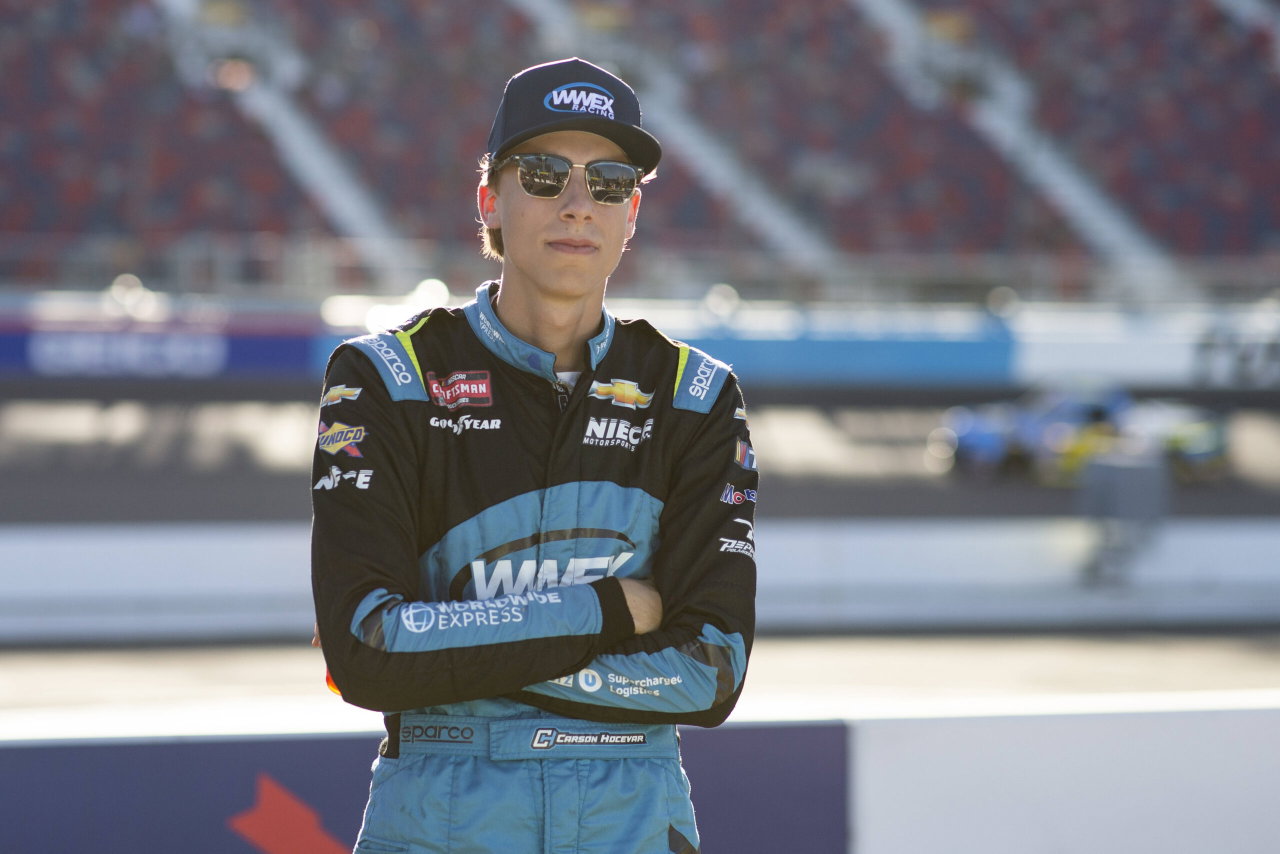
Carson Hocevar’s afternoon at Martinsville Speedway created controversy long before the checkered flag flew. A spin while racing William Byron for position raised questions throughout the garage, while a later incident involving Austin Cindric left the Team Penske driver with heavy front-end damage and an early trip to the garage.
Watch What’s Trending Now!
By the time the race ended, NASCAR was facing questions about whether further action would follow. Among those calling for a strong response was veteran broadcaster Bradley Gillie.
“I’m here for Carson Hocevar. I’m a fan. I think what he does and the way he engages people are awesome. But you cannot let people do things like this on the racetrack. You’re going to turn the sport into a mockery. You can’t overlook the things that are done just because someone’s popular. That’s where you lose your credibility as the sanctioning body.”
Gillie made the comments on PRN Live and went beyond proposing a simple fine. He suggested NASCAR should seriously consider keeping Hocevar out of the season finale at Homestead-Miami Speedway.
Importantly, Gillie’s warning was directed at NASCAR’s response as much as Hocevar’s actions. He argued that overlooking conduct like this would damage the sanctioning body’s credibility moving forward.
The first controversy arrived during Stage 2.
While trying to stay on the lead lap against William Byron, Hocevar spun entering Turn 4 and brought out a caution while several teams were making green-flag pit stops. Christopher Bell was among the drivers affected. The timing of the yellow eventually contributed to Bell receiving a speeding penalty on pit road and altered strategy for several competitors.
Hocevar insisted the incident was accidental, claiming his Chevrolet had become difficult to control because of damage and a failing right-rear tire. But not everyone agreed. Bell, Austin Dillon, and Shane van Gisbergen all questioned the incident over team radio.
Gillie was among the skeptics.
“The second part of it, I’m sorry. When he was racing the leader, William Byron, trying to stay on his lap or get his lap back, he spun on his own. I was in the other room, with a wall between me and the TV, and my glasses off, and I could tell he spun on his own. I think that’s a bad thing.”
The bigger flashpoint came later. Following a restart, Hocevar and Austin Cindric became involved in an increasingly aggressive exchange. After several contacts between the cars, Hocevar appeared to brake-check the No. 2 Ford multiple times. Cindric’s car sustained extensive front-end damage and was eventually forced to retire from the race in 36th place.
His frustration came through clearly over the radio.
“NASCAR, what are we doing? Like, we’re just weaponizing cars here. I stack on entry with the guy and he has a mental breakdown.”
However, Hocevar disagreed with the criticism. After the race, he characterized the contact as typical Martinsville racing, where drivers routinely use bumpers to move competitors out of the way.
One reason the incident has drawn so much attention is NASCAR’s recent willingness to penalize similar behavior. Zane Smith was fined $50,000 after hitting Hocevar on the cooldown lap at Phoenix Raceway following several weeks of escalating tensions between the two drivers.
NASCAR officials had previously summoned both drivers to the hauler and warned them that further incidents would trigger intervention. Vice President of Racing Communications Mike Forde later explained that Smith’s penalty stemmed from ignoring that warning.
Gillie also referenced Ryan Preece’s punishment following an incident with Ty Gibbs at Texas Motor Speedway. Although Preece disputed the contact, NASCAR ultimately upheld a $50,000 fine and a 25-point penalty after review.
Those precedents are part of the reason many observers believe NASCAR now faces a difficult decision. Homestead-Miami Speedway hosts the Cup Series finale on November 8. Hocevar is not competing for a championship, but his actions could still influence the outcome for drivers who are.
That reality is exactly why Gillie believes NASCAR cannot afford to do nothing.
For him, this has become about more than one aggressive driver. It is about whether NASCAR is willing to consistently enforce the standards it has already established.