
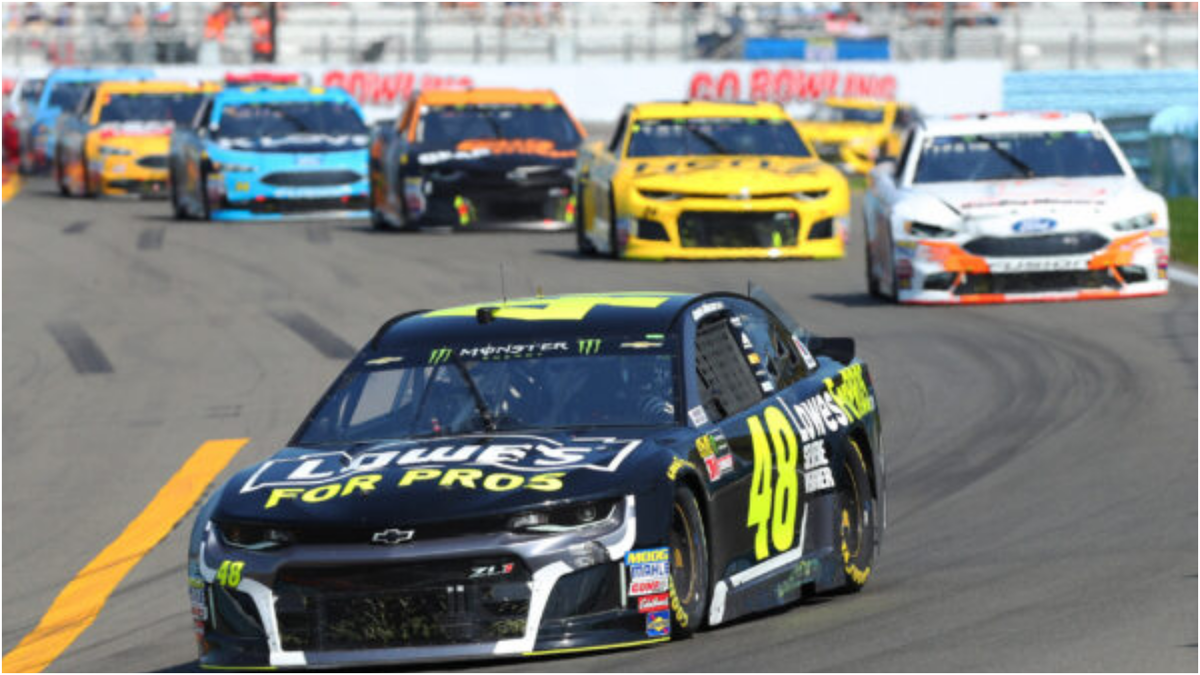
‘Ah, the good ol’ days.’ It’s something older NASCAR fans often say while talking about the 1990s, an era many still consider the sport’s golden age. Larger-than-life personalities, louder cars, and nonstop drama. Many believe NASCAR will never feel the same again. But not Kenny Wallace or Ken Schrader, two drivers who actually lived through the era fans continue to romanticize.
Watch What’s Trending Now!
After the Coca-Cola 600, Wallace and Schrader seemed convinced that the Next Gen cars still have what it takes to give fans that old NASCAR feeling again.
“I have not watched a race, a 600-mile race, where they went at it lap after lap. It felt like these guys felt like it was gonna rain at any lap. The bottom was there, the top was there, the middle was there,” Wallace said on the Herm & Schrader podcast.
“This Next Gen car, I think, that is the blueprint,” he added.
Schrader, with his three decades of experience, further opined that the “good old days” fans reminisce about are right in front of them. The racing is the best he’s ever seen.
“I tell people all the time that whenever we talk, and they say, ‘Oh, I like the good old days,’” he said in the same podcast. “And I said, ‘Well, let me tell you what — if you’re not watching now, you’re missing the best NASCAR Cup racing that we’ve ever had.’”

Are “the good ole days” actually right now? 🤔 Don’t miss this week’s Herm & Schrader, out now! 🔥 Spotify: open.spotify.com/episode/65QbVN… Apple: podcasts.apple.com/us/podcast/bes… YouTube: youtu.be/KpwWpDA-fAk?si… @Kenny_Wallace | @KenSchrader
The common belief among fans is that races have become too clean and too dependent on track position. But the Coca-Cola 600 was pure chaos in that regard. The track became slick, cars were sliding around, and drivers constantly had to search for grip instead of sticking to just one preferred lane.
Then Daniel Suárez and his team rolled the dice. While most played it safe with four tires, Suárez took only two, a gamble that put him out front. But the harder part came after when faster cars closed in while rain moved toward the speedway. Suárez still had to hold them off on worn tires with the track changing underneath him.
When the rain finally ended the race with 27 laps remaining, Suárez had survived the kind of race veterans usually claim NASCAR no longer produces. It was messy, aggressive, and completely dependent on the driver managing the car.
Wallace credited the Next Gen cars for that, despite the criticism they have faced since debuting.
Drivers and fans have complained that once a car gets stuck in traffic, passing becomes almost impossible because of dirty air. Charlotte completely flipped that narrative. Drivers moved through all three lanes, built runs in traffic, and raced side-by-side for much longer than usual.
Praise for the Next Gen cars coming from the likes of Wallace and Schrader means something. They raced during the sport’s biggest boom period, when it exploded into mainstream America during the late 80s and 90s. Stands were packed every weekend, and drivers like Dale Earnhardt, Jeff Gordon, and Rusty Wallace became national celebrities.
But what fans really remember and miss from that era was how unfiltered it all felt.
One of the wildest races NASCAR has ever seen
If newer fans want to understand why people still obsess over NASCAR’s old days, Bristol in 1999 is usually the first race that gets mentioned. The Goody’s Headache Powder 500 was pure chaos from start to finish.
Bristol Motor Speedway was already brutal back then. It is a tiny, half-mile concrete track where drivers spend most of the race leaning on each other because there is barely enough room to race cleanly. Now add 43 cars with more than 700 horsepower, 140,000 fans packed into the stands, and tempers building under the lights.
Tony Stewart, still a rookie at the time, dominated the first half of the race in the No. 20 Home Depot Pontiac and led 225 laps. Then, contact with Kenny Irwin Jr. sent Stewart into a rage. He drove his damaged car directly toward Irwin’s pit stall and began angrily gesturing at the crew.
Back then, nobody considered that shocking. That was simply Bristol. The race ended with 11 cautions, destroyed fenders, crushed noses, and steam pouring from damaged radiators. Only 11 cars remained on the lead lap by the finish.
There was the finish. Terry Labonte led coming to the white flag. Dale Earnhardt lined up behind him in the black No. 3 Chevrolet. Entering Turn 2 on the final lap, Earnhardt never really tried to pass him cleanly. He just drove into him. Labonte spun into the wall while Earnhardt blasted through the smoke to win the race. Fans erupted. Beer cans flew from the stands. Labonte pulled his destroyed car beside Earnhardt in Victory Lane before climbing out, furious.
Then Earnhardt famously said: “I didn’t mean to turn him around, I just wanted to rattle his cage.”
Today, a move like that would trigger telemetry reviews, penalties, maybe even a suspension. NASCAR now studies throttle traces and steering data after incidents. In 1999, officials looked at it, called it short-track racing, and moved on.
That is why Wallace and Schrader’s comments landed the way they did after Charlotte. These are drivers who came from NASCAR at its loudest and wildest. And after one race, they saw pieces of that same energy again.