
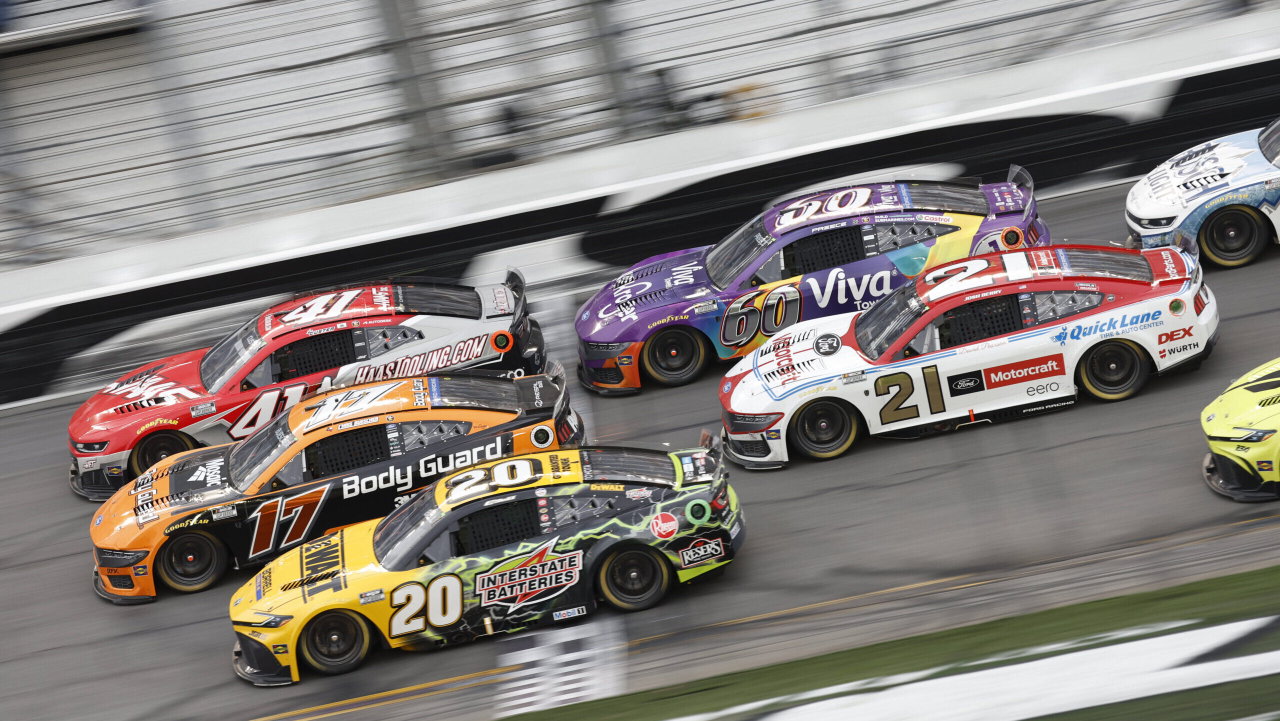
NASCAR may have finally realized it cannot win every Sunday fight. As the NFL season takes over the sports calendar, NASCAR executive Ben Kennedy raised the question the sport has increasingly faced: “Should we be going up against the NFL at this point in the year on every single Sunday? It’s a challenging proposition.” His comments come as insiders point to NASCAR’s scheduling choices, particularly races clashing with major NFL games, as a growing problem for attendance and fan attention. Now, the criticism is getting harder for NASCAR to ignore.
Watch What’s Trending Now!
“He wrote me this beautiful letter. He goes. Well, no. I had him on Kenny Conversation. Scott Ackerson, who started the NFL today, biggest show in football. He said, “NASCAR has got to change this. You cannot go up against the behemoth. You got to know your place in life,” Scott Ackerson’s warning to Kenny Wallace could hardly be more direct.
Ackerson, who Wallace described as the man behind The NFL Today, was making a simple point: NASCAR does not need to hand the NFL an advantage. Yet the South Point 400 landed directly in the middle of a massive Chiefs-Raiders matchup, while NASCAR’s own insiders continue to question whether late Sunday races are creating another problem for fans.
The October 4 schedule made the conflict obvious. The South Point 400 was scheduled for 5:30 p.m. ET, or 2:30 p.m. local time in Las Vegas. Just over an hour earlier, the Kansas City Chiefs and Las Vegas Raiders kicked off at Allegiant Stadium at 4:25 p.m. ET, with the game airing nationally on CBS. The two events then overlapped for much of the afternoon.
And this was not a routine NFL game that happened to occupy the same window. Chiefs-Raiders was a matchup between two undefeated AFC West teams, played in the same city where NASCAR was racing. The NFL game ultimately averaged 28.45 million viewers, its largest audience of the 2026 season and the biggest Week 4 audience on any network in the Nielsen people-meter era. Chiefs-Raiders appeared in 69% of markets during CBS’ late national window.
NASCAR was asking fans to choose between that and a playoff race featuring Kyle Larson, Denny Hamlin, Chase Briscoe and Tyler Reddick. The South Point 400 delivered its own drama, with Briscoe winning after leading 175 of 267 laps and Larson and Reddick fighting him in the closing laps. But the race’s television window still put NASCAR directly against one of the biggest sports broadcasts of the day.
That is exactly where Wallace’s argument becomes relevant. NASCAR does not have to surrender Sundays, but it can avoid deliberately placing marquee races against the NFL’s biggest windows. Ben Kennedy has already acknowledged the dilemma, asking whether NASCAR should really be going against the NFL “on every single Sunday” at this point in the year. The October 4 clash showed why the question matters.
There is another scheduling problem NASCAR could solve at the same time: late Sunday finishes. The Atlanta race earlier this year became the clearest example. A rain delay pushed the Cup Series race into the early hours of Monday, with the finish coming around 2 a.m. to 3 a.m. ET, depending on the report.
Fans were not happy. Some complained about having work Monday morning, while others argued NASCAR had effectively boxed itself in by starting the race so late. Jeff Gluck called for earlier starts specifically to avoid another midnight or Monday finish, especially considering the blue-collar fanbase of the sport.
Chase Elliott heard similar complaints directly from fans. He said people he knew either attended the Atlanta race and were unhappy about their Monday morning, or chose not to attend because they had to work. Elliott has openly pushed for more Saturday night races, pointing to the atmosphere of Bristol’s Saturday night event and calling Sunday-night races awkward when Monday morning is waiting.
That creates a potential solution to both problems. Moving more races to Saturday night would remove NASCAR from the NFL’s Sunday battlefield while giving fans a schedule that leaves Sunday night free and Monday morning intact. NASCAR already has proof that Saturday works: the 2026 schedule included Saturday-night races at Richmond, Daytona and Bristol.
The NFL will remain the behemoth Wallace described. NASCAR cannot change that. But it can decide how often it puts itself directly in the behemoth’s path. And with fans already questioning late Sunday finishes, Saturday nights could offer NASCAR a way to solve two scheduling headaches with one move.