
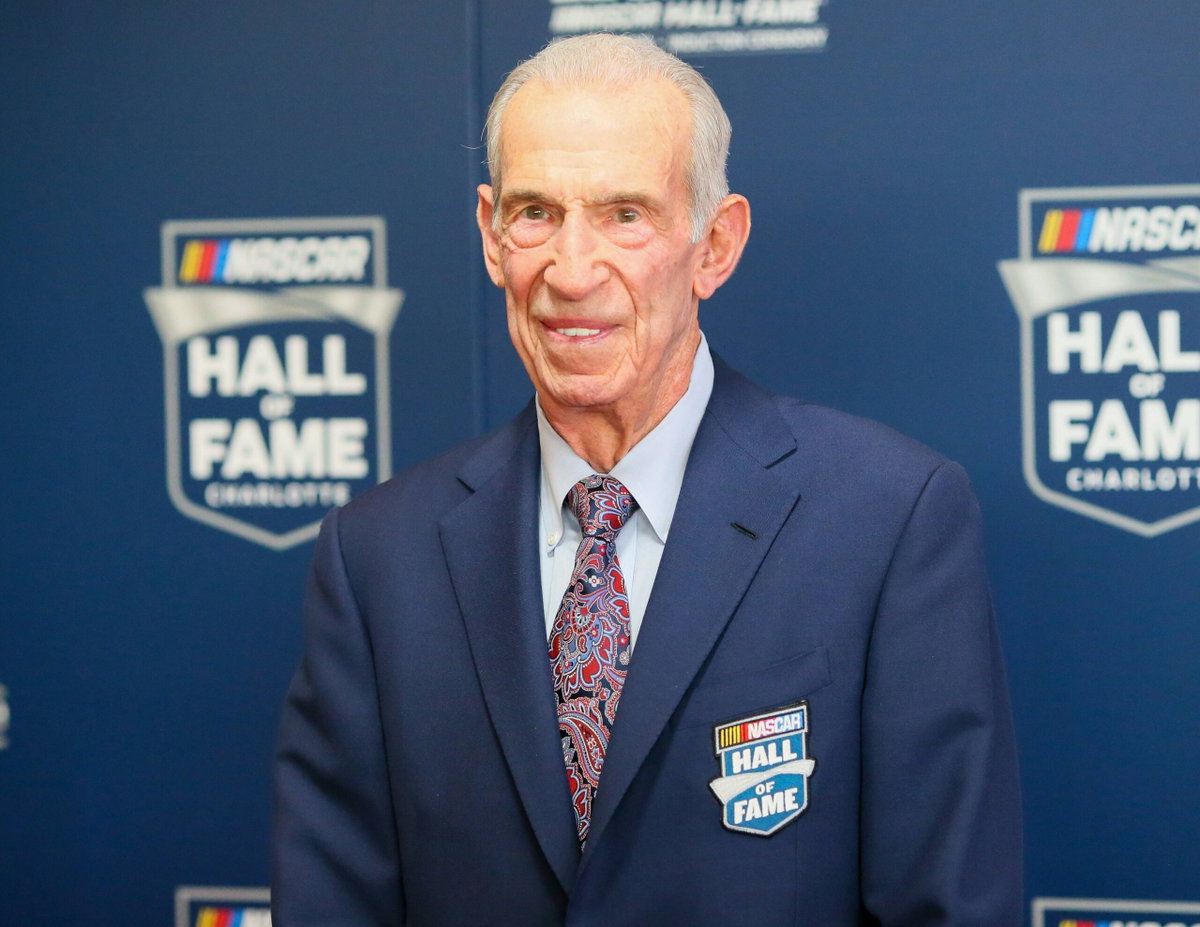
In a sport where drivers pride themselves on being aggressive and ‘rowdy,’ being called a ‘gentleman’ is truly an achievement. But he earned that reputation the hard way, as he started from a sawmill in Conover, North Carolina, and clawed his way onto the Grand National grid by writing a $2,000 check he knew would bounce, and he had only until Monday morning to cover it. He won back-to-back races at Myrtle Beach and the Charlotte dirt track over the weekend, collected $1,600 in prize money, borrowed the rest, and walked into the bank before it could draw the funds. That was how, in 1959, Ned Jarrett bought Junior Johnson’s former Ford and launched a NASCAR Hall of Fame career.
Watch What’s Trending Now!
And on Thursday, NASCAR lost its oldest living champion. Jarrett died peacefully of natural causes at his home in Newton, North Carolina, with his family by his side. He was 93. His family released a statement:
“With profound sadness, the family of NASCAR Hall of Fame driver and radio/TV personality Ned Jarrett announces his passing on Thursday, June 4, 2026. He died peacefully of natural causes at his home in Newton, N.C., with his family by his side. He was 93 years old. Our father was a devout Christian and a devoted, loving family man.
“He was a friend to everyone he met and NASCAR’s oldest living champion. By all accounts, he was a true NASCAR legend. While we mourn his passing, we celebrate the remarkable life of an amazing man and truly the best father anyone could have wished for. Rest in peace, Dad.”

The NASCAR family is saddened by the loss of Ned Jarrett, a NASCAR Hall of Famer, two-time Cup Series champion and one of our sport's greatest ambassadors. We extend our deepest condolences.

For being a two-time champion, Jarrett did not really race for long. He only contested six full seasons across a 13-year career. Yet, in 352 career starts between 1953 and 1966, he won 50 races, recorded 239 top-10 finishes, and earned 35 pole positions, taking championships in 1961 and 1965.
During those full seasons, he never finished worse than fourth in the standings. More remarkably, he remains the only Cup Series champion in history to willingly retire the season after winning the title, as he hung up his helmet at just 34 years old when Ford announced its departure from the sport in 1966.
His racecraft was historic in its own right. In 1965, driving for DuPont heir Bondy Long, Jarrett won 13 races and placed in the top five 42 times in 54 starts, despite suffering a back injury at Greenville-Pickens Speedway mid-season. That same year, he won the Southern 500 at Darlington Raceway by 14 laps, a whopping 17.5 miles, still the largest margin of victory in NASCAR Cup Series history. Of his 50 career wins, 43 came in a Ford, placing him ahead of Bill Elliott and Mark Martin as the winningest driver in that manufacturer’s Cup history.
All of this was achieved alongside legends who defined that era, like Richard Petty, David Pearson, and Fireball Roberts. Yet Jarrett stood apart not only because of what he did on track, but also because of how. Jarrett was the opposite of the likes of Curtis Turner, Fireball Roberts, Joe Weatherly, and the Flock brothers: he was a family man who genuinely earned “Gentleman Ned.”
And fittingly, the story of how he first got there involved both a lie and a father’s correction. During the early 1950s, Jarrett raced under his brother-in-law John Lentz’s name after taking over his car when Lentz stepped away. He kept racing and kept hiding it.
When his father eventually caught him winning under an assumed name, he told him that if he was going to race, he should at least do it under his own name. It was both a reprimand and a permission. From that point, Ned Jarrett raced as himself.
He was inducted into the International Motorsports Hall of Fame in 1991, and ultimately into a dozen halls of fame across his lifetime, before the NASCAR Hall of Fame came calling in 2011, as part of its second-ever five-member class.
As for his gentlemanly behavior, when Jarrett switched from his championship-winning No. 11 Chevrolet back to Ford for the 1962 season, he sold the car to Wendell Scott, the only African-American driver on the top circuit, who drove it to compete full-time. And before a long trip to Riverside, California, Scott found himself without enough cash in his pocket to make the journey and asked Jarrett if he could borrow $500. Having grown up on a farm and worked in a sawmill, Jarrett remembered travelling from bullring to bullring on the lint in his pockets. He lent Scott the money.
Years later, at Scott’s funeral in 1990, his widow, Mary, singled Jarrett out by name, the only driver she mentioned, per the Las Vegas Review-Journal, when describing the respect Wendell had earned from his peers.
“When Ned Jarrett and all of those old drivers came to Wendell’s funeral, they told us he had the respect of all the drivers,” she said.
Then there was the 1964 World 600 at Charlotte Motor Speedway. On lap seven, Jarrett and Junior Johnson tangled racing for position, and Fireball Roberts crashed trying to avoid them. Roberts’ car slammed into the retaining wall and burst into flames, as witnesses heard Roberts screaming, “Ned, help me” from inside the burning car. Jarrett got there without wasting a second.
“I got to him first and tried pulling him out of his car. He was covered with gas and on fire. I remember he was wearing suede shoes and they fell off of him as we were pulling him out,” Jarrett recalled. “Our driver suits back then were pretty much whatever we could find. Every opening in his suit was an opening for gas to get into, and of course, for fire to follow.”
Jarrett was treated for minor burns himself. Roberts suffered third-degree burns and died two months later from his injuries. The incident shook Jarrett deeply and also became a factor in his decision to eventually retire.
NASCAR joins in to pay respects to Ned Jarrett
After the news was announced, NASCAR released an official statement commemorating his career. NASCAR CEO Steve O’Donnell said:
“Despite his calm demeanor, ‘Gentleman’ Ned Jarrett was as fierce a competitor as NASCAR has ever seen. His on-track accomplishments speak for themselves with wins and championships across several NASCAR divisions. But it was his off-the-track persona that separated Ned from his peers.
“He was as kind as his nickname indicated. And his endearing personality helped him excel in his second career as a broadcaster. Ned was an outstanding ambassador for the sport for more than six decades, and he will be dearly missed. On behalf of the France family and all of NASCAR, I offer my deepest condolences to all of Ned’s family and friends on the loss of a NASCAR legend.”
That second career was not an afterthought. After retiring from driving, Jarrett launched “Ned Jarrett’s World of Racing,” a daily radio news show that became a staple in the sport. He went on to work with MRN Radio as a pit-road reporter before moving to the television booth with CBS and ESPN. His voice became as synonymous with NASCAR as his helmet once was.
None of it, though, compared to the afternoon of February 14, 1993. Calling the final laps of the Daytona 500 for CBS, Jarrett openly cheered his youngest son, Dale, across the finish line ahead of then five-time series champion Dale Earnhardt. That call remains one of the most beloved moments in NASCAR broadcasting history. Jarrett later apologized to Earnhardt for his ‘biased’ commentary — but nobody who was watching that day begrudged him a word of it. The phrase “it’s the Dale and Dale show” has lived in the memory of an entire generation of fans.
The Jarretts then became only the second father-son combination to win championships at NASCAR’s highest level, after Lee and Richard Petty, and both Ned and Dale now sit in the NASCAR Hall of Fame, inducted in 2011 and 2014, respectively. Glenn Jarrett, Ned’s other son, competed in both the Cup Series and the NASCAR O’Reilly Auto Parts Series before going into broadcasting.
“He and Benny were the goats of calling races,” one fan wrote on X. “Great racecar driver and announcer. I miss those days,’ another fan chimed in on the same note.

Gentleman. Start your engine.

There was another fan who also had a rather nostalgic memory about Jarrett from his early days. “My favorite in the booth. My grandpa raced against him in 1953. RIP, champ.” While they never elaborated on that aspect, it was still a big deal to go up against a driver of his caliber.
His time as a driver and announcer had undoubtedly touched many hearts, as one of the fans aptly summarized in their message. “Sir, my childhood is filled with memories of you announcing the races. Always brought so much pertinent info to broadcast and was always a class act. Rest in peace, Mr. Jarrett.”
In the end, the entire community was left thinking the same thing: “What a rough year (putting it mildly) for NASCAR and the motorsports community in general. RIP, Ned Jarrett…”
It has been a terrible year indeed, with legends like Ned Jarrett and Kyle Busch leaving us midway through the year. As we move on, we can only try to respect their legacies in the sport of NASCAR.
We at Essentially Sports offer our sincere condolences to Ned Jarrett’s surviving family. May he rest in peace.