
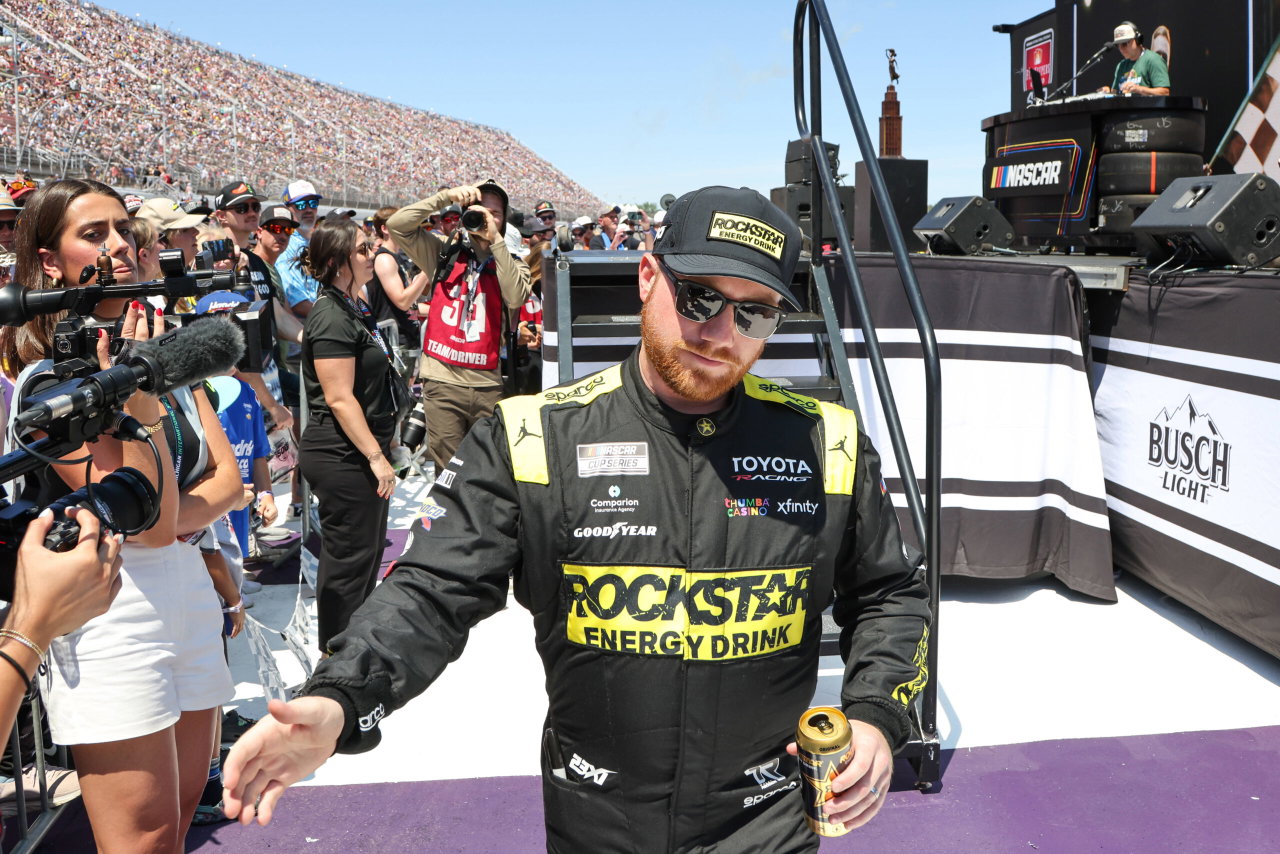
Tyler Reddick had gone more than 20 races without a victory after claiming five of the first nine races of the 2026 NASCAR Cup Series season. That drought finally ended at Phoenix, as he capitalized on a late-race opening to claim his sixth win of the year. The victory was valuable on its own, but it also rescued his championship hopes at a critical moment.
Watch What’s Trending Now!
NASCAR veteran Kyle Petty believes the win may have saved Reddick from falling too far behind in the title race. Before Sunday, Reddick was 114 points behind Kyle Larson. After winning the Freeway Insurance 500 and capitalizing on Larson’s disastrous afternoon, he cut that deficit to 56 points.
“He was teetering on the brink of being that guy,” Petty said during a PRNLive discussion on X. “If he had come out of yesterday, I’m not sure he would’ve been above my cut line.”
The Chase format has no elimination rounds, with the championship decided by cumulative points across the final 10 races. Petty was describing how close Reddick had come to falling outside his own group of realistic title contenders.
Reddick’s early-season form had made him one of the strongest drivers in the field. He won five of the first nine races, including the opening three, and appeared capable of controlling the championship conversation. However, things suddenly changed, and the long wait for his sixth victory changed the picture considerably.
The No. 45 23XI Racing Toyota had not found the improvements it needed during that stretch. Reddick remained a threat on certain weekends, but without another win, the gap to Larson had grown to 114 points. With three races remaining after Phoenix, he was running out of time.
Then came Sunday. Reddick did not lead the Freeway Insurance 500 until the closing stages, but when he did, he made it count. A two-tire call during the final pit-stop sequence helped put him in position to attack, and he moved past Chase Briscoe after the restart with 18 laps remaining.
Reddick held on to defeat Ryan Blaney by 0.801 seconds, securing his first career victory at Phoenix Raceway.
The timing could hardly have been better. Larson crashed late and finished 34th, turning a difficult afternoon for the championship leader into a major loss of points. Reddick’s victory, meanwhile, gave him a route back into contention.
According to NASCAR’s official race report, Reddick’s win and Larson’s result brought seven drivers into the championship mix with three races left. Petty believes that is exactly why the victory mattered so much.
There has been debate about whether NASCAR should reward race victories so heavily under its new championship format. Petty sees Reddick’s Phoenix result as a strong argument for keeping that emphasis.
“Everybody was like, man, they need to eliminate that. That makes it a lot closer,” Petty said, referring to the extra points associated with winning.
Under the 2026 points structure, a race victory pays 55 points, compared with 35 for second place. That 20-point gap between first and second makes winning especially valuable, particularly when a driver is trying to make up a large deficit late in the season.
Reddick’s result demonstrated how quickly those points can change the outlook. His victory did not erase the entire gap to Larson, but it narrowed the margin that seemed quite large. Without the win, he would have missed out on that substantial gain at precisely the moment he needed it most.
Petty also highlighted how Reddick’s team took advantage of the situation in front of it. Bubba Wallace had controlled much of the final stage, but a mistake allowed teammate Reddick to capitalize. Reddick still had to execute the restart and complete the pass, but the opening arrived at the right time.
“Just the right place, right time to get it done,” Petty said.
The win was therefore about more than ending a long drought. It gave Reddick the kind of points swing that a strong but ultimately unsuccessful run could not provide.
Reddick’s situation also reflects a wider change in how drivers must approach the championship. NASCAR returned to the Chase format in 2026, replacing the elimination-style playoffs that had been used for more than a decade. All 16 drivers who qualify for the Chase remain in contention throughout the 10-race stretch, and the champion is determined by total points.
That means no driver can rely on surviving a round and starting fresh. Every finish remains part of the final calculation, making a poor result difficult to shake off.
Christopher Bell has made a similar point in recent comments about the format. Bell recently told SiriusXM NASCAR Radio that every stage, race and position now matters because the points earned or lost carry through to the end.
Reddick’s season highlights both sides of that system. His long winless stretch allowed Larson to build a substantial advantage, but a single victory has helped him claw back and get much closer to a shot at the title. The same rules that make a bad afternoon costly also give drivers a meaningful reward when they convert an opportunity into a win.
With Talladega, Martinsville and Homestead still to come, Reddick has no guarantee of closing the remaining 56-point gap. Those races present different challenges, and another difficult result could quickly undo the progress made at Phoenix.
But he is no longer relying on a perfect run merely to stay relevant. He has given himself a genuine chance to challenge the leaders again.
Petty’s assessment captures the significance of that change. Reddick was approaching the point where a championship challenge would have become increasingly difficult to defend. Instead, he found a way to win when the opportunity appeared, and his points deficit is now roughly half of what it was before Phoenix.
It would be premature to say that the title fight is settled. For Reddick, however, Sunday’s victory changed the immediate question from whether he could stay in the fight to whether he can use the final three races to catch the drivers ahead of him.