
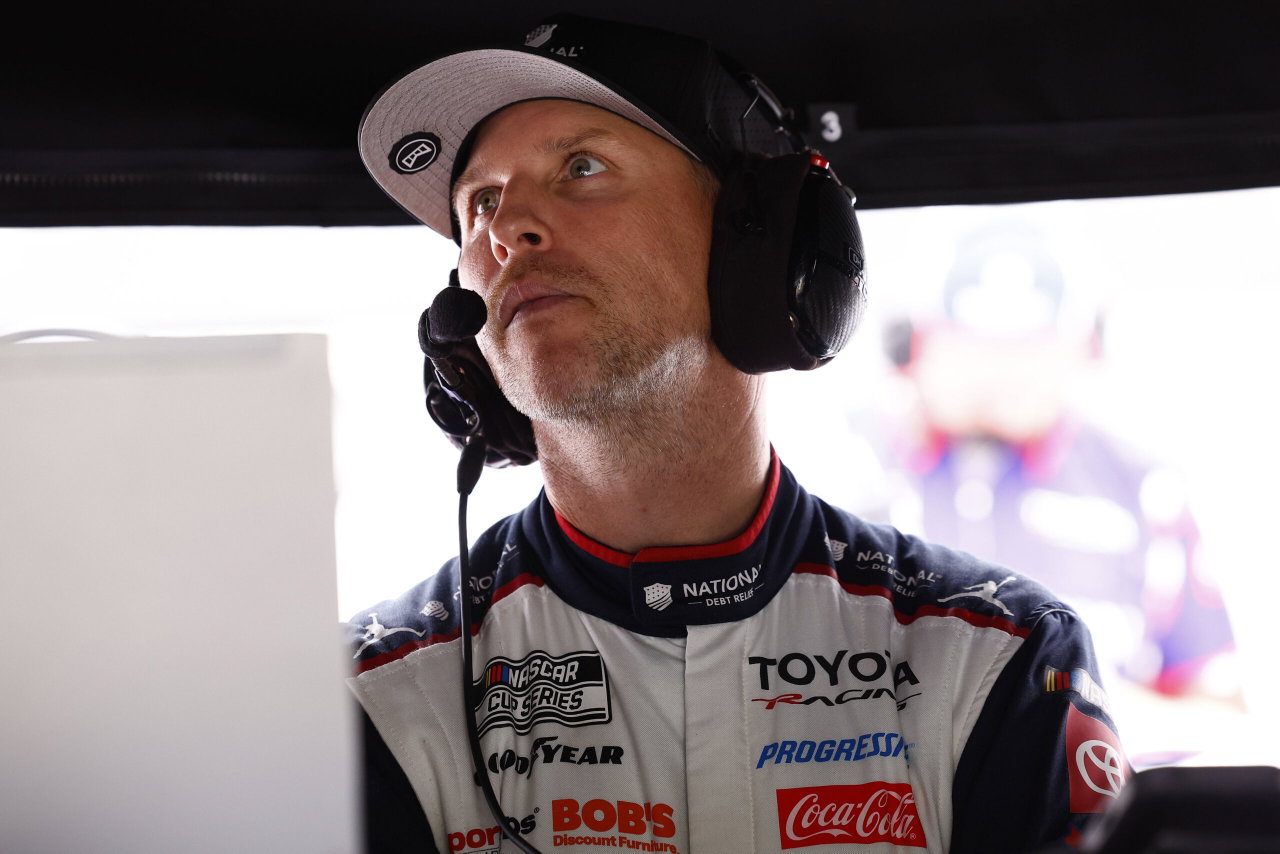
Denny Hamlin entered the 2026 NASCAR Chase as the No. 1 seed after a dominant regular season, but currently, his championship position looks very different, with Kyle Larson taking the lead on an opposite rags-to-riches story in points. This has led many to question whether the points reset has worked against the Joe Gibbs Racing driver, particularly after his recent run of difficult races.
Watch What’s Trending Now!
“Is it fair to reset points, or is it not?” NASCAR pundit Crash Gladys said on the “SpeedFreaks” podcast. “I guess that’s the question that we should put out there, because I think some will agree that, yes, it’s fair, you need that for a playoff, while others will agree, no, it’s not fair, because in cases like Denny Hamlin right now, he’s getting scr**ed.”
Hamlin started off slow in the regular season but stepped things up at Las Vegas earlier this year, where he scored his first win of the season. He followed that up with four more wins, including the non-championship All-Star Race at Dover. The other three came consecutively in Nashville, Michigan, and Pocono, allowing him to build an eventual 89-point advantage over Ryan Blaney when the regular season ended.
The points reset then reduced that lead to just 25 points heading into the Chase. This obviously changed the scenario quite a bit.
“I think where you’re going with that is resetting the points before the Chase,” Gladys continued with her argument. “Is that a problem in this new format? You could argue both ways, but for a driver like Denny Hamlin, who suddenly has a string of bad races after a points reset when he was fairly dominant through the summertime, yeah, that was not good for him to have a points reset.”
The first half of Hamlin’s Chase has only made the argument stronger.
At Darlington, pit-road trouble and contact with Michael McDowell hurt his race, leading to an 18th-place finish. He finished ninth at Gateway and eighth at Bristol, before Larson’s victory at Kansas changed the points picture once again, where the Hendrick driver swept both stages, won the race and collected 76 points.
Then came Las Vegas, where Hamlin looked set for a strong result after taking pole and leading the first 39 laps. However, his race took a rather ugly turn near the end of Stage 1, when he went high in Turns 3 and 4 and spun due to collecting marbles.
As a result, the No. 11 Toyota suffered damage and was never the same. A later fuel-pressure problem further heightened problems, leaving Hamlin with a 16th-place finish and zero stage points. He later acknowledged that the mistake came while he was trying to recover track position.
“I guess there was marbles up there, but I was just trying to get back to track position that we lost,” Hamlin said (via motorsport.com). “I went up there and got the marbles and spun out, obviously damaged the car where it was nothing like it was before.”
He also described the first five Chase races as “not smooth” and admitted that his team had left a large number of points on the table.
Despite that poor result, Hamlin lost only 14 points to Larson at Las Vegas on Sunday, because Larson scored only 36 points despite finishing second. The gap between them is now 40 points.
So, is the points reset actually unfair? That is the question Gladys does not have an easy answer to.
Without the reset, regular-season performance would continue to matter throughout the championship. But without it, the postseason would not provide the fresh starting point that a playoff system is designed to create.
“How else are you going to do a playoff format?” Gladys asked. “If you don’t reset the points, then you’re not really having a playoff, so to speak.”
She also acknowledged the purpose behind the system.
“And I know it’s not called the playoffs, but like other sports, there is an even ground that you start from.”
This is the strongest argument in favor of the reset. Every driver who makes it to the Chase gets a chance to compete for the title, without carrying the full weight of the regular-season standings. However, the downside is best explained using Hamlin’s example; a driver who was dominant for months suddenly struggles when a clean slate is presented.
The reset may have made Hamlin’s position more dangerous, but it has not ended his title hopes just yet. After Las Vegas, Kyle Larson leads Hamlin by 40 points, with Christopher Bell 55 points behind Larson, Joey Logano 71 points back, and Ryan Blaney 80 points behind.
Team owner Joe Gibbs also believes that the gap is still manageable. After Las Vegas, Gibbs highlighted the impact of a maximum-points haul, citing Chase Briscoe’s example, who won the race.
“Everybody can see, you win a race and have a day like Chase [Briscoe] did today, you get 70-something points – I think that’s where we are with the 11,” said Gibbs. “We need a win, and I think we will be right on top of it. We’ve got five races. I only go off of the first five and it’s been wild. I think the next five will be the same way.”
Jeff Gluck also expressed similar sentiments on “The Teardown” podcast recently; one dominant weekend can change the standings quickly, and therefore the championship battle is still far from decided for any particular contender.
For Denny Hamlin, however, the problem is that he no longer has that cushion that would have protected him earlier. But five races remain, and the three-time Daytona 500 winner can still recover.