
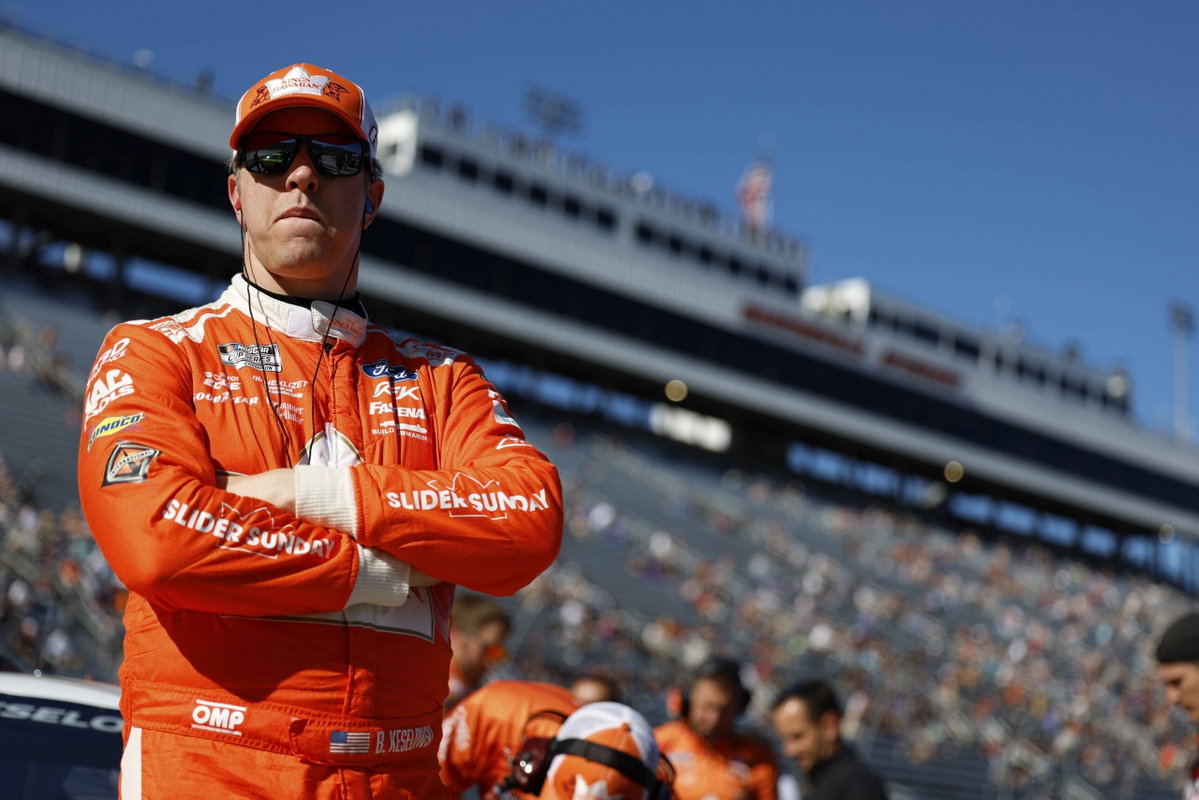
On Sunday, September 27, Brad Keselowski climbed out of the No. 6 Ford at Kansas Speedway after a 12th-place run, having started 16th, and gave the kind of answer a driver gives when he thinks the future looks bright. It was his first race with new crew chief Mike Skarbowski, and he called it “a great start to a new era.” Forty-eight hours later, RFK Racing announced that its driver, co-owner and head of competition would walk away after the season. If you only watched the Kansas interview, you’d have sworn the man was settling in for the long haul.
Watch What’s Trending Now!
The timing made it feel like a bomb going off, but I’d argue the bomb had a very long fuse. Keselowski had been dropping hints in public for months, some of them gentle and one of them loud enough to hear from the cheap seats. Once you lay them out in order, the exit starts to look less like a shock and more like a slow argument that finally ran out of patience.
The radio call that gave it away
The loudest hint came at Gateway on September 13, and it came from the middle of a race. Keselowski was running near the front at World Wide Technology Raceway when Joey Logano went by him in the No. 22 Team Penske Ford. Drivers get passed all the time, and most of them mutter something about the balance of the car and move on. Keselowski went somewhere else entirely. He told his team,
“I wish I was a Ford considered good enough to get one of the good engines,” then called RFK a “shit box team” and said Logano had “motored” past him thanks to a far better engine.
Remember who was talking. This was not a hired hand venting about his ride. This was the co-owner of the team, the guy who had spent five years deciding how that organization should compete, insulting his own operation on an open channel.
The target of the complaint made it sting more. Keselowski spent 12 years at Penske before leaving after the 2021 season, won his 2012 Cup championship there, and collected 34 of his 36 Cup wins in that building. Few people in the garage know what Penske equipment feels like better than he does, so watching the No. 22 leave the No. 6 behind was a data point he understood perfectly.
I’d also stay fair to the facts here, because both teams buy their engines from Roush Yates, and nobody has shown that Ford deliberately shorted RFK. What we know is that Keselowski believed a real gap existed and said so out loud.
He’d already made the case in July
If Gateway were the only evidence, you could write it off as a hot moment. It wasn’t, because Keselowski had been making a calmer version of the same argument since July 3 at Chicagoland. Toyota had won 11 of the first 18 points races, Ford had one, and he was happy to explain why he thought that gap existed.
His point was about structure. Toyota, in his view, had two “A” organizations working closely together, while Ford had an “A,” a “B” and a “C,” and the information was not flowing between them the way it needed to. He said Ford had to find a way to share more among its top teams, that RFK had “proven our merit,” and that both Ford and RFK were in a “lull” he didn’t want to stay in. That is a manufacturer-level complaint from a guy who thinks his team has already done its part.
Put the two moments side by side and the Gateway radio looks different. It was the same grievance he had been laying out politely for two and a half months, only now it came with profanity and no filter. Anyone who read the Chicagoland interview closely should have heard the Gateway call coming.
Why a guy like this was always going to clash with someone
To see why this hurt him so much, you have to rewind to the day he left Penske. Keselowski wasn’t running out of options in 2021. He was leaving one of the top organizations in the sport, and he said exactly why: he wanted a long-term home, an ownership stake, a role in NASCAR after his driving career, and what he called “more control over my overall destiny with respect to matters competition related.” He called that last piece “critical.”
That sentence explains almost everything that came after. He didn’t join Roush Fenway for a bigger paycheck or an easier schedule. He joined because he wanted a hand in how a race team gets built and run, and RFK gave him that. He became a minority owner, drove the No. 6, joined the competition committee, and was set to take on an even larger competition role once he hung up the helmet. He also admitted the move was risky, since he knew he could win at Penske, but he called RFK “a big dream of mine” and bet on it.
So when you hear that the ownership group wasn’t aligned on how to move forward, think about what that means for this particular man. A driver without equity can shrug at a boardroom disagreement and keep driving. Keselowski had traded a winning seat for the right to steer, which means a stalemate about direction cuts at the very reason he came. None of that proves anyone forced him out or that Ford drove him away, but it explains why this fight mattered to him more than it would to almost anyone else.
The rebuild nobody wants to credit
Keselowski had tried ownership once before, and the first attempt didn’t go the way he hoped. His Brad Keselowski Racing team ran in the Truck Series from 2008 through 2017 and helped develop Ryan Blaney, Austin Cindric, Tyler Reddick and Chase Briscoe, which is a hell of an alumni list. Even so, he later admitted BKR never reached the level he wanted, because he felt he didn’t understand engineering and manufacturing well enough, and shutting it down shook his confidence as an owner.
He fixed that by building Keselowski Advanced Manufacturing, and the experience changed how he saw the technical side of racing. By the time he got to RFK, he was convinced he could run a major team. He went after the place with a sledgehammer, too. A 2023 NASCAR feature described how he attacked what he called “legacy thinking,” the habit of doing things a certain way because that’s how they’ve always been done, and he reworked shop processes, pushed common standards and questioned the engineering system. At one meeting he got so frustrated that he told the whole organization, “We suck. We absolutely suck.”
He had a blueprint in mind, and it was Penske. Around 2010 and 2011, Keselowski saw Penske go through its own stretch of disorganization and internal problems before fixing its processes, and then he won the 2012 title. His plan was to run the same play at RFK, with the added goal of building something that would last beyond his driving career.
The results say it worked, mostly
The early going was ugly. He finished 24th in 2022, and NASCAR hit the No. 6 early with a Next Gen penalty of 100 driver points and 100 owner points after finding an improperly repaired single-source body component. Crew chief Matt McCall was fined $100,000 and suspended for four races, and the penalties held up on appeal.
Then the team found its footing. In 2023, Keselowski finished eighth in the standings with 16 top-10 finishes and a 14.4 average finish, and both RFK cars made the playoffs, with Chris Buescher winning three races that year. In 2024, Keselowski finally got his own victory at Darlington in the Goodyear 400, which ended a 110-race winless streak and was his first win as a principal owner. It was also the first win for the No. 6 since David Ragan’s 2011 Daytona victory.
Then 2025 arrived and reminded everyone how fragile progress can be. RFK went winless, Keselowski finished 20th, Buescher 17th and Ryan Preece 18th, and none of the three made the playoffs. RFK was clearly a better organization than the one Keselowski had joined, but it hadn’t turned into the consistent title threat he’d promised himself, and for a guy wired the way he is, that gap is a hard thing to live with.
Then came the money problem
While all of that was happening on the track, a business problem was quietly growing. RFK had run two permanent Cup charters until 2025, when it expanded to three cars and put Ryan Preece in the No. 60, using a charter leased from Rick Ware Racing. That charter won’t be available to RFK for 2027, and Legacy Motor Club is expanding to three cars of its own, which meant RFK needed to find another one if all three entries were going to have guaranteed starting spots.
None of this was a secret. In May, Keselowski said RFK was looking for a charter but didn’t know of one for sale, and on May 28, team president Chip Bowers said the organization would run three cars in 2027 whether it landed a charter or not. If it couldn’t, the third entry would run as an open car, which has to race its way into the field when qualifying is oversubscribed and plays by different financial rules than a chartered one.
That is where Kroger comes in. Jordan Bianchi reported after the news broke that Kroger’s agreement requires its car to have a charter, and that the sponsor would not run an open entry. Preece was expected back, and Kroger was a big part of the No. 60 program, so you can see how a charter shortage could turn into a sponsor problem very quickly. Bianchi didn’t claim Kroger caused the split, though, and I won’t either. He described it as one example of a broader disagreement among the owners about how to move RFK forward.
The uncomfortable scoreboard
The hardest part for Keselowski to swallow might have been the standings. He was one of the biggest backers of Ryan Preece when RFK went to three cars, publicly calling him talented, underrated, hardworking and coachable, and arguing that RFK could give him what he needed to succeed. Two years later, Preece won the Coke Zero Sugar 400 at Daytona, his first points-paying Cup victory, and it put him in the 2026 Chase as the final qualifier.
Buescher made the Chase too. Keselowski did not, which meant that RFK had two cars in the championship fight while its co-owner and flagship driver watched from outside. After Kansas, Preece sat 14th in points, Buescher 15th and Keselowski 18th.
I don’t think Preece’s win caused anything, and nothing in the reporting says it did. But it does tell you something about where the problem sat. The organization Keselowski built was producing results he wanted from other parts of the operation, and the program with his own name on the car wasn’t keeping pace.
A crew chief change eight days before the announcement
Then the pit box started moving. On September 21, RFK and Jeremy Bullins parted ways, and this wasn’t a minor staffing tweak. Bullins and Brad Keselowski had worked together at Penske, a partnership that produced five Cup wins, 23 top-five finishes and 41 top-10s, and Bullins had returned to RFK in 2025. The team called the exit amicable and said Bullins was leaving for a new opportunity, with Skarbowski stepping in on the No. 6.
I’m not going to tell you Bullins left because he knew what was coming, because there’s no evidence of that and it would be irresponsible to imply it. What I will say is that the calendar is hard to ignore. Bullins was out on September 21, Keselowski ran 12th at Kansas on the 27th, and the announcement of his own exit came on the 29th, eight days after the crew chief change.
That is why I don’t buy the search for one clean breaking point. It reads like a slow pile-up of small moments, with the final piece arriving at the very end.
What the Next Gen car does to a team like this
There’s a technical layer under all of this that helps explain why Brad Keselowski’s complaint was about more than horsepower. The Next Gen car cut down the places where teams can create their own hardware advantages, because many major parts are standardized or come from common vendors. It isn’t a spec series, though, since teams still find speed through vehicle dynamics, simulation, suspension tuning, mechanical balance, body prep, tires, strategy and execution.
The practical effect is that more of the competitive burden shifted toward manufacturers, suppliers and technical collaboration. That makes his July comments about Toyota make sense, because Joe Gibbs Racing and 23XI Racing share a close working relationship that Ford’s top teams apparently don’t match. His argument was never just that RFK needed better engines. It was that the manufacturer structure had become more important and that Ford had to improve how its best organizations work together.
The irony is that RFK had already spent years building its own technical muscle. It launched the RFK TeK Alliance in 2024 and added AVL RACETECH in 2026 to strengthen vehicle-dynamics simulation and development. The team was doing what Keselowski wanted it to do, and his complaint was that team-level work only goes so far when the bottleneck is bigger than the team.
What RFK said, and what it left out
RFK’s official statement was careful. It didn’t blame Ford, Fenway Sports Group or Roush Enterprises, and it didn’t describe a feud with Keselowski. The organization said it respected his desire to keep racing, would work with him on next steps involving his ownership interest, would remain a three-car team and would keep pursuing a third charter.
As of October 1, the ownership transfer wasn’t complete, so the question of what happens to his stake is still unresolved. That makes this bigger than a normal driver change. RFK is losing its No. 6 driver, a minority owner, its head of competition and one of the people most responsible for its technical turnaround, while still planning to field three cars.
Bianchi’s reporting fits that picture. He said the ownership interests weren’t on the same page about how to proceed, that the disagreement went beyond Kroger, and that the formal separation hadn’t been in the works for months but developed over roughly the previous couple of weeks. In other words, the long-running tension was real, and the final decision was fast.
The market he’s walking into
Keselowski says he is “nowhere near ready to be done as a driver,” and he wants to accomplish more in NASCAR. The problem is that October is a rough time to be on the market. Jesse Love is headed to Wood Brothers Racing, Josh Berry is going to Legacy Motor Club, Austin Cindric is expected to stay at Team Penske, AJ Allmendinger is committed to Kaulig Racing and the main Spire lineup isn’t expected to change, so most of the obvious seats are taken. NASCAR’s own September 30 analysis raised the real possibility that he could enter 2027 without a full-time Cup ride.
John Hunter Nemechek is a name to watch on the other side of this. Legacy is replacing him with Berry, which leaves him without a confirmed 2027 Cup seat, and Bob Pockrass has pointed to him as a possible fit for the vacant No. 6. He also brings sponsorship support that could help RFK carry the cost of an open entry, though it is still a possibility and not a deal.
Keselowski’s own next step is murkier. Bianchi has reported that his name has come up in discussions about a full-time Truck Series opportunity, and he’s been clear that nobody knows whether Keselowski wants it. The idea is more interesting than it sounds, though, because Keselowski has 66 Truck starts and a win, owned a Truck team that sent drivers up to Cup, and has already won titles in Cup and the O’Reilly Auto Parts Series. A Truck championship is the one national-series crown he’s missing, and a full-time run would give him a shot at it, but nothing about that is confirmed.
The part that doesn’t add up
Look at what he did here. Brad Keselowski left a championship organization to get control, then spent five years changing the shop, attacking old habits, investing in technology and turning an underperforming team into a winning one. RFK won seven Cup races during his ownership period, and he took one of them, the 2024 Darlington win that ended a 110-race drought. Buescher won races, Preece won at Daytona, and both made the 2026 Chase.
By almost any measure the team got healthier, and the man most responsible for that is outside the championship fight and on his way out. By 2026, the question was no longer whether RFK could improve, because it already had. The question was how far it could go, how much investment and manufacturer support the next step required, and who got to decide, and Brad Keselowski had been asking those questions in public for months before Logano’s Ford went by him at Gateway.
So here is what I keep coming back to. If a champion who owns part of the team, runs its competition side and spent five years rebuilding it still couldn’t get the control he left Penske to find, how much real power does any owner or driver have in a sport where the manufacturer holds the keys?