
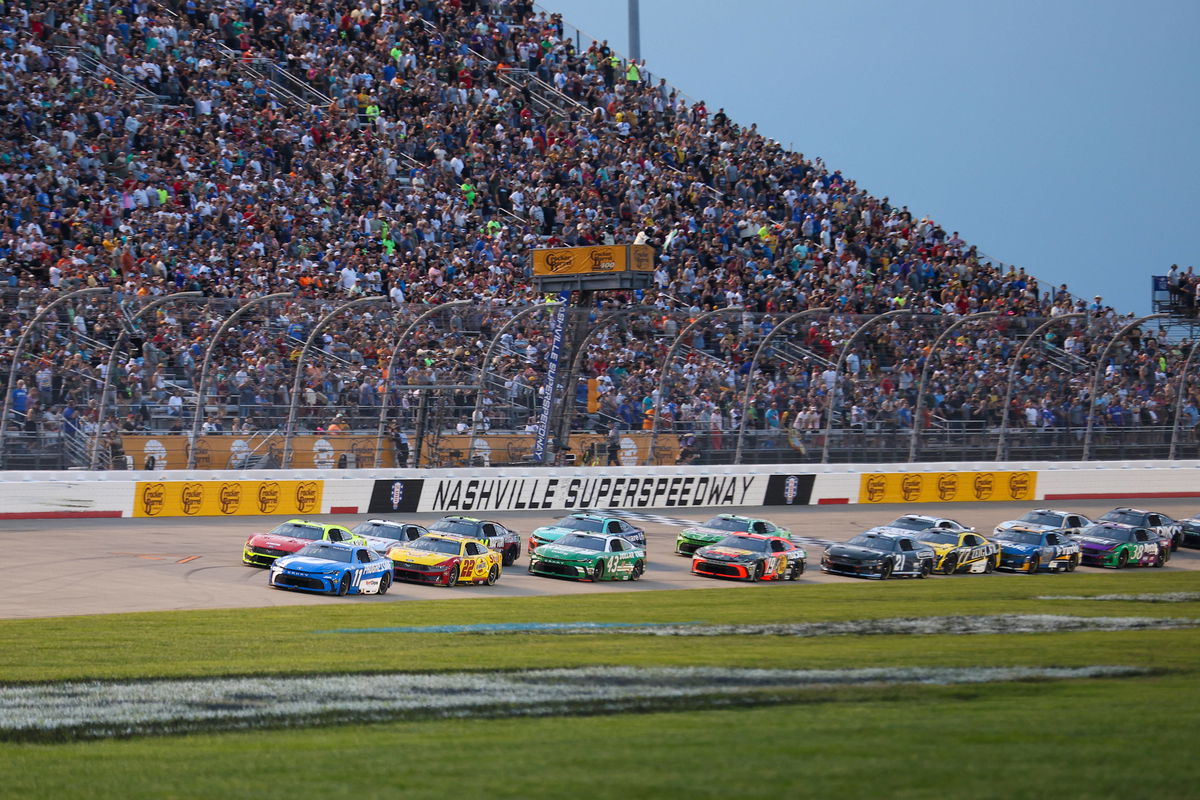
12 cautions for a whopping 75 laps ensured that NASCAR’s visit to Nashville Superspeedway was anything but boring. However, one unusual issue ended the race for several drivers: brake rotor failure. While many pointed to the Next Gen car as the culprit, former Hendrick Motorsports crew chief Steve Letarte believes he has identified the real problem.
Watch What’s Trending Now!
“I believe these are too much of a cooling situation,” Letarte said while speaking on NASCAR’s Inside The Race analysis.
The issue first occurred on lap 72 when Connor Zilisch’s right front rotor exploded, sending him into the wall. But it was rather odd, as Zilisch mentioned he had no feeling of a “soft pedal” or a wearing disc, as it usually happens with an overheated brake rotor, which was first thought to be the case.
However, when his teammate, Ross Chastain, had the same fate just a few laps later, many started talking. Usually, when a brake rotor explodes, it is due to excessive heat, which can cause the rotor to weaken and eventually break into chunks. However, that didn’t seem to be the case here. In fact, as Steve Letarte explained, it was quite the opposite.
“I think they’re overcooled, right? So what I think is happening is you take a hot glass mug, you put it in the microwave, you heat it up for a couple of minutes, take it out, and stuff it in an ice-cold cooler, the glass is going to break,” he explained.
There was one very essential element that many seemed to be missing when the first rotor was damaged: the sudden changing temperatures.
- Going into the corners, the rotors were glowing red hot because of the heavy braking, especially the right fronts.
- Once the drivers were back on the straight, the higher horsepower (following NASCAR’s short-track package for this season) allowed the cars to reach peak speeds faster.
- This also meant that the rotor, which was glowing because of the heat just a few moments ago, now cooled down rapidly.
- This sudden temperature change became the recipe for disaster, and the brake rotors began ‘exploding.’
Moreover, the uneven temperature distribution around the rotor tore it into chunks, making it seem like they exploded out of the car.
“When you apply it—that brake pressure—you’ve got a thermal spike in it. And that rotor now has to grow. Well, it grows so quickly, parts of it that aren’t heated, around the bell, they aren’t growing with it. It starts cracking,” Todd Gordon noted, following up on Letarte’s comment.
Overheating brakes is quite a common phenomenon in motorsports, and the cars are built with materials to counter that. The cast iron discs, along with ventilation holes for cooling down, are regularly put through temperatures around 1,800°F.
If the brakes do begin to overheat, however, they don’t explode, as it kept happening during the Nashville race. The brakes first begin to fade, and the drivers usually point this out rather quickly. However, in the case of last weekend’s NASCAR race, it was the rapid cooling that hampered the race for many drivers.
NASCAR drivers were not the only ones affected by ‘exploding’ brake rotors
There were quite a few drivers who saw their races hampered because of the brake rotors. Trackhouse Racing breathed a sigh of relief soon because the issue first seemed to be limited to just their cars. However, when the likes of AJ Allmendinger and Chris Buescher also suffered the same wrath, it became apparent that it was not a team-specific issue. But it did raise a warning for some NASCAR fans, too.
When the brake rotors exploded, the debris didn’t stay on the track. The high speed gave enough velocity to the debris that it reached the stands and ended up hitting multiple fans. Many posted on social media platforms, including Reddit, with one of the users even reporting that they witnessed a couple bleeding because of the speed at which the debris hit them.
This was particularly interesting, revealing just how dangerous the debris could be, even from such a small part of the car. In fact, Ryan Preece was also a victim of this, as a piece of debris struck his car, damaging his radiator.
As the race ended, this remained one of the most-discussed topics amongst the analysts. Even NASCAR’s official analysis pointed to the higher horsepower, lower downforce package, and the ‘reduced aerodynamic stability’ as the reason for this issue. At the moment, it remains unclear how the authorities are planning to tackle it in the future.