
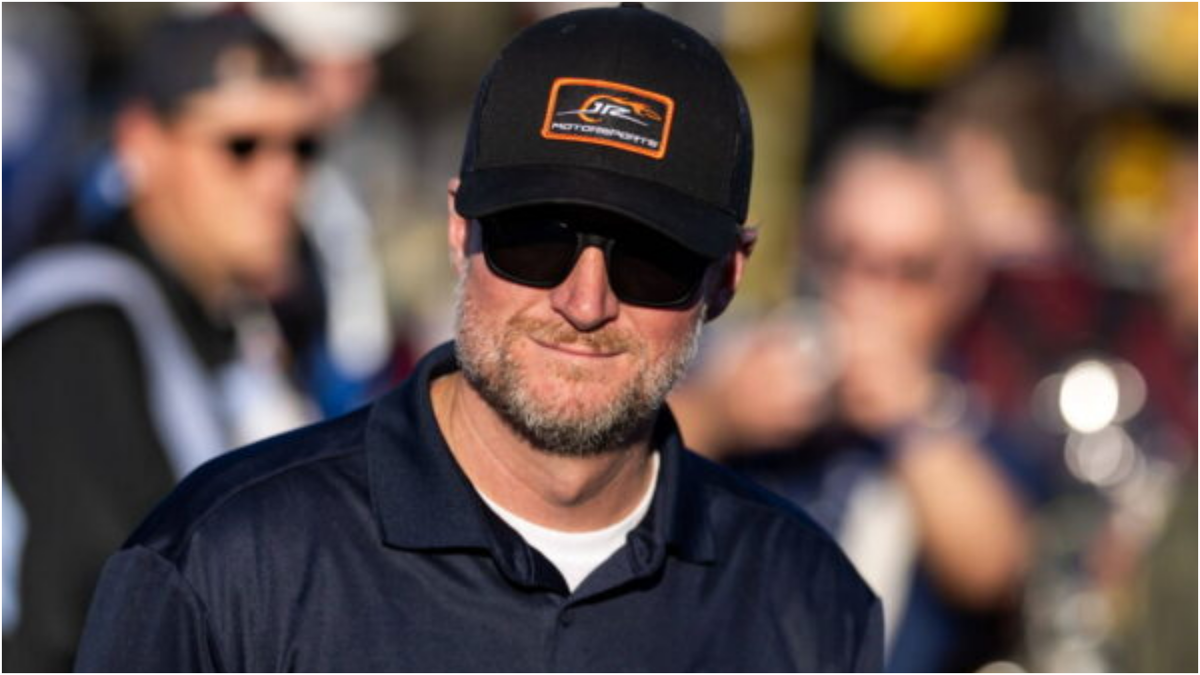
You don’t dream of making it to the NASCAR garage just to stand around all day. You want to work on these incredible machines, get your hands dirty, and feel like you’re playing a bigger part throughout a race weekend. And in recent years, NASCAR has been testing the passion of those working in the garage.
Watch What’s Trending Now!
Hall of Famer Dale Earnhardt Jr. believes reality is pushing experienced personnel away from the sport. Meanwhile, NASCAR’s restrictive rules are leaving teams with little to do between sessions.
“All of our road guys go to the racetrack, and they are eager to have a mechanical f***ing job to do, something to f***ing work on,” Earnhardt Jr. said on The Dale Jr. Download podcast.
“And you know, a lot of our road guys that used to be on the road years ago have left because they don’t want to go to the racetrack and sit around and hold a f***ing umbrella and push a car through tech and then go race,” Dale Jr. added.
His point is that crew members joined racing to work on race cars, not spend hours dealing with technical procedures before finally getting another opportunity to turn a wrench.
The restrictions placed on teams between practice, qualifying, and the race can limit how much meaningful work they can actually do. For instance, practice sessions, which once lasted hours, have been reduced to just 50 minutes. So, during that time, teams work intensely. After that, they can spend hours unable to do much of anything. That creates a frustrating environment for personnel who want to diagnose issues, change components, and improve the car.
The recent brake controversy involving Denny Hamlin only highlights the same issue from another angle.
Hamlin’s No. 11 team found serious brake problems during practice and qualifying ahead of the Iowa Corn 350 last Sunday. Yet NASCAR’s rules kept the team from replacing the brake pads, even if the team accepted a penalty.
Hamlin argued that NASCAR’s rule forced his team to keep using pads they believed were defective. His crew still got the car through all 350 laps, but the situation raised questions about whether NASCAR’s rules leave enough room for common sense.
Dale Jr. agrees and thinks NASCAR should allow teams to change brake pads in controlled circumstances. “Should NASCAR let teams change brake pads? I believe they should. I think there should be some reasonable understanding, common sense,” he added.
He wants NASCAR to let teams make the necessary change and give the crew something to work on, even if it means imposing a penalty, such as sending the car to the rear. The bigger issue remains giving crew members a reason to be at the racetrack beyond pushing cars through inspection and waiting for the next session.
Dale Jr.’s concerns, however, go beyond what happens in the garage. He also believes NASCAR needs to rethink how it determines which drivers get a shot at the championship, especially with the current 16-driver Chase field.
Dale Earnhardt Jr. wants the Chase cutline to matter again
With only three races remaining before the Chase, Dale Earnhardt Jr. believes NASCAR has another issue worth addressing. The return to the Chase format has already created tighter points racing. However, a 16-driver field can dilute the importance of the cutline.
“Does it hurt anybody that Austin Cindric is 16th and gonna be in the Chase? No. But if we want the cut line to be a conversation worth having at this point in the season, you’re gonna have to move that cut line to 12th or 10th,” he said on the same podcast.
A driver sitting 16th can qualify for the championship fight despite being well behind the favorites. And Dale Jr. has a point.
Cindric will likely make it to the Chase. So will Trackhouse Racing’s Shane van Gisbergen and 23XI’s Bubba Wallace. Ryan Preece may be there too if he has a strong finish to the season, as could Ross Chastain, whose seventh-place finish in Iowa pushed him up three spots to 18th in the standings, 45 points behind the cutoff.
But none of these drivers scream, “I’m coming for the championship.” And unless something astounding happens, that will likely remain the case.
NASCAR’s own simulations also give his argument some weight. According to the simulations Earnhardt referenced, the eventual champion started the Chase inside the top six 85% of the time.
That suggests a smaller field could make the regular-season battle more meaningful without necessarily changing who is capable of winning the championship.
Dale Jr. remembers the first Chase, which featured only 10 drivers. And he believes that smaller field created greater urgency. With the current standings tightening and just three races left, his proposal could reshape how NASCAR approaches the Chase beyond 2026.