
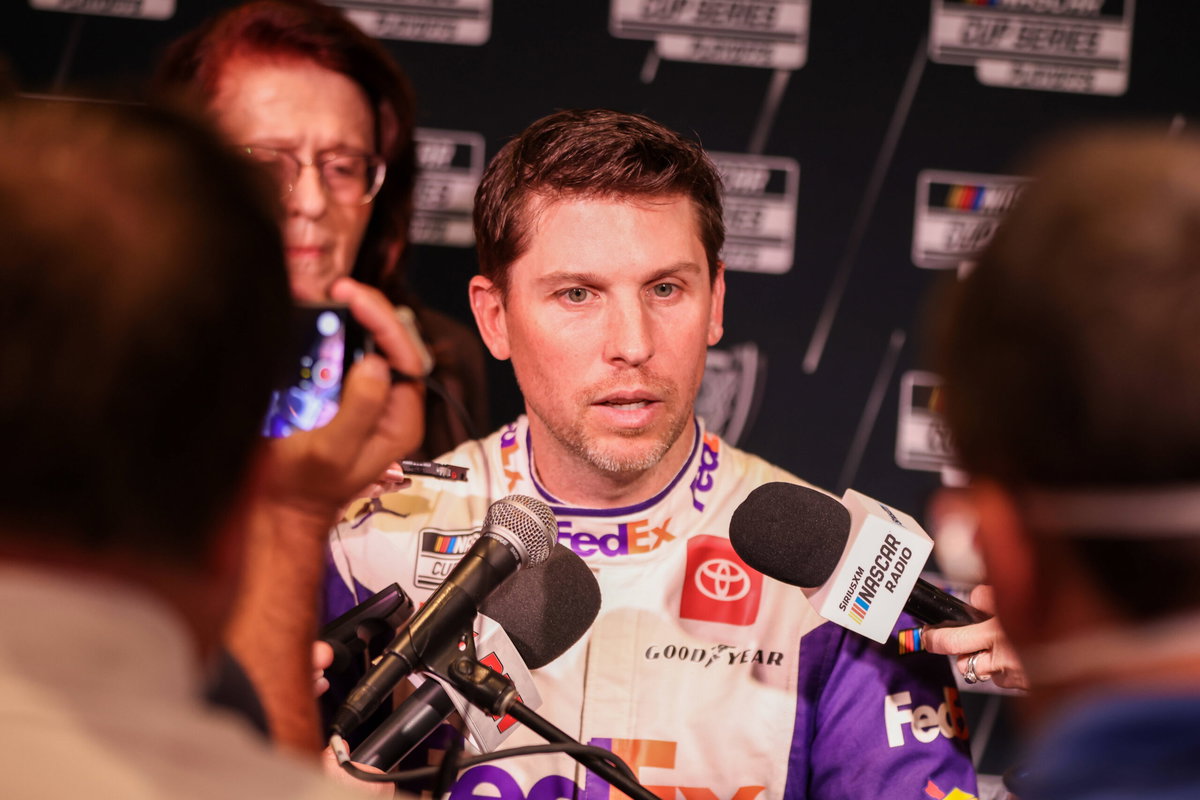
Three incidents. One yellow line. And NASCAR’s explanation has only made things worse. Kyle Larson’s final-lap move to win at Talladega raised the question of whether his No. 5 Chevrolet crossed the double-yellow line. Austin Hill’s move underneath Larson and Todd Gilliland’s battle with Ross Chastain and Carson Hocevar added two more debates about how the rule was enforced. NASCAR reviewed all of it and let the results stand. Then Denny Hamlin heard the explanation and did not hold back.
Watch What’s Trending Now!
“My goodness. This is horrible officiating or horrible comms. I think it might be both.” Denny Hamlin did not hold back on X after NASCAR explained why it declined to penalize several drivers during the controversial finish at Talladega.
The Joe Gibbs Racing driver questioned the reasoning behind decisions involving Austin Hill, Todd Gilliland, Ross Chastain, and Carson Hocevar, particularly NASCAR’s consideration of intent. What followed was a pointed exchange with NASCAR communications executive Mike Forde, while Gilliland also appeared to react to the controversy on social media.
The debate intensified after The Athletic reporter Jeff Gluck shared takeaways from Hauler Talk, where Forde explained NASCAR’s review of the final-lap incidents. According to Gluck’s summary, officials considered whether a driver went below the double-yellow line, improved their position, and was forced underneath it. Hamlin immediately challenged the apparent role of intent in the decision-making.
“Jeff, I’m dying to know. Since when does ‘intent’ matter? I specifically remember NSC saying intent doesn’t matter in these situations. Well, until now,” Hamlin wrote in response to Gluck’s post.
The explanation covered three separate incidents, beginning with Hill’s move underneath Kyle Larson in Turn 2. Hill’s No. 33 Chevrolet appeared to go below the double-yellow line while attempting to pass Larson’s No. 5. NASCAR believed Hill moved down before Larson forced him underneath the line and that Hill improved his position.
Officials discussed a black flag but did not issue one because Hill had already fallen to the last position on the lead lap. A penalty would not have changed his finishing position, although Forde indicated that a similar move could have required a call had Hill been in contention for the win.
The incidents involving Gilliland, Chastain, and Hocevar created the bigger question for Hamlin. NASCAR determined that Chastain and Hocevar had gone below the line after Gilliland’s No. 34 Ford forced them down. Neither received a penalty. Officials considered penalizing Gilliland but said it was inconclusive whether he deliberately moved down to block their progress, so they ultimately made no call.
Gilliland also reacted to Gluck’s post, sharing an image of a shocked person pointing at themselves. The gesture appeared to draw attention to his role in the officials’ explanation, though Gilliland did not provide a detailed written statement alongside the image.
Hamlin, meanwhile, received a response from Forde after criticizing NASCAR’s handling of the incidents. “Thanks for listening,” Forde wrote. Hamlin quickly clarified that he had not listened to the episode. “I didn’t. I read. Which in case im guessing, Jeff just misquoted you,” he replied, suggesting that Gluck’s summary might not have accurately captured Forde’s explanation.
The dispute also connects to Hamlin’s earlier criticism of NASCAR’s yellow-line enforcement. On his Actions Detrimental podcast, he questioned whether Hill had been forced below the line by Larson and argued that the circumstances behind the move mattered.
Hamlin has described the rule’s interpretation as too ambiguous, saying he was “tired of the ambiguity” surrounding NASCAR’s decisions. Importantly, he agreed that Larson had not crossed below the line, so his objection was not simply an attempt to overturn the race winner’s result.
Bubba Wallace’s penalty earlier this season provides another point of comparison. After initially believing he had secured second place in the Quaker State 400, Wallace was relegated to 29th when NASCAR ruled that he had gained a position by going below the line on the final lap. The ruling demonstrated how consequential the interpretation can be when officials determine that a driver gained an advantage beneath the line.
The key difference is that NASCAR’s explanation in Wallace’s case focused on whether he crossed the line and improved his position, with no need to establish intent. In Gilliland’s case, however, officials considered whether he deliberately forced Chastain and Hocevar below the line, creating the distinction that prompted Hamlin to question NASCAR’s consistency.
For Hamlin, therefore, the issue is whether NASCAR is applying the same standard to every driver. The Wallace and Gilliland incidents have renewed questions about when intent matters and how officials distinguish a violation from a driver being forced below the line.
Until NASCAR clarifies that distinction, its yellow-line rule will remain a source of controversy.