
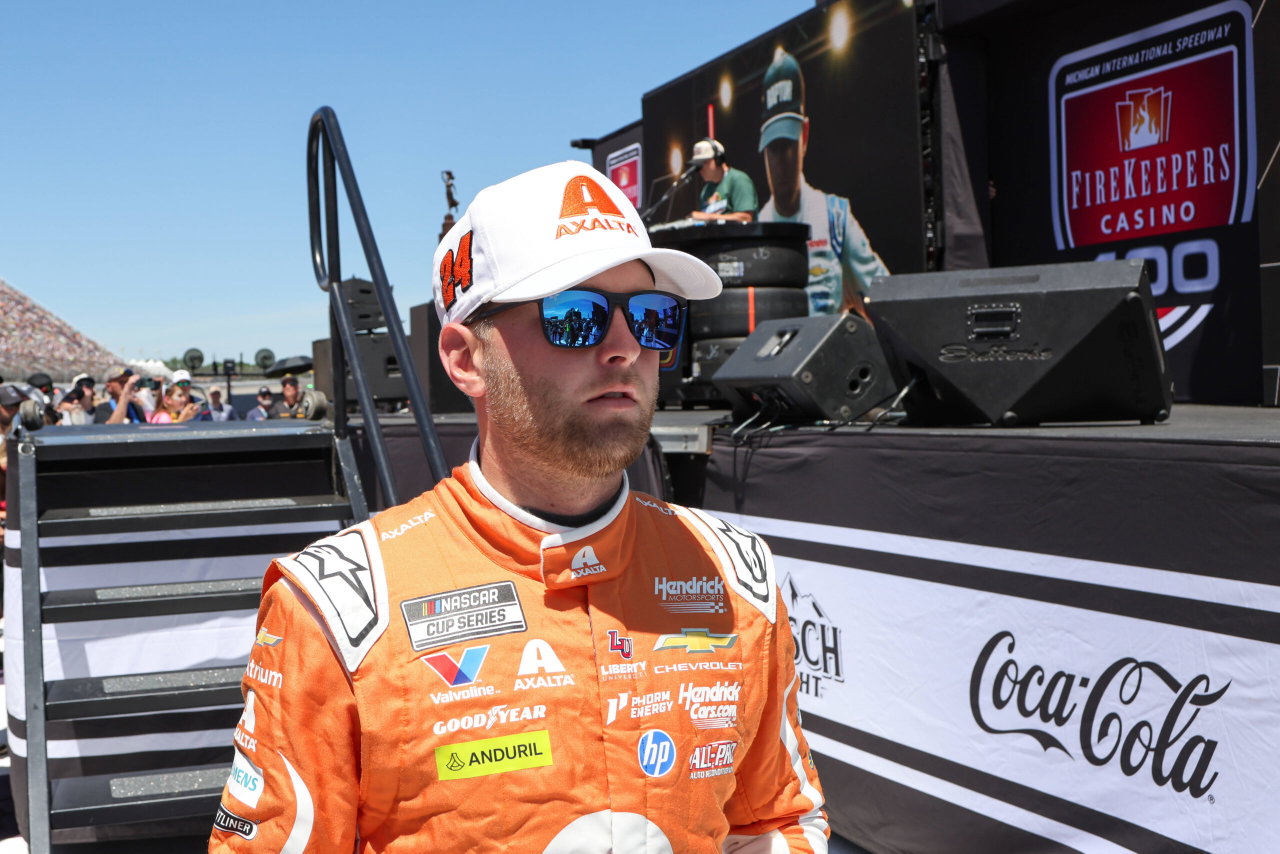
Hendrick Motorsports entered the 2026 Chase with three drivers capable of fighting for the championship, but their seasons had taken distinctly different turns. While one had already established himself as a winner, another was still searching for his first breakthrough, and the third was beginning to find the form that would eventually make him the championship favorite.
Watch What’s Trending Now!
That contrast became increasingly difficult to ignore as the championship battle progressed. Each of the three Chevrolets had shown enough speed to contend, yet their strongest stretches arrived at different points of the schedule. Asked to explain why the organization had experienced such uneven peaks, one of its drivers admitted he did not have a straightforward answer.
“I think it’s just different track types and kind of what suits each team, so I don’t have a good answer for that,” Byron told Above The Yellow Line Media. “No. I think it just kind of worked out that way.”
The results leading into the Chase offered the first indication of that disconnect. Chase Elliott was the only one of Hendrick’s three championship-qualified drivers to have visited Victory Lane in the Cup Series.
The No. 9 team had won at Martinsville and Texas, with the latter coming after a strong opening stretch that included five top-five finishes in the first 11 races.
However, Elliott’s momentum did not carry uninterrupted into the second half. Between his Texas victory and the start of the Chase, he managed just one top-five finish and two top-10s across 15 races. The No. 9 still had the credentials to contend, but the consistency that had defined its opening months became harder to find.
Byron’s season followed a different pattern. The No. 24 Chevrolet regularly showed competitive speed without converting enough of those performances into victories.
He collected strong finishes at Las Vegas, Martinsville, Pocono, and Chicagoland, while his second-place run at Talladega demonstrated how close he could come to breaking through. Yet the win column remained empty.
Larson, meanwhile, was building towards a much stronger championship campaign. His early-season results included a third-place finish at Phoenix and a runner-up at Kansas, but the real transformation came during the Chase.
He ended a 51-race winless drought at Gateway before following it with victories at Kansas and Talladega. Suddenly, the No. 5 was no longer simply another Hendrick contender. It was the car everyone else had to catch.
The contrast was particularly striking because Larson’s surge did not come at the expense of his teammates’ competitiveness. Byron continued to lead laps and collect strong finishes, while Elliott remained capable of running near the front.
By the time the series reached Martinsville, Larson had three Chase victories, while Byron had accumulated 364 laps led during the championship run. The No. 24 had speed, but the breakthrough had proved elusive.
For Byron, however, the biggest lesson from the season had little to do with comparing his team’s performance against those of his teammates. It was about understanding how quickly one result could change the complexion of an entire championship campaign.
“I think just kind of a surprising thing is probably just how much it means to win races for the points and then just kind of how that changes your season,” Byron said. “Just looking at kind of where we were in points going into Martinsville and then now being on the other side of that, you know, and just seeing how much of a swing that is.”
That change became evident at Martinsville. Byron arrived without a victory despite having remained competitive throughout the year. His previous visit to Victory Lane in the Cup Series had come at the same track a year earlier, making the wait for another win particularly significant for the No. 24 group.
This time, there was little doubt about who had the strongest car. Byron started seventh, took control of the race after a strategic pit stop from crew chief Rudy Fugle and proceeded to dominate the afternoon. He led 362 of the 500 laps, swept both stages, and finished 2.049 seconds ahead of Elliott. It was his fourth Martinsville victory and 17th career Cup win.
The result also delivered 76 points, giving Byron a substantial boost in the standings. He moved up two positions to ninth, although he remained 166 points behind Larson with one race left. The championship was beyond his reach, but the victory provided something the No. 24 team had spent the entire season chasing.
It also ensured Byron would extend his streak of consecutive Cup seasons with at least one victory to seven. For a driver who had endured months of competitive weekends without the ultimate reward, that mattered.
The Martinsville performance was not simply another strong points day; it was confirmation that the team could still put together a race-winning package when everything came together.
Hendrick’s three championship contenders may have reached their strongest points at different times, and Byron himself could not offer a definitive explanation for that separation.
But his Martinsville breakthrough provided a fitting reminder that speed and results do not always arrive together. Larson found his championship rhythm, Elliott had established the early benchmark, and Byron finally got his reward. The No. 24 team’s wait was over.