
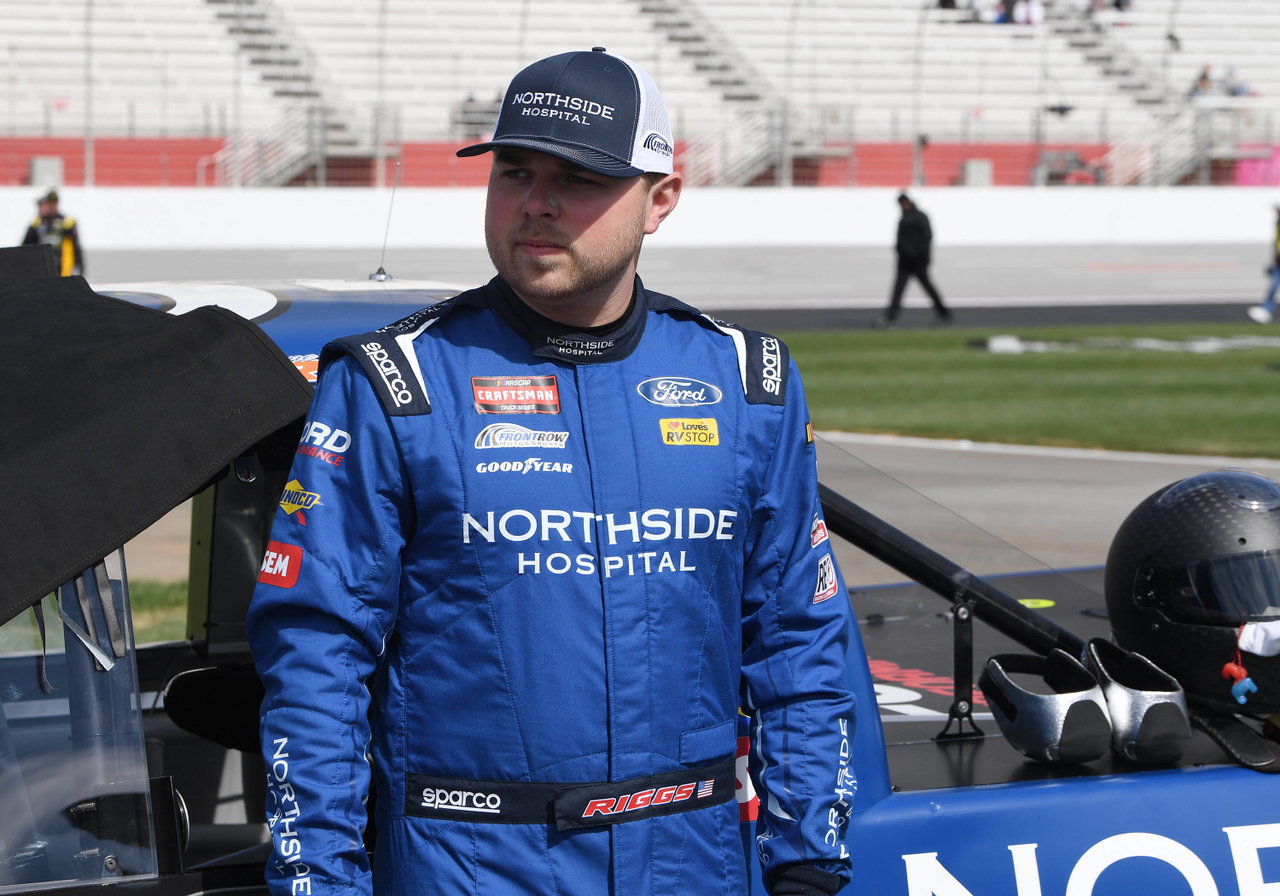
Layne Riggs started 22nd at Kansas, fought into the top three, recovered from a bad pit stop, and was running second late in the race. Then, while chasing Kaden Honeycutt, the Front Row Motorsports driver hit the wall and watched a substantial championship finish slip out of reach.
“I don’t pay you just to run second. I pay you to go win races.” said Layne Riggs in an interview with Matt Weaver.
Those were the words Drew Blickensderfer gave Riggs after the crash, according to Riggs. They came at a difficult moment for the No. 34 driver, who had just turned a likely runner-up finish into a 19th-place result.
Riggs did not need much convincing that the mistake was his. He immediately took responsibility for it. The problem was that the mistake came after he had already fought through several setbacks during the Race to Stop Suicide 200.
“I got in the wall. I just tried too hard.”
Riggs started 22nd after rain washed out both practice and qualifying. NASCAR therefore used its performance metric to set the field. He still climbed to third by the end of Stage 1 and finished second in Stage 2.
Then another problem hit. During the Stage 2 pit stop, the No. 34 Ford was released before the left-front wheel had been secured properly. All five lug nuts were loose, forcing Riggs back into his pit stall.
He fell deep into the field, but the race gave him another chance after a lengthy rain delay. Riggs quickly moved from 16th to ninth after the restart, then reached second within six laps. That recovery put him back in position to fight Honeycutt.
The problem was that Honeycutt had most of the afternoon under his dominance. The No. 11 led 111 of 134 laps and won both stages. Riggs had speed, but he did not have the strongest truck throughout the race.
The final fight was such that Riggs took two tires during the late pit cycle, while Honeycutt took four. The move gave Riggs track position and briefly put him into the lead on Lap 122. Fresh tires eventually changed the scenario. Honeycutt passed Riggs with 12 laps remaining and regained control. Then another caution set up a seven-lap sprint, giving Riggs one final chance to attack.
“I should have been a lot smarter and think a bigger picture and known that I could have just easily come out of here second,” he said.
That is where the Kansas result became more than a late-race crash. Riggs knew what second place meant for his championship. He also knew what a win meant to his team.
The timing, though, made the decision especially costly. Riggs entered the Chase as regular-season champion and No. 1 seed with six wins, 10 top-fives, 11 top-tens, and 598 laps led.
Bristol had already hurt his advantage. Riggs led the opening 135 laps there and won both stages before finishing 32nd. Honeycutt finished eighth, cutting Riggs’ 25-point Chase advantage to only three points. Kansas then swung the fight further. Honeycutt won and collected 75 points after sweeping both stages. Riggs secured 35 points and finished 19th.
Honeycutt therefore left Kansas with a 37-point lead over Riggs. A second-place finish would have left the gap at roughly 20 points instead. That 17-point difference came from the positions Riggs lost after hitting the wall. His right-front tire was cut by the contact, and the damaged truck fell through the field. Riggs said he had been running high because that was where he had found the balance he needed. But closing on Honeycutt changed the situation.
“These trucks are so sensitive. When you just barely touch the right rear, it sucks the right front around.”
Riggs said he got into Honeycutt’s wake and pushed too hard. He then made contact with the outside wall in Turns 3 and 4 with two laps remaining. The mistake also came with a reminder from the past. Riggs had finished second at Kansas in 2024. In 2025, he crossed the line second again before being disqualified after post-race inspection. This year, he finally had a chance to avoid another Kansas runner-up result. Instead, the pursuit of the win left him 19th.
Now going back to Blickensderfer’s response to what happened. He is Front Row Motorsports’ competition director, not Riggs’ crew chief. Dylan Cappello remains Riggs’ crew chief. Blickensderfer has a stellar record. He won Daytona 500s as a crew chief with Matt Kenseth and Michael McDowell. After Kansas, he consoled Riggs and pushed him toward the races ahead.
NASCAR.com also reported Blickensderfer discussing team owner Bob Jenkins’ desire for winners. That fits with the message Riggs said he received after the crash. The important point is that Riggs was not ignoring the championship. He understood the points situation and admitted that second would have been the smarter result.
At the same time, Front Row had winning expectations. Riggs had already won six races before the Chase. His victories came at St. Petersburg, Charlotte, Nashville, Naval Base Coronado, Lucas Oil Indianapolis Raceway Park and New Hampshire. That mentality had been fruitful.
Kansas exposed the other side of that approach. Riggs kept trying to beat a driver who had the faster late-race tire combination. He did not make the finish he needed, but he also did not hide from the decision afterward.
“I feel like I had a decent shot there and I took it, and wrong place, wrong time.”
The championship now moves to Charlotte with Riggs 37 points behind Honeycutt and five Chase races remaining. He already won at Charlotte earlier this season, giving him a familiar place to begin repairing the damage.
Still, Kansas will stay a costly reminder of the difference between chasing a championship and chasing a win. Riggs wanted both. For a few laps, he had a chance at either. In the end, he left Kansas with neither.