
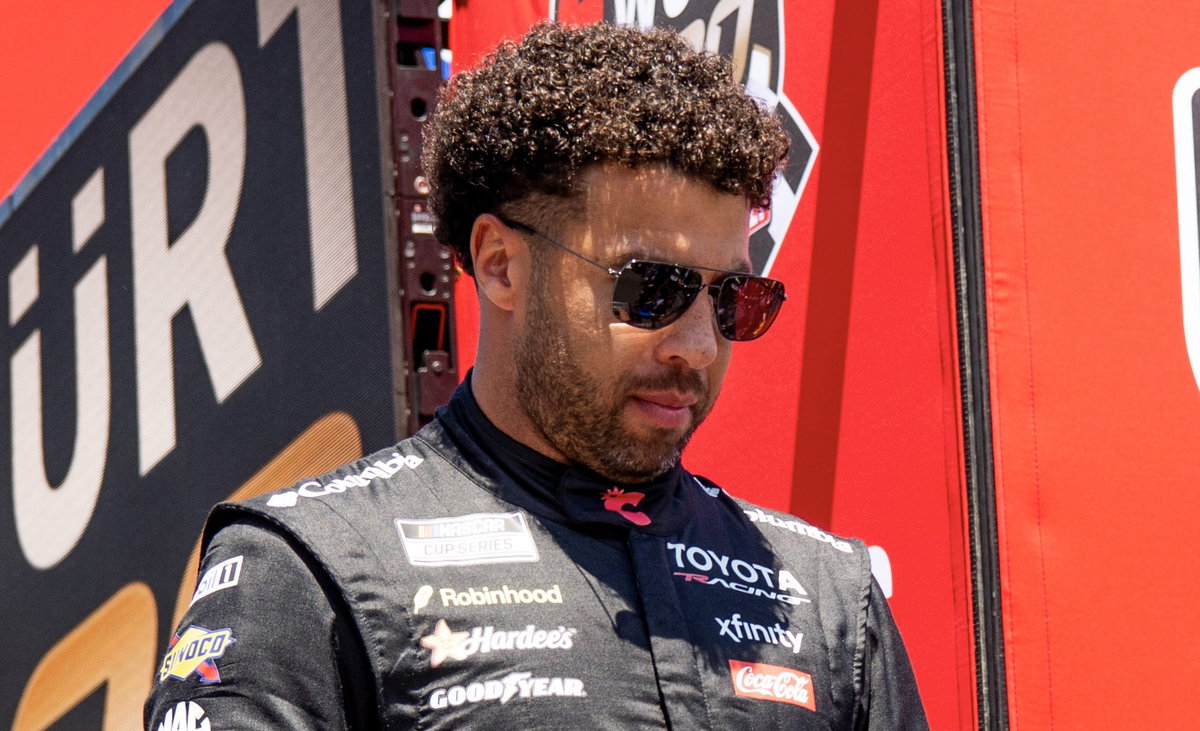
Bubba Wallace was leading with a potential NASCAR Cup Series victory within reach when Kyle Larson’s late crash changed everything at Phoenix Raceway. But for Freddie Kraft, the disappointment went beyond the No. 23 team’s final result.
Watch What’s Trending Now!
Wallace’s spotter believes he missed crucial information during the late caution that could have influenced the team’s pit strategy, and he has been questioning himself ever since.
Speaking on the Door Bumper Clear podcast, Kraft admitted that he failed to notice several cars staying out while Wallace’s team prepared for a crucial pit stop. The decision to take four tires sent Wallace back to ninth before a pit-road speeding penalty pushed him further down the order. He eventually finished 17th after leading 52 laps.
He said, “I fought myself because I didn’t notice where we were leading—focused on our pit road lights for me, ironically enough. I missed a couple guys staying out, which Charles probably could have factored into his decision, obviously. And then, you know, we did make the decision to put four on and came off pit road ninth.”
Kraft did not claim that a different call would have guaranteed victory. However, he believes the information he missed could have changed how the team approached the final restart.
Wallace appeared to be in control during the closing stage. Kraft believed the No. 23 Toyota was in a position to win, although he was keeping an eye on the threat posed by Chase Briscoe in the No. 19 Joe Gibbs Racing Toyota.
Briscoe had stayed out longer and possessed tires four or five laps fresher than Wallace’s. He was gaining ground, but Kraft believed the gap was large enough to leave the outcome uncertain.
“I told Bubba, ‘He’s got four lap better tires, but he’s a straightaway back, so just maximize what you got here,’” Kraft recalled.
Then came the caution for Larson’s crash. With the field heading to pit road, Wallace’s team had to choose between protecting track position and prioritising fresh tires for the closing run.
Kraft acknowledged that he was focused on the pit-road lights and failed to register which competitors were staying out. That was the detail he believed could have helped crew chief Charles Denike assess the alternatives.
The choice between two and four tires was particularly difficult at Phoenix because the race had demonstrated how sensitive the field was to tire strategy and clean air.
Tommy Baldwin pointed to the mixed results different teams had experienced throughout the afternoon. Some drivers who took two tires early struggled afterward, while others found better performance when they gained track position and cleaner air late in the race.
“The 12 car did a really good job all day of just staying the most patient,” Baldwin said, referring to Ryan Blaney’s No. 12 Team Penske Ford.
Blaney had occasionally surrendered track position earlier in the race but remained in contention when the decisions mattered most. His approach highlighted how patience could pay off when the track and tire behaviour made aggressive calls difficult to predict.
Kraft and Baldwin also explained why collecting that information was particularly challenging at Phoenix. The pit road is long and curved, and the spotter stand’s position around Turns 1 and 2 limits visibility of activity on the backstretch.
Kraft usually tries to monitor the final pit stalls when his driver is in contention, looking for clues about competitors’ tire choices. But as cars moved farther down pit road, he could no longer clearly see what everyone was doing.
Baldwin suggested that a dedicated pit-road spotter communicating which drivers had taken two tires could be useful in such situations. With so little time to make a final decision, even a small piece of information could affect the crew chief’s assessment.
The challenge does not excuse the missed observation, but it explains why the decision was more complicated than it appeared from the grandstands or television coverage.
Wallace’s four-tire call was followed by a separate execution error. He was penalised for speeding on pit road after apparently cutting too much distance through the corner while entering his stall.
In comments reported by Motorsport, Wallace explained that corner pitting required drivers to balance entering quickly with avoiding an excessive shortcut between timing lines.
The penalty sent him to the rear for the final restart, leaving little opportunity to recover. Wallace admitted that he had pushed the limits too far and expressed frustration that his mistake had hurt a team that had worked hard throughout the season.
The situation was especially painful because teammate Tyler Reddick went on to win the race.
Reddick had opted for right-side tires during the final stop and used the advantage to charge through a four-wide battle before passing Chase Briscoe for the lead. He ultimately beat Blaney by 0.801 seconds, as detailed in Motorsport’s race report.
The contrasting outcomes offered a reminder of how quickly the tide changes in NASCAR. Wallace had looked capable of winning, but a strategic gamble, a missed observation and a pit-road penalty combined to leave him 17th.
For Wallace and the No. 23 team, Phoenix became another missed opportunity. For Kraft, the lasting frustration was knowing that he might have helped the team make a better-informed decision when it mattered most.
More importantly, it also revealed the seriousness with which he took his responsibility when the race was on the line.