
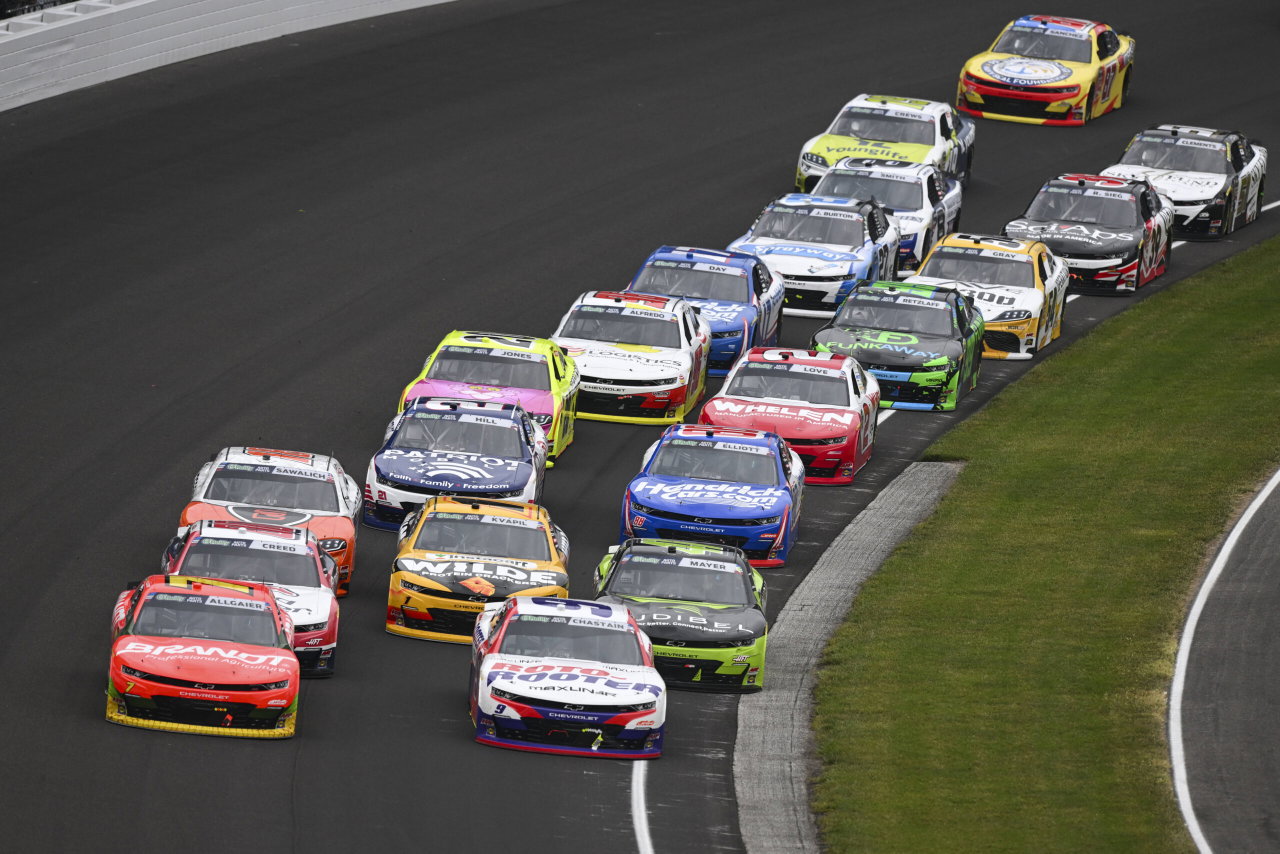
Lightning strikes and severe weather cells moving toward Darlington Raceway forced NASCAR to cancel Saturday’s practice and qualifying sessions. This left the starting grid for the Chase opener to be determined by the standard performance metric outlined in the NASCAR rule book. However, what was meant to provide a straightforward solution quickly became another source of frustration.
Watch What’s Trending Now!
Former Cup Series champion Kevin Harvick joined several veterans in questioning the system, arguing that the metric unfairly carried over from the regular season and could put championship contenders at a disadvantage.
“Let’s be clear, I hate the metric. There is no reason for the damn metric. We should be random drawing for qualifying every week to keep it mixed up. The metric thing was for COVID. And the metric thing needs to go away. It’s confusing for everybody. Draw a damn pill, go out and qualify, and be done with it. If it rains out, then start them by points,” Harvick said on the Happy Hour podcast.
The former Hendrick Motorsports driver questioned why NASCAR would carry the metric from the regular season into the opening race of the Chase, particularly when the championship standings had just been reset.
With the lineup instead determined by NASCAR’s performance metric, results from the regular-season finale at Daytona International Speedway carried significant weight into the Chase opener. The current metric, modified in 2025, is weighted 70% toward a car’s finish in the previous race and 30% toward its position in the owner standings.
That created a difficult situation for several Chase contenders. Carson Hocevar and Chris Buescher, both involved in incidents during the regular-season finale, started 34th and 35th, respectively. Meanwhile, Tyler Reddick, who had struggled before Daytona but finished third in the Florida race, started from the pole alongside fellow Chase driver Daniel Suárez, who finished second at Daytona.
For Harvick, the problem was that the metric was still looking backward when NASCAR had already reset the championship picture. A driver could enter the Chase with a clean slate in the points battle but still carry the consequences of what happened at Daytona into the starting lineup.
If qualifying is canceled, Harvick wants the starting order to be based on points rather than a metric that still reflects majorly just the previous race. He is not necessarily arguing that the metric should never be used again.
The system itself was born during the COVID-19 pandemic. NASCAR first introduced its qualifying metric in 2020 as a mathematical formula to set starting lineups when on-track qualifying sessions were canceled. The original formula was based on 35% owner points, 25% driver finish from the previous race, 25% car owner finish from the previous race, and 15% fastest lap from the previous race.
Before the metric was introduced, NASCAR used a random draw to determine qualifying positions. This meant pure randomness could decide the starting order for a race. The sanctioning body later made changes, including separating cars that were guaranteed a starting position from those that were not, allowing for more head-to-head competition when more cars were qualifying than could make the race.
Harvick now wants NASCAR to return to that simpler approach. And he is not the only prominent voice calling for random-draw qualifying to return. Dale Earnhardt Jr. offered his own support last year when asked about the system on the Dale Jr. Download podcast.
The criticism of NASCAR’s current approach did not stop there. 23XI Racing employee Freddie Kraft pointed to what he saw as an inconsistency in how the sport treats qualifying order and rainout lineups. Chase drivers can be given an advantage by qualifying later, yet a canceled session can suddenly put some of those same championship contenders deep in the field because of the metric.
Former NASCAR driver Jamie McMurray also questioned on the same podcast whether that was fair to drivers beginning their title campaigns.
“I mean, it was really bad this week, right? And all of a sudden, you need the stage points and there was a few of those guys that started way. I’m like, well, that’s not fair to me that you’re all of a sudden penalized to start your championship run because of what happened.”
For Harvick, Kraft, McMurray (and many others), the problem is simple: a Daytona incident should not leave a Chase contender fighting from the back when the championship has just been reset.