
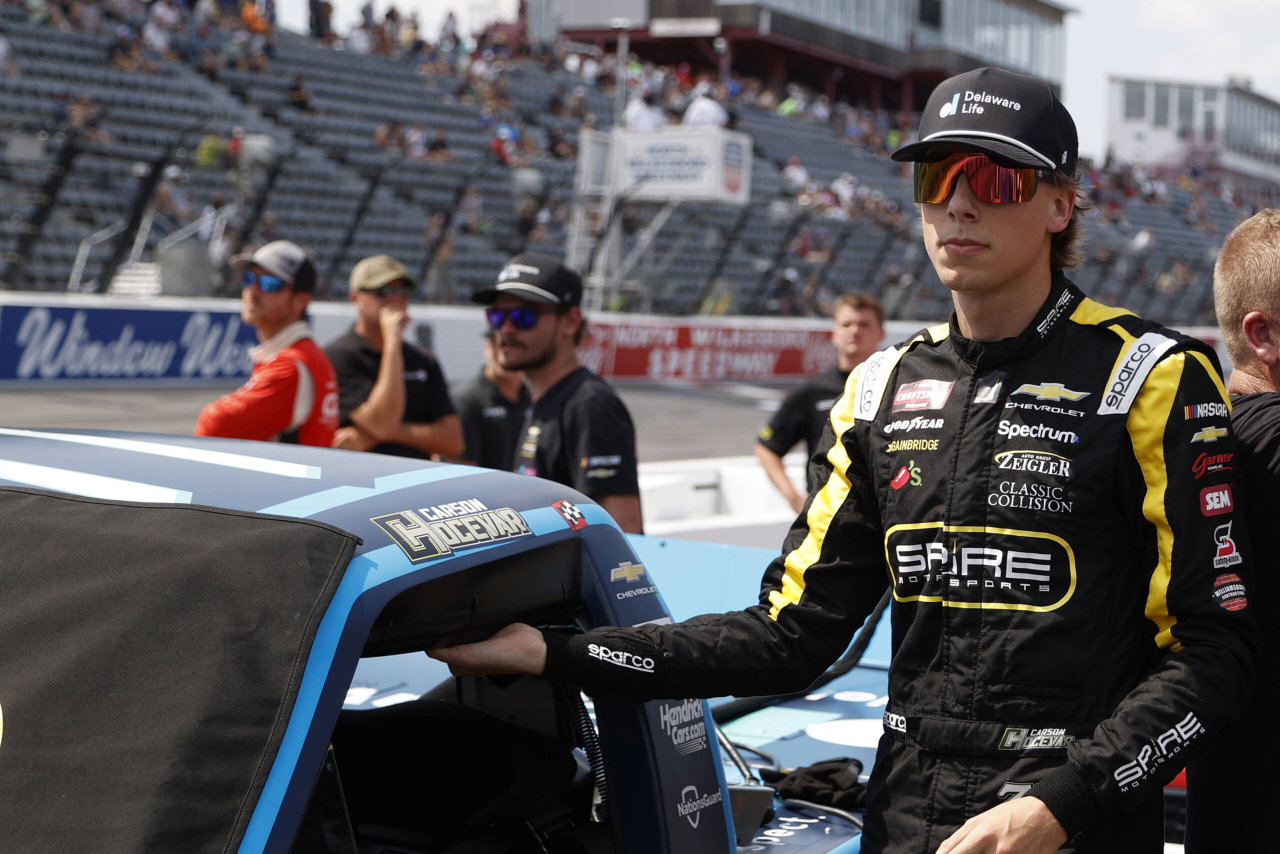
Two Penske cars, six weeks, one driver. Carson Hocevar’s Martinsville ended Austin Cindric’s day on Sunday, but it may not end the story. NASCAR has yet to say publicly whether it will act, and the garage is already picking sides.
Watch What’s Trending Now!
“I have no problem with it. Berry did like it. Whoa. You have no problem with that? I mean, it’s we sit here and talk about how we want old-school short track racing, and we want beating and banging and all this stuff like and then it happens, and then we’re gonna be up in arms about it. Like, what do you want?” NASCAR insider Jordan Bianchi said on ‘The Teardown’
“Do you want you want full contact racing on a short track like what you’re supposed to see at Martinsville or do you not?” Bianchi said during his discussion with Jeff Gluck. He defended the physical nature of short-track racing, but he also acknowledged that Hocevar’s retaliation was unnecessary.
The flashpoint came just past Lap 200, on a restart. Cindric nudged the rear of the No. 77 Spire Chevrolet a couple of times. Hocevar answered on the frontstretch, slowing sharply in front of the No. 2 Ford, then again exiting Turn 2.
Jeff Gluck counted four brake checks in all. Austin Cindric’s hood was bent upward, and he was forced to the garage. He was done after 222 laps and finished 36th. Hocevar took the checkered flag 21st.
Cindric made his feelings known over the radio. “NASCAR, what are we doing? Like, we’re just weaponizing cars here. I stack on entry with the guy, and he has a mental breakdown,” he said.
NASCAR had also introduced a significant change to its short-track bumper rules ahead of the Martinsville race. Teams were required to remove the high-density foam from the front and rear bumpers, along with modifying the front bumper structure.
The aim was to make heavy contact carry greater consequences, with harder impacts more likely to cause aerodynamic damage. Martinsville was the fourth track to use the revised configuration in 2026, following North Wilkesboro, Richmond and Bristol.
Gluck, who set up the debate, called it a moment “people are going to be talking about,” with Hocevar “breaking the absolute hell out of Austin Cindric.” His verdict was blunt.
“That was an intentional wreck of another car just out the back. No. How is that not intentional wrecking?” Hall of Famers Jeff Burton and Dale Jarrett were just as unforgiving of Hocevar’s post-race response, saying “That’s not racing.”
Carson Hocevar, for his part, started with a shrug. “No, I don’t know, I got lost there for a second,” he told NBC.
Pressed on intent, he said: “I just think that’s just Martinsville and I think we were just having fun.” Later he called it “normal Martinsville racing.” “Sometimes you’re getting hit, sometimes you’re causing it,” he added.
Carson Hocevar’s record gives critics plenty to work with
The Cindric exchange was not the only controversy attached to Hocevar’s day. On Lap 198, he spun while being lapped by race leader William Byron, triggering a caution in the middle of green-flag pit stops. Rivals accused him of spinning on purpose. Hocevar denied it. “They can come drive it,” he said.
It is a pattern critics know well. In 2024, NASCAR fined Carson Hocevar $50,000 and docked him 25 points for spinning Harrison Burton under caution at Nashville, a penalty Denny Hamlin had publicly urged.
This September at Bristol, late contact sent Ryan Blaney into the wall and ended his race while Hocevar finished third. Blaney shoved him on pit road afterward, Hocevar answered with punches, and NASCAR issued no penalties. Blaney later shrugged off the contact as a racing incident.
Bianchi’s defence came with a limit, and he spelled it out.
“He obviously intentionally break-checked. I mean he did it four times, and it was aggressive, and does it need to happen? No. Is it going to help Carson Hocevar’s reputation? No… But like I’m not going to get upset by it… this stuff happens on short tracks, man.”
“It was unnecessary because there was nothing that really set this up… it is clearly over the line in the sense that you’re retaliating for something that wasn’t there.”
Reports from the restart say Cindric had tapped Hocevar’s bumper first, and Cindric himself admitted he “stacked on entry,” but Bianchi saw nothing that justified a string of brake checks.
That is the line the sport keeps failing to draw. NASCAR has spent years promising drivers the freedom to settle things themselves, and fans have asked for exactly that. When a driver takes that freedom to its edge, the room splits between those who want the show and those who want the rules enforced.
Austin Cindric, parked early with a wrecked nose, is left wondering which NASCAR actually wants, and Carson Hocevar is left with the same question hanging over him.