
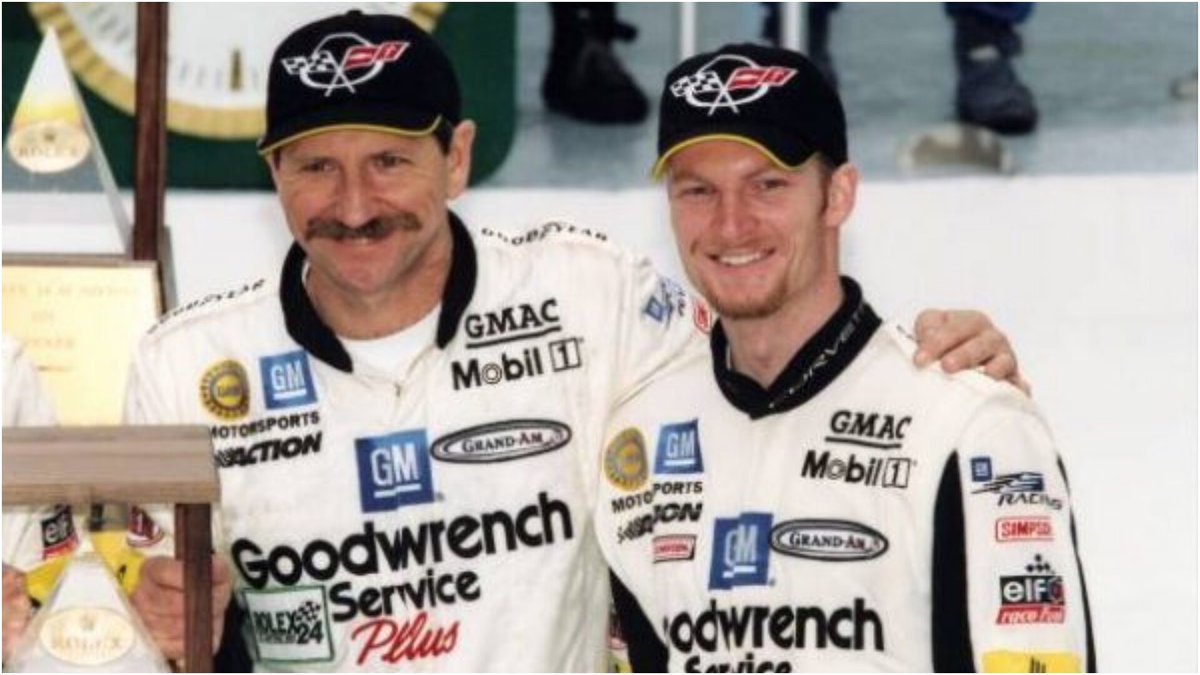
In the summer of 2001, still mourning his father’s death, Dale Earnhardt Jr. drove down from Charlotte to Florida ahead of the Pepsi 400 – his first race back at Daytona International Speedway since his father died there. Entering the track, he parked his car at Turn 3, hopped out, and faced the wall that had claimed his father’s life. He did not know exactly where the car came to rest, but he still spent 15-20 minutes standing there. What happened inside him in that moment is what he spent some time feeling guilty about.
Watch What’s Trending Now!
“I think I really wanted to see how I would feel. Would I get emotional? Would it be too much? Would it feel too heavy? Would I have a problem with it? I didn’t know. If I was going to have some kind of a reaction, I didn’t want to have it in front of everybody.”
But he quickly realized: “I just had this feeling that I shouldn’t be mad at it. I shouldn’t dread going to Daytona.”
Then came the part he almost kept to himself. Almost, but not quite.
“There was this really strange feeling of freedom. And I felt guilty even about feeling that way at all. I almost hesitate to say this because it isn’t going to make any sense to anybody.”


Dale Jr. on returning to Daytona for the first time after his father's passing.
Dale Jr. had crossed the line second while his father crashed in Turn 4, going from celebrating his DEI teammates’ 1-2 finish to hospital hallways in the span of minutes. As he described in the documentary, he sprinted through Halifax Medical Center, looking into every room until he saw his father on a table surrounded by eight or ten doctors working on him.
“Finally, somebody grabbed me and told me that dad was gone or dad passed away or dad didn’t make it,” he said.
He went back to his motorhome, shut the door, and sat alone. He later said his first thought was that his cheat sheet for life was gone. So, this is what Daytona held for him, a 26-year-old who hadn’t been back since February. Hence, it is understandable why he had to test that internal checklist of emotions before he had to face a crowd of thousands.
Jr. had also confessed how he earlier held a grudge against the place, but it all shifted during those minutes.
As he explained it to Fox News, “Daddy loved Daytona. Loved winning here. Just loved to win any race here. I had to figure out a way to be OK with it. I knew that it wasn’t the track that took him. I knew that, wherever he was, he still felt the same about Daytona. So I’ve embraced it. Him losing his life in this property brought this property closer to me.”
Truly, Dale Sr. owned the place in a way almost no driver ever has. In his career, he won 34 races across all series: Twin 125 qualifying duels, the Busch Series, IROC, and the Shootout.
The one that took the longest was the Daytona 500 itself. He tried for 20 years before finally winning it in 1998. He drove into Victory Lane, was mobbed by every crew member on pit road, stood on the car, and told a camera, “We won it, we won it, we won it.” The relief on his face was unlike anything he had ever shown anywhere else.
The 2001 Daytona 500 was his 46th points-paying Cup start at the track. He was running third on the final lap. Not for himself, for his son and his teammate, Michael Waltrip, both driving for Dale Earnhardt Inc. His last words on the radio were “Look at those boys go.” And the boys stood up to those remarks in the next Daytona race as well.
In the 2001 Pepsi 400, Dale Jr. led 116 of 160 laps in the first race at Daytona since his father’s death. And Michael Waltrip, the man his father had been protecting on that final lap in February, finished second behind him. Junior stood on the car with his arms raised, and the entire grandstand stood with him.
“I have never been to a place where I was so dominant. I probably never will have the chance to enjoy it because I just can’t believe it happened,” Junior said afterward.
But the preparation to get over the anxiety began days ago. Dale Jr. had walked into the DEI shop the Monday after his father died and told the crew he wanted to win the 4th of July race at Daytona, and crew chief Tony Eury Sr. had started building the car that same day.
Where Senior Held the Line, Dale Earnhardt Jr Chose Differently
Dale Sr. was the Intimidator. He raced through broken bones. He never showed weakness. The entire culture around him, and around NASCAR, was built on one idea: showing vulnerability cost you your seat, your sponsors, and your reputation.
Dale Jr. grew up inside that world. By his own estimate, he drove through around 20 to 25 concussions without telling anyone. Drivers simply did not talk about what was happening inside their heads. The sport did not ask, but two incidents changed that.
In August 2012, during a Goodyear tire test at Kansas Speedway, Earnhardt hit the wall at 190 mph and got a concussion. He knew something was wrong, but did not reveal his symptoms for fear of being taken out of the car for the start of the Chase.
Six weeks later, a wreck at Talladega caused a second concussion around the brain stem, producing severe anxiety, vertigo, and double vision. He sought treatment from Dr. Micky Collins at the University of Pittsburgh Medical Center Sports Medicine Concussion Program and missed two races. Then in 2016, after crashes at Michigan and Daytona triggered a second major episode, he missed the remainder of the 2016 season, amounting to 18 races in total.
What made it significant was that it was NASCAR’s most popular driver who walked away mid-season, putting his future at risk. He did it anyway, and later said that only a driver with his public profile could have forced the sport to take the issue seriously.
Junior was right, as NASCAR now uses black box data to automatically flag impacts above a certain G-force threshold, requires drivers to visit the care centre after significant crashes, and mandates independent neurological clearance before any driver can return.