
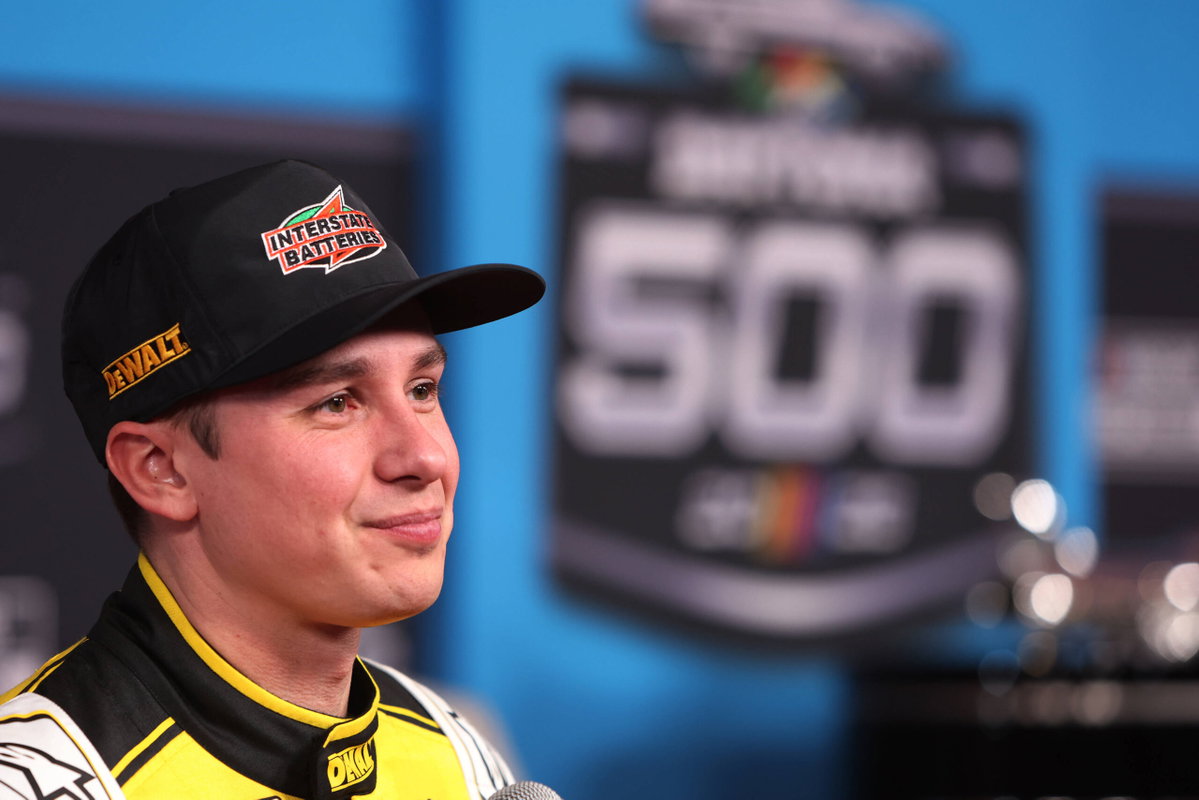
Christopher Bell had already spent enough of Sunday fighting his steering wheel. His No. 20 Toyota had started third, scored 17 stage points and looked like a car capable of staying near the front at Las Vegas, until the power steering began fading and turned the second half of the race into a test of how long Bell could physically keep control of the car. He slowed down, changed his lines and leaned on the car’s setup just to make the corners, eventually finishing 23rd. Four days later, Kyle Larson questioned just how bad the problem really was.
Watch What’s Trending Now!
“I hope it happens to him, so he can talk about it.”
Bell’s response came after Larson had openly challenged his description of the problem on Corey LaJoie’s Stacking Pennies podcast. Larson was not denying that Bell had struggled. The in-car camera made that difficult to argue. What Larson questioned was Bell’s use of “no power steering,” particularly the suggestion that he had been wrestling a Cup car around a 1.5-mile track with zero power assistance.
“No power steering? There’s no chance that Christopher Bell is hanging onto a race car,” Larson said.
That is where this gets more interesting than a couple of drivers taking shots at each other. Larson’s argument was that drivers sometimes say they have “no power steering” when there is still some assistance left in the system. He later acknowledged Bell was clearly working hard, but maintained that neither he nor LaJoie would be able to hold onto an intermediate-track Cup car with literally 0% power assist. Larson even joked that there was a good chance he was stronger than Bell, before insisting that the zero-assistance claim did not add up.
Christopher Bell’s explanation, however, was never quite as absolute as the sound bite makes it seem. He described a progressive loss of steering assistance rather than an instant switch from normal power steering to a perfectly measurable zero. Bell said the assist had fallen from roughly 50% to around 20% before deteriorating further. By the time the problem had become severe, he did not know whether he had 10% assistance, 20% or practically nothing. He simply knew he could no longer turn the car the way he normally could.
That distinction is important when talking about a Cup car. “No power steering” is often shorthand from a driver’s perspective, not a claim that someone has taken a measurement and established the system is producing exactly 0% assistance. There is a point where whatever assistance remains is no longer doing enough to make the car behave normally. Bell’s description fits that situation much better than the idea that he was claiming to know the exact hydraulic output of the system.
His radio traffic gives the story some useful context. During Stage 2, Bell reported that the power steering was fading and that he was losing it quickly. Roughly nine laps later, he said he had “lost it all.” Adam Stevens later suspected that the power-steering cooler had cracked, allowing water into the system and boiling the power-steering fluid out. That was a suspected cause, not a publicly confirmed final diagnosis, but NASCAR’s race report confirmed Christopher Bell spent the final half of the race without power steering.
The obvious question is how he managed to keep the car on the track. Las Vegas was a big part of the answer.
Bell explained that the track’s long, sweeping corners gave him enough room to adapt. If he released the steering wheel, the car naturally wanted to turn left, so instead of trying to force the car around the corner the way he normally would, he slowed his pace and let the car’s natural tendencies work for him. Camber, caster and the overall setup became part of the solution.
That would have been a very different proposition at Bristol or Martinsville. At a short track, the corners arrive quickly and demand much more frequent steering input. There is less time to let the car rotate on its own and far less room to compensate for a steering system that is no longer doing its job. Christopher Bell’s point was not that driving without power steering at Las Vegas was easy. It was that the track gave him a fighting chance.
The tires also changed the equation. Bell said new tires were the hardest part because the car was more difficult to manage, while the steering became easier to handle as the tires aged. He had to find a way to make the car work without trying to drive it at the same pace or in exactly the same manner as he would with normal steering assistance.
Physically, it still took a lot out of him. Bell said his hands, arms and shoulders took most of the punishment from gripping and fighting the wheel. That detail carries some extra weight because Bell had already fractured his left wrist in a crash at Michigan earlier this season. He said the wrist was not what limited him at Las Vegas, and he was actually thankful the steering problem had not happened a couple of weeks earlier while he was still recovering.
There was also considerably more at stake than simply getting a wounded race car to the finish. Bell had entered Las Vegas in the middle of the championship fight. He had banked 17 stage points before the steering problem took away his chance to convert a strong run into a strong finish. He ended the day with 31 points and a 23rd-place result, leaving him third in the Chase standings, 55 points behind Larson and 15 behind Denny Hamlin.
Larson’s own afternoon was hardly clean. His No. 5 Chevrolet struggled badly with its handling early in the race, forcing Hendrick Motorsports to make a 26-second green-flag pit stop for major adjustments. Larson fell a lap down, yet eventually recovered to finish second. Through five Chase races, his finishes are 5th, 1st, 2nd, 1st and 2nd. He has not finished outside the top five and is averaging a remarkable 2.2 finish.
That is the problem Bell is now trying to solve. Despite the 19th and 23rd-place finishes during the Chase, he remains second in total Chase scoring behind Larson. But the points gap is still there, and Bell has already acknowledged that he probably needs at least two wins to make up the ground. In a cumulative Chase, simply stacking second-place finishes may not be enough.
Which brings the story back to Larson’s comment.
There is a legitimate technical argument over whether “0% power assist” is the most precise description of what Christopher Bell experienced. There is not public evidence showing that Bell had an exact zero-assistance measurement throughout the entire period. But there is also little mystery about what happened to the driver. The steering assistance progressively disappeared, Bell could no longer turn the car normally, and he had to fundamentally change the way he drove for the rest of the race.
Larson can argue about the percentage. Christopher Bell has already offered him a more practical way to settle it. Get behind the wheel when it happens to you. Then they can compare notes.